
A new study by IIT-Kharagpur warns that ozone pollution could significantly reduce agricultural yields in India, particularly impacting wheat, rice, and maize production. The study, published in the journal 'Environmental Research', highlights the vulnerability of major food crops to rising surface ozone levels, especially in the Indo-Gangetic Plain and Central India. The researchers call for effective emission reduction strategies to mitigate these risks and ensure global food security.

'It has the potential to sow seeds of furthering discord when the direction of the discourse is aimed at propagating the perceived supremacy of 'cultural nationalism' from a distant past over the prevailing dominance of 'Constitutional nationalism',' argues N Sathiya Moorthy.

Satellite imagery showed a layer of dense fog extending from Punjab and north Rajasthan to the northeast. Patches of fog were also visible along the east coast.

In underlining the role of border villages as custodians of India's frontiers, New Delhi is following China's example in Tibet.

In view of air pollution in the national capital, the December winter break of all schools has been rescheduled and it will be now from November 9 to November 18, a circular of the Delhi Directorate of Education stated on Wednesday.

Satellite imagery showed a dense elongated band of fog stretching from Punjab to the northeast.

Cold-day conditions prevailed in parts of north India on Friday though the maximum temperatures rose slightly amid clear skies and sunshine during the day.

Some areas in the Indo-Gangetic basin in India have already passed the groundwater depletion tipping point and its entire northwestern region is predicted to experience critically low groundwater availability by 2025, according to a new report by the United Nations.

A railway official said around 20 trains were delayed by 15 minutes to 2 hours in the morning.

The minimum temperature in the national capital on Saturday settled at 10.2 degrees Celsius, three notches above the season's average, it said.

At the review meeting, chaired by cabinet secretary Rajiv Gauba in New Delhi, the IMD said above normal maximum temperatures are likely over most parts of northeast, east and central India and some parts of northwest India.

After becoming active over the rice-growing Indo-Gangetic plains, the southwest monsoon might witness weak phase for the next 3-4 days over the already rain-deficient region. So far, the main deficit states are Uttar Pradesh (-42 per cent), Bihar (-36 per cent), Jharkhand (-48 per cent), and West Bengal (-24 per cent). According to private weather forecasting agency Skymet, rains in west UP, Punjab, Haryana, Bihar, and Jharkhand are expected to be weak in the next 3-4 days before again picking pace.

India is the most polluted country in the world, with more than 480 million people or about 40 per cent of its population living in the Indo-Gangetic plains in the north where pollution levels regularly exceed those found anywhere else in the world by an order of magnitude, stated the University of Chicago's Air Quality Life Index (AQLI) report.
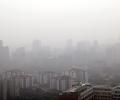
Air quality in Delhi and its suburbs dropped to the severe category again on Wednesday morning, with smoke from post-harvest paddy straw burning in neighbouring states accounting for one-third of the air pollution in the national capital.

The city's Air Quality Index (AQI) stood at 420 at 8 am on Thursday, compared to 426 at 4 pm on Wednesday. The AQI map prepared by the Central Pollution Control Board showed clusters of red dots (indicating hazardous air quality) spread across the Indo-Gangetic plains.

The residents of Delhi stand to lose 10 years of life expectancy if the current air pollution level persists.

'Our study finds that only about 20% of Indians are vegetarians and the rest of the 80% are non-vegetarians or meat-eaters.'
Although the monsoon is not active, it is not sluggish either he said, adding that the eastern coast, central India and north east are getting fairly good rains. Even Maharashtra and parts of peninsula are having rain.

Delhi's minimum temperature on Wednesday morning plunged to 4.4 degrees Celsius -- the season's lowest -- making the national capital colder than Dharamsala, Nainital and Dehradun.

In the 30-year period between 1986 and 2015, temperatures of the warmest day and the coldest night of the year have risen by about 0.63 degree Celsius and 0.4 degree Celsius, respectively.

Operations at the Delhi airport remained normal. However, three flights were returned or diverted to the Delhi airport due to bad weather in Chandigarh, Varanasi and Lucknow on Tuesday night.

Climate change can impact the amount and quality of livestock produce,says a report released by inter-governmental panel.

'When you are travelling in Mumbai when the air quality is bad, you feel suffocated.' 'You may feel uncomfortable breathing Delhi air, but the level of discomfort is higher in Mumbai.'

Dense to very dense fog engulfed the Indo-Gangetic plains, including Delhi, for the second morning on the trot on Tuesday, lowering visibility to 50 metres in the city and affecting road traffic and train movement.
According to the Central Pollution Control Board's mobile application SAMEER, the city recorded an air quality index of 168, which falls in the 'moderate' category, much better than Monday's AQI of 221, which falls in the 'poor' category.

In India, air pollution is most severe in the Indo-Gangetic Plain (northern India), where topography and meteorology concentrate pollution from energy, mobility, industry, agriculture, and other activities, the researchers said.

A collection of photos taken from the International Space Station of cities as they appear in the night
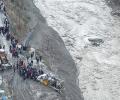
Originating from Vasudhara Tal, perhaps the largest glacial lake in Uttarakhand, the Dhauli Ganga flows in a meandering course, which takes it through the Nanda Devi National Park.

The January of 1919 recorded 15 degree Celsius and it remains the warmest January so far. "So January 2021 has also become the warmest in 62 years after 1958," the IMD said.

China plans to divert about 200 billion cubic metres of water annually from the Brahmaputra at its highest point, namely the Great Bend, where it turns into India. China's Brahmaputra dam will severely impact India, warns former senior RA&W officer and China expert Jayadeva Ranade.
Peasants relying on Information Technology to plan their farm practices can now turn to a software, which promises to help them identify and destroy weeds.

The nationwide 'Janta Curfew' followed by the 21-day lockdown to combat the coronavirus outbreak have led to a significant reduction in pollution in the country, with 91 cities recording air quality in the 'good' and 'satisfactory' category on March 29, a Central Pollution Control Board report has stated. Travel restrictions and the closure of industries have helped reduce the pollution level, it said.

'Its aim is to force the Bhutanese government to cede territory that China wants elsewhere in Bhutan to give Beijing a military advantage in its struggle with New Delhi.'

There were no immediate reports of any loss of life or damage to property.
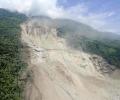
A landslide dammed river started flowing normally after sweeping away debris that had blocked it.
Nepal has alerted India of possible flash floods in Bihar and Uttar Pradesh after massive landslides, likely triggered by recent devastating earthquakes, blocked Kali Gandaki river in western Nepal, creating a huge artificial lake.
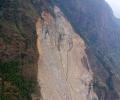
A massive landslide in western Nepal has blocked a river that also flows through India, forcing thousands of people to flee to safety and triggering fears of a flood, officials said on Sunday.
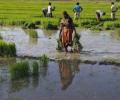
Critics said a 10-plus per cent annual increase in incomes is a tall order, given that between 2002-03 and 2012-13, farm incomes grew yearly by 3.6 per cent.

The news may come as a relief to the Delhi government, whose odd-even traffic rule is set to be rolled out from January 1.
 © 2026 Rediff.com - Investor Information - Advertise with us - Disclaimer - Privacy Policy - Sitemap - Feedback - About us - Terms of use - Grievances