
With the Bangalore police securing the custody of Sameer, an accused in the 2008 serial blasts in the city, more involvement of the Oman-Kerala and Karnataka links into terrorism has surfaced. Sameer was apprehended by the airport immigration authorities in New Delhi on Wednesday while he was trying to flee the country.
A special tribunal on Wednesday upheld the ban imposed by the Centre on Students Islamic Movement of India, which has links with Pakistan-based terrorist outfits including Lashkar-e-Tayiba and its front, Indian Mujahideen.
The four low-intensity explosions Wednesday evening in the busy Junglee Maharaj Road area in Pune that injured one person are the second such incident in Pune since the 2010 German bakery blast. Vicky Nanjappa find out if the blasts were just to create a scare, or something else.
In a revised chargesheet, the Bengaluru police has stated that minutes before Indian Mujahideen operative Mohammad Qateeel Siddiqui could plant a bomb at the Chinnaswamy Stadium, he came in contact with a sex worker, who distracted him and he ended up connecting the wires of the bomb in a wrong manner.
After his deportation and arrest, Fasih Mohammed, a suspected Indian Mujahideen terrorist and an accused in the Delhi and Bangalore blasts, has been sent to ten-day police custody by a Delhi court.
Security has been tightened at Raxaul railway station in Bihar on Sunday night following an intelligence report that Indian Mujahideen, a terror group, has threatened to blast its premises and to target Delhi-bound trains, the police said.

One more suspected Indian Mujahideen terrorist allegedly involved in the Pune serial blasts in August has been arrested in Jaipur by the Delhi police, taking the total number of arrests to four.
As many as 313 fidayeens, out and about in Pakistan, plan to strike in India during the Lok Sabha elections.
According to sources, the Bihar police was reluctant to book Indian Mujahideen founder Yasin Batkal on Thursday, and wanted to hand him over to the National Investigation Agency soon after his arrest.

Continuing with the leads provided by the arrested people, National Investigation Agency on Tuesday arrested two more persons from Uttar Pradesh in connection with the blasts outside the rally of the Bharatiya Janata Party's prime ministerial candidate Narendra Modi on October 7.
The city police on Wednesday told a Delhi court that six of the seven Indian Mujahideen operatives arrested recently have confessed about their involvement in the September 2010 blast near Jama Masjid.
A suspected Indian Mujahideen terrorist, an alleged aide of the outfit's elusive chief operative Yasin Bhatkal, was arrested from north-east Delhi with one kg explosives and a detonator, police said on Wednesday.
Delhi police is likely to seek an extension of remand of 26/11 handler Abu Jundal, which may put a spanner in Mumbai police's efforts to question him soon.
The Delhi Police has arrested Abu Hamza alias Saeed Zabi alias Zabi Ansari, an Indian Mujahideen operative who is suspected to have been one of the handlers who was giving instructions to the 26/11 terrorists in Mumbai.
A Delhi court on Thursday remanded a suspected Indian Mujahideen operative, who was arrested from Bihar for his alleged role in various blasts across the country, in seven days' police custody.

The investigations into the April, 2010 Chinnaswamy stadium blasts in Bengaluru have revealed that the reason behind the attack was to 'avenge' leaving Pakistani cricketers out of the Indian Premier League.
The police have been looking at a suspicious transaction of Rs 20 lakh which was traced between Delhi and Pune. The police say this money was facilitated by a jeweller in Pune, which later landed in the hands of two suspected IM operatives. Vicky Nanjappa reports
Delhi Police on Wednesday claimed to have smashed a pan-India terror module with the arrest of six suspected Indian Mujahideen operatives, including a Pakistani, allegedly involved in blasts in Pune, Chinnaswamy Stadium in Bangalore and Delhi's Jama Masjid.
It has often been asked as to why groups such as the Indian Mujahideen have been resorting to lower intensity blasts over the past couple of years. The group is existent, but the gusto appears to be missing, says Vicky Nanjappa
Muzaffar Kola, accused for funding the 13/7 blasts is marked as 'wanted' in the chargesheet filed by Maharashtra Anti-Terrorism Squad, but in reality, he lives at Jaali Cross Road in Bhatkal, Karnataka. Vicky Nanjappa speaks to the man and his family.
The All India Muslim Majilis-E-Mushwarat, an umbrella body of Muslim organisations in India, has taken strong exception to the manner in which security was handled at the Yerawada Jail in Pune, where an alleged member of the Indian Mujahideen Qateel Siddiqui was murdered on Friday.
The family of suspected Indian Mujahideen operative Mohammad Qateel Siddiqui, who was murdered in a Pune jail on Friday, will move the Supreme Court for a probe by the Central Bureau of Investigation into his killing. Advocate M S Khan, who was representing Siddiqui before a Delhi court, on Saturday said he will approach the apex court for a CBI inquiry into the incident.
An operative of the Indian Mujahideen and an accused in the Delhi and Bangalore blasts has reportedly been strangled by inmates at Pune's Yerawada jail. Qateel Siddiqui had allegedly helped the conspirators of the Delhi and Bangalore blasts. He was picked up last year by the Delhi police. He was moved to the Pune jail as he had allegedly tried to plant a bomb at a local temple.
The Maharashtra Anti Terrorism Squad on Wednesday arrested two accused already in custody in the July 13 triple blasts case for allegedly lifting two bikes that were used to trigger explosions at two out of three venues.
An engineer by profession, Fasih Mehmood is under probe by investigation agencies for his suspected role in the Chinnaswamy stadium blasts at Bengaluru in April 2010.
Two of the five alleged Indian Mujahideen operatives behind bars in connection with 13/7 bomb blasts case were on Monday arrested in a motorcycle theft case, a senior Anti-Terrorism Squad official said.
The Maharashtra Anti-Terrorism Squad has arrested a close associate of Indian Mujahideen's elusive chief operative Yasin Bhatkal in connection with the 13/7 serial bomb blasts case, taking the total number of arrests to five.
Faseeh Mahmood, an engineer from Dammam in Saudi Arabia, was brought to India on terror charges a couple of days ago. While his arrest is officially pending confirmation, sources say that this man, who hails from Darbhanga in Bihar, is being questioned in connection with certain terror incidents undertaken by the Indian Mujahideen in the country.
A local court on Friday extended till February 18 the police custody of two alleged operatives of Indian Mujahideen, arrested for one of the three bomb blasts that rocked the metropolis on July 13 last year.
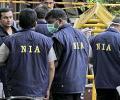
Continuing their investigation into the blasts ahead of Prime Minister Narendra Modi's rally in Patna last October, the National Investigating Agency on Saturday recovered 16 live bombs from the Sithio village near Ranchi, Jharkhand.
Security agencies are now becoming quite certain that the August 1 low-intensity multiple blasts at Pune last week were carried out by the Yasin Bhatkal module, and not some new module of the Indian Mujahideen. Vicky Nanjappa reports.
The explosive powder, collected from an apartment in Mumbai of an alleged Indian Mujahideen operative, who carried out the July 13 triple blasts, was RDX though it was not used to trigger explosions on the fateful day, a senior ATS official said on Wednesday.
The National Investigation Agency, which is probing the August 1 serial blasts in Pune, has sent a team to Bidar in Karnataka to track the antecedents of Patil -- the tailor who picked up one of the bombs and was injured in the blast. Meanwhile, another team of the NIA is probing the Indian Mujahideen's link to the serial blasts.
Investigators trying to string together bits of evidence in the serial low-intensity blasts in the city have hit a hurdle as some CCTV cameras at the explosion sites have been found to be non-functional.
Toral Varia Deshpande brings you the details of how rivalry between India's two of the most recognised agencies, the Maharashtra Anti Terrorism Squad and the Special Cell of Delhi Police, has cost India one it's most wanted terrorist and 13/7 Mumbai serial blasts mastermind -- Yasin Ahmad Siddibappa alias Yasin Bhatkal.

A convict in the 1993 Mumbai serial bomb blasts case, Jalees Ansari, who went "missing" while on parole, was arrested on Friday from Kanpur in Uttar Pradesh, an official said. Ansari (68), a Mumbai resident who was serving a life term in a Rajasthan jail, was nabbed in a joint operation by Maharashtra's Anti-Terrorism Sqaud and the Uttar Pradesh Special Task Force (STF), he said.
The 13/7 Mumbai blasts were a wake up call to India's security agencies. The fact that these blasts are today half-a-year old, and security agencies have not found a single clue, is a major cause of concern. Vicky Nanjappa reports.
A year on, how successful have investigators been in taking to task perpetrators of the triple blasts that wreaked havoc in Mumbai on July 13, 2011?

When the Union government had launched the Prime Minister's Rozgar Yojana with much fanfare years ago, they could not have imagined in their wildest nightmares that one day, the welfare scheme will be used by terrorists to carry out their subversive schemes.
The custody of two alleged Indian Mujahideen members, brought to New Delhi from a Bangalore jail, was on Monday given to Delhi police for ten days by a court in the Jama Masjid attack case in which Mumbai's 26/11 terrorists' handler Abu Jundal is also an accused.
