
The next annual budget of India will have to be very carefully structured to sustain the country's growth momentum, Union Finance Minister Nirmala Sitharaman said on Tuesday, noting that it will also address inflation concerns. Visiting Washington DC to attend the annual meeting of the International Monetary Fund and the World Bank, the finance minister was responding to a question on the next year's Budget at a fire-side chat with eminent economist Eshwar Prasad at the prestigious Brookings Institute. "Specifics (of the next Budget) may be difficult at this stage because it's a bit too early. "But broadly, the growth priorities will be kept absolutely on the top. "Even as I speak about the concerns that inflation brings before me. So, inflation concerns will have to be addressed. "But then how would you manage growth would be the natural question," Sitharaman said.
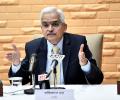
The Reserve Bank of India (RBI) on Wednesday raised the benchmark lending rate by 35 basis points to 6.25 per cent in a bid to tame inflation, which has remained above its tolerance level for the past 11 months. With the latest hike, the repo rate or the short-term lending rate at which banks borrow from the central bank now has crossed 6 per cent. This is the fifth consecutive rate hike after a 40 basis points increase in May and 50 basis points hike each in June, August and September.

'India has not integrated into any major trade agreement'.

Shaktikanta Das is a master of the finest balancing act who listens to all but takes his own decisions, discovers Tamal Bandyopadhyay.

'The entire idea behind the serial bomb blasts was to strike fear in the minds of Indians.' 'I don't think the blasts were targeted to derail the Indian economy; the idea behind the blasts was retribution.'

The banking sector in the country is stable, capital is available and credit offtake is poised to take off, he said at a webinar organised by Bharat Chamber of Commerce. "We are not unique to the phenomenon of uncertain growth and high inflation due to the pandemic.

"If we think that China is a security threat and Chinese think that India is not going to open up certain sectors for them, the economic relations between the two countries would not go far," he said.

The Congress released a booklet 'Nau saal, Nau sawaal', asking nine questions from Modi. The BJP rejected the Congress' criticism as a 'bundle of lies and mountain of deception' and said the questions are born out of 'pathological hatred' of the PM.

'80% of the rural and urban population don't have enough purchasing power.'

India's economy grew by 6.3 per cent in the second quarter of the current fiscal, official data released on Wednesday showed.

The Reserve Bank of India on Wednesday retained its growth projection at 7.2 per cent for the current fiscal on the back of improvement in urban demand and gradual recovery in rural India. Unveiling the third monetary policy for the current fiscal, RBI Governor Shaktikanta Das said the Indian economy remained resilient, and the central bank will continue to support growth. The RBI expects growth in the first quarter of the current fiscal at 16.2 per cent, which will taper to 4 per cent by the fourth quarter.

"Delighted to meet the one and only Rakesh Jhunjhunwala... lively, insightful and very bullish on India," Modi tweeted. The prime minister also had a "productive" meeting with Nunzio Quacquarelli, the CEO and managing director of QS Quacquarelli Symonds Ltd, and said they talked at length about aspects relating to the education sector.
India's GDP grew by 9 per cent in 2007-08 as compared to advance estimate of 8.7 per cent. GDP grew by 8.8 per cent in the fourth quarter of 2007-08 as compared to 9.7 per cent in the corresponding period previous fiscal.

Modi on the global stage always comes across as a statesman, counselling peace and amity to world leaders even as his policies at home hurt certain sections, explains Virendra Kapoor.
Amidst all the doom that prevails in India, there are many reasons to feel good about its achievements and future prospects.
He takes over at Mint Road at a time when the governor's job is even less easy than it is normally.
The food processing sector in the country with its vast potential has emerged as one of the major driver of economic growth. It is encouraging to note that while the country's GDP growth rate had increase from 3.5 per cent in 2002-03 to 9 percent in 2006-07, the food processing sector has grown from 7 per cent to 13.1 per cent during the same period. India is a country of over 1.10 billion consumers, there is a large untapped domestic market of 1,000 million consumers.
Despite misgivings about India's economic performance, investors have not lost faith in the country's long-term growth trajectory.
The first, and perhaps the most important, "known" for judging economic prospects is the slowdown in the US economy with the fourth quarter 2007 GDP growth rate there coming down to below 2.0 per cent. US economic growth is expected to be sluggish in 2008 and so too in the Euro-zone and Japan. In fact most analysts are looking to continued high growth in China and India to maintain global GDP growth at 4 per cent or thereabouts.

'You may see some movement indicating a simpler tax regime with less exemptions but with fewer tax rates making life simpler for taxpayers.'
Two long-stalled reforms are lifting FDI cap in insurance and simplifying land acquisition for factories.

The outlook is improving and that mostly reflects the fact that the new government has pledged to prioritise economic reforms.

Fitch Ratings on Tuesday retained India's economic growth forecast at 7 per cent for the current fiscal, but cut projections for the next two financial years saying the country is not impervious to global developments. In its December edition of the Global Economic Outlook, Fitch projected India's GDP to grow at 7 per cent in the current fiscal, at a slower rate of 6.2 per cent in 2023-24 and at 6.9 per cent in 2024-25. In September, Fitch projected 7 per cent growth for the current fiscal, followed by 6.7 per cent in 2023-24 and 7.1 per cent growth in 2024-25.

After failing to get a court order to block an antitrust ruling, Google on Wednesday said it will allow users in India to choose default search engine on Android-based smartphones. As part of the key changes the tech giant will make to its platforms and business in India in the aftermath of the landmark CCI ruling, OEMs (Original Equipment Manufacturers) will be able to license individual Google apps for pre-installation on their devices. Google is also updating the Android compatibility requirements to introduce changes for partners to build non-compatible or forked variants, the company said in its blog.

The Economic Survey released before next year's Budget could become a single volume, reverting to the practice followed till FY14. "There is so much to write about the Indian economy's performance in the past year. "Most of the exciting themes will be covered in what used to be considered Part II," said a senior government official who is part of the preparations for the Survey.
Ahead of the Union Budget for 2023-24, Budget makers have welcomed the global consensus view that India will remain one of the bright spots in calendar year 2023. But there is some alarm over the grim global situation and how that might impact the Centre's projections and assessments for next financial year. The big global headwinds include a deep and sustained recession in the West, including India's biggest trading partners in North America and Europe, continuing volatility in commodity markets, and renewed Covid-19 fears, as lifting of strict curbs by China could potentially lead to a massive spread again.

India's economy had recorded a subdued growth of 4.7 per cent in the April-June quarter of the last fiscal, 2013-14.

Singh made the remarks while addressing a "CEOs' Roundtable" at the 14th edition of Aero India at the Yelahanka Air Force station complex on the outskirts of Bengaluru.

Chief economic advisor V Anantha Nageswaran on Tuesday said Indian economy will grow at over 7 per cent, down from above 8 per cent of growth rate projected in January. He, however, said that the economic momentum and the animal spirits are "unmistakable". "India's own growth rates have come off the projections made in January down to about 7-plus per cent for the current financial year," Nageswaran said speaking at Global Fintech Fest event in Mumbai.
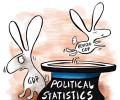
The Economic Survey 2022-23 (FY23), to be presented a day before Union Budget 2023-24 (FY24), is likely to project India's real gross domestic product (GDP) growth between 6 per cent and 7 per cent for FY24, Business Standard has learnt. The broader theme of the Survey could be on how India has dealt with two years of a global pandemic and the ongoing geopolitical disturbance, the strengths and weaknesses that emerged, and what lessons may be learnt. The much-awaited Survey will be the first one by Chief Economic Advisor V Anantha Nageswaran and his team in the finance ministry's economic division.

Dalal Street investors became richer by more than Rs 16.36 lakh crore this year as the equity market scaled new highs despite persistent geopolitical uncertainties and inflation worries. Analysts attributed better macroeconomic fundamentals, the confidence of retail investors and foreign investors investing again in the domestic equities towards the latter half of 2022 as the key factors that led to the outperformance of the Indian market in comparison to many other stock markets worldwide. During the initial part of the year, markets were jolted by the Russia-Ukraine war.

India is likely to become a $40 trillion economy by 2047 -- a 13-fold jump from its current size -- driven primarily by a clean energy revolution and digitalisation, billionaire Mukesh Ambani said on Tuesday. Ambani's estimate for the Indian economy, currently the fifth largest in the world behind only the US, China, Japan and Germany, is more optimistic than Asia's richest man Gautam Adani, who last week stated that India will become a $30 trillion economy by 2050 on back of rising consumption and socio-economic reforms. "From a 3 trillion-dollar economy, India will grow to become a 40 trillion-dollar economy by 2047, ranking among the top three economies of the world," Ambani said at the 10th convocation of Pandit Deendayal Energy University in Gandhinagar.

India has the best hiring outlook globally, second only to Brazil, with 54 per cent of companies surveyed planning to hire in the December quarter as against 51 per cent in the September quarter, according to a report by global staffing firm ManpowerGroup. The report titled "ManpowerGroup Employment Outlook Survey" showed that India has the strongest net employment outlook for the December quarter in the Asia-Pacific region, followed by China (46 per cent), and Australia (38 per cent). The global net employment outlook in the December quarter would stand at 30 per cent, down by three percentage points from the June-September quarter, yet six percentage points higher than the same period last year, the staffing firm said.

'It is requested that listed equity shares or units of equity-oriented fund schemes be exempted from capital gains tax (LTCG) if equity shares or mutual funds units are held for at least three years.'

During the meeting with President Barack Obama, Singh said, there was a need to "rewrite" the architecture of global economic system in which the G-20 could play an important role.
Indian economy is projected to grow 7.1-7.6 per cent in the current financial year despite shifting geopolitical realities across the world, a report said on Wednesday. In its India's economic outlook - July 2022 report, leading consultancy Deloitte India said that as 2021 was coming to a close, there was optimism in the air but the optimism received a jolt early this year as a wave of Omicron infections swept through the country and Russia's invasion of Ukraine happened in February. "These events aggravated the pre-existing challenges such as surging inflation, supply shortages, and shifting geopolitical realities across the world with no definite end in sight.

Indian economy is expected to grow 10.5 per cent or more in the current fiscal, Niti Aayog Vice Chairman Rajiv Kumar said on Thursday. Speaking at a virtual conference organised by the Public Affairs Forum of India (PAFI), he also said that modernisation of the retail sector is very much on the cards. "India Purchasing Managers' Index (PMI) for both manufacturing and services has shown a very smart uptick last month. "This (Indian economy) will strengthen even further," he said. "I expect Indian economy to grow 10.5 per cent or higher in FY 22," he noted.

India is likely to lose Rs 53,000 crore from its economy as companies are unable to hire people with right talent for the job and are incurring high recruitment costs, says a study.

On November 8, 2016, Prime Minister Modi had announced the decision to withdraw Rs 500 and Rs 1,000 denomination notes with the ultimate aim of reducing corruption and black money in the economy.

'The potential headwind is that the Indian economy is likely to see a slowdown in growth rates over the next two years.'
 © 2026 Rediff.com - Advertise with us - Disclaimer - Privacy Policy - Sitemap - Feedback - About us - Terms of use - Grievances