
Banking operations at public sector banks across the country were impacted on Tuesday as the United Forum of Bank Unions (UFBU) went on nationwide strike demanding the immediate implementation of a five-day work week.

The amount involved in banking system frauds surged to Rs 21,515 crore in the first half of FY26, up 30 per cent from the same period last year, even as the number of frauds fell 2.8 times to 5,092.

The country's largest lender SBI is open to collaborating with foreign banks once the Reserve Bank makes it possible for local banks to do acquisition finance, its chairman CS Setty said on Tuesday. Speaking to reporters, weeks after the central bank announced its intent to allow Indian banks to fund companies for executing domestic acquisitions, Setty acknowledged that the "MNC (multinational companies) banks" are dominant in the space.

The Reserve Bank of India (RBI) on Wednesday met the long-standing demand of banks by allowing them to finance acquisitions by Indian companies, a move that also expands banks' capital market lending in the country.

Last fortnight, State Bank of India Chairman C S Setty lifted the veil on a subject long spoken of in corporate corridors: Why can't our banks finance mergers and acquisitions (M&As)? Change is in the air: Indian Banks' Association (of which Setty is the chairman) is to "make a formal request" to Mint Road to make way for it. Thus far the exclusive turf of foreign banks even though its funding remains offshore - as in, it's not on these entities rupee-book (and a few select shadow banks) - a most lucrative segment in the investment banking suite, M&As, will be homeward-bound.

India Inc, which is sitting on cash balances of 13.5 trillion, is using the funds to meet capital expenditure as well as brownfield expansion, resulting in 'anaemic' demand for bank loans, State Bank of India (SBI) chairman CS Setty said at an event on Monday. He added that a slowdown in corporate credit is mainly due to lack of demand.

Bank unions on Friday deferred their two-day nationwide strike beginning Monday after they received positive assurance from both the finance ministry and the IBA on their demands, including a five-day work week and adequate recruitment in all cadres. The strike call for March 24 and 25 was given by United Forum of Bank Unions (UFBU), an umbrella organisation of nine bank employees' association.

The United Forum of Bank Unions (UFBU) on Thursday said its two-day nationwide strike on March 24 and 25 will be observed as scheduled since discussions with the Indian Banks' Association (IBA) over key demands failed to yield any positive outcome. In a meeting with the IBA, all UFBU constituents raised issues, including recruitment in all cadres and a five-day workweek.

The bank made a Rs 67 crore net profit, up 21% from the previous year. Its deposits grew 8%, the loan book 10%. Net bad loans dropped from 7.53% to 6.07%. So why was the banker, who headed the bank, not promoted?

Isn't there something significant in the UPI example for all of us to learn from and execute to enable world-scale success for our startups?, asks Ajit Balakrishnan.
Bank employees want a five day work week.

The number of frauds in the banking sector increased over four times in the past five years to 36,075.

Will allowing business correspondents to hawk insurance products help in reviving 5-lakh strong field agents as a viable channel?

'It's a debatable topic, and we will submit our comments to the RBI by June 15.'

The interchange fee -- paid by the card-issuing bank when a customer swipes at another bank's ATM, including at white-label ATMs -- may be raised to Rs 20 to Rs 23.

Postings to places at an altitude above 1,000 metres but less than 1,500 metres, between 1,500 and 3,000 metres, and above 3,000 metres entail different rates of allowances -- the higher the location, the bigger the allowance, reveals Tamal Bandyopadhyay.

'We are also conducting ongoing training and grooming at the branch level to pre-empt such cyberattacks.'
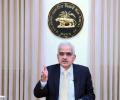
The challenge for the RBI in 2024 is likely to be less about containing elevated inflation and more about curbing excessive financial market exuberance and a 'problem of plenty', notes Sajjid Chinoy, Chief India Economist JP Morgan.

The governor made it clear that the RBI is aware of what's happening and acts accordingly, but doesn't make a noise about that, points out Tamal Bandyopadhyay.
The Reserve Bank of India on Monday gave banks time till end of December 2023 to complete renewal of agreements for the existing safe deposit lockers of customers. Banks were earlier required to complete the process by January 01, 2023. The central bank has asked them to complete work in phases with intermediate milestones of 50 per cent by June 30, and 75 per cent by September 30.

Using ATMs beyond the permissible free transactions for cash as well as non-cash purposes will cost more from Saturday. As per the Reserve Bank directive issued in June, the banking customers would be required to pay Rs 21 per transaction with effect from January 1, 2022 for transactions beyond the free permissible limit. Presently, banks are allowed to charge Rs 20 for such transactions through ATMs.

Currently, banks are closed every second and fourth Saturday of a month. Why shouldn't they be shut every Saturday? When most customers carry their banks in their pocket (the app on the mobile phone), there is no need to keep banks open on Saturdays, argues Tamal Bandyopadhyay.

Reserve Bank and the finance ministry on Wednesday asked top management of banks and representative of trade bodies to push exports and import transactions in rupee. It was stressed during a meeting that banks should connect with their foreign counterparts for opening special rupee vastro accounts to facilitate cross-border trade in Indian currency rather than popular mode dollar, sources said. Trade associations and their foreign trading partners should explore opportunities to make use of the framework, sources added.

Banks have written off bad loans worth Rs 10,09,511 crore during the last five financial years, finance minister Nirmala Sitharaman informed Parliament on Tuesday. The non-performing assets (NPAs), including those in respect of which full provisioning has been made on completion of four years, are removed from the balance sheet of the bank concerned by way of write-off, she said in a reply to Rajya Sabha. "Banks write off NPAs as part of their regular exercise to clean up their balance sheet, avail tax benefit and optimise capital, in accordance with RBI guidelines and policy approved by their boards.

The average time lag between the date of occurrence of a fraud and its detection is 23 months; for large frauds (Rs 100 crore and above), it was 57 months.
United Forum of Bank Unions is seeking at least a 15-per cent hike, but the Indian Banks' Association has capped the raise at 12.25 per cent.

The Reserve Bank on Thursday permitted banks to increase charges for cash and non-cash ATM transactions beyond free monthly permissible limit from next year. Bank customers will have to pay Rs 21 per transaction, instead of Rs 20, with effect from January 1, 2022, if they exceed the monthly limit of free transactions. "To compensate the banks for the higher interchange fee and given the general escalation in costs, they are allowed to increase the customer charges to Rs 21 per transaction. "This increase shall be effective from January 1, 2022," the RBI said in a circular.

Addressing the 74th Annual General Meeting of the Indian Banks' Association (IBA), she said the industry needs to imagine how Indian banking has to be in the immediate and long-term future. As far as the long-term future is concerned, she said it is going to be largely driven by digitised processes and there is a need for seamless and interconnected digital systems for a sustainable future for the Indian banking industry.

Making a strong case for banning cryptocurrencies, Reserve Bank Deputy Governor T Rabi Sankar on Monday said they are even worse than ponzi schemes and threaten the financial sovereignty of a country. Observing that crypto-technology is underpinned by a philosophy to evade government controls, he said they have been specifically developed to bypass the regulated financial system. More substantially, he added, cryptocurrencies can wreck the currency system, monetary authority, banking system, and in general the government's ability to control the economy.

The unions also made a case for introduction of cluster or hub banking, identifying few branches of each bank in each locality so as to enable bank employees to work on rotation.

The government is considering withdrawing legal cases against telecom companies, involving disputes of about Rs 40,000 crore, a source said on Tuesday. In line with this, the Department of Telecom has already filed an affidavit before the Supreme Court in a case against Anil Ambani-promoted Reliance Communications to take an informed decision whether to proceed with the present appeal or not, the source said. DoT has said the telecom sector is passing through a financial stress due to various circumstances and telecom services providers are making losses.

The National Company Law Tribunal (NCLT) has directed to freeze and attach assets and properties of Videocon promoters following a petition by the ministry of corporate affairs. The NCLT Mumbai bench has directed the Central Depository Services Ltd (CDSL) and National Securities Depository Ltd (NSDL) that securities owned or held by the Videocon promoters "in any company or society be frozen, and be prohibited from being transferred or alienation" and the details be shared with the Ministry of Corporate Affairs (MCA). It directed the Central Board of Direct Taxes (CBDT) to disclose information about all assets of the Videocon promoters in their knowledge or possession, for the purpose of freezing and restraining such assets.

The government may drop its plan to decriminalise cheque bounce offences after there were requests to continue the existing system, which can potentially make people honour their financial commitments due to fear of prosecution. It would seek directions from a Supreme Court panel formed to expedite the pendency of cheque bounce cases before taking a final call. Last year the Department of Financial Services (DFS) had proposed decriminalising minor offences, which included cheque bouncing, for improving business sentiment and unclogging court processes.

Public sector banks may have to bear a burden of Rs 1,800-2,000 crore arising due to a recent Supreme Court judgement on the waiver of compound interest on all loan accounts which opted for moratorium during March-August 2020, sources said. The judgement covers loans above Rs 2 crore as loans below this got blanket interest on interest waiver in November last year. Compound interest support scheme for loan moratorium cost the government Rs 5,500 crore during 2020-21 and the scheme covered all borrowers including the prompt one who did not avail moratorium.

The Reserve Bank of India on Wednesday extended the timeline by six months to comply with its guidelines related to recurring online transactions with Additional Factor of Authentication (AFA), but reprimanded players that the non-compliance is a "serious concern". RBI had directed all banks including RRBs, NBFCs, and payment gateways to comply with AFA for automatic recurring payment by March 31, 2021, in order to make digital transaction safe and protect customers from fraudulent transactions. However, some of the players failed to meet the deadline and approached the RBI seeking extension of the deadline.

The finance ministry on Friday asked state governments to accord priority to employees of banks and insurance companies for Covid-19 vaccination, saying they are exposed to high risks during these difficult times.

On October 31, Chaudhuri was arrested from his Delhi home by the Jaisalmer police for his alleged role in crippled Rs 200 crore Garh Rajwada hotel project in the city which was sold for Rs 25 crore to Alchemist ARC in March 2014. The project was financed by the bank in 2007.

The Reserve Bank on Wednesday came out with revised guidelines for the hiring of lockers under which the liability of banks will be limited to 100 times its annual rent in case of fire, theft, building collapse or frauds by bank employees. As per the revised guidelines, which shall come into effect from January 1, 2022, banks will be required to incorporate a clause in the locker agreement prohibiting the hirer from keeping anything illegal or hazardous in lockers. The RBI said it has reviewed the 'Deposit Locker/Safe Custody Article Facility provided by the banks' after taking into consideration various developments in the area of banking and technology, nature of consumer grievances and also the feedback received from banks and Indian Banks' Association (IBA).

The decision, the Reserve Bank of India said, "is expected to revolutionise the retail payments system of the country".
'Let them put their house in order first.' 'Let the RBI first rectify themselves.'
 © 2026 Rediff.com - Investor Information - Advertise with us - Disclaimer - Privacy Policy - Sitemap - Feedback - About us - Terms of use - Grievances