
India's top listed companies reported their best-ever quarterly net profit of Rs 2.39 trillion in the September quarter of FY22, up 46.4 per cent year-on-year. The earnings were driven by a big surge in the profitability of banks, non-banking financial companies & insurance (BFSI), oil & gas, and metal & mining firms. The combined net profit of these three cyclical sectors were up 87 per cent YoY to a record high of Rs 1.53 trillion, up from Rs 82,000 crore a year ago and Rs 1.08 trillion in Q1FY22.

We are already seeing pressure of inflation, we also seeing slowdown in manufacturing, hope excise rates are not increased because that will get passed to the consumer.
There has been a sharp recovery in the headline corporate earnings in the April-June 2023 quarter (Q1FY24), after a dismal showing by early bird companies. The combined net profit of the 983 listed companies that have declared their quarterly results, so far, was up 64.7 per cent year-on-year to record a high of Rs 2.68 trillion in the first quarter, but growth in earnings remained lopsided because most of the incremental gains came from a handful of companies. Moreover, the quarterly numbers showed a continued slowdown in revenue growth.
Mamata-wary corporate heads hope economics wins over politics in Budget.

Industry body Assocham said the focus continues to be on rising inflation and not on the country's economic growth.

Over the weekend, many companies stepped in to ease the bottleneck in supply and transportation of oxygen, as demand ran high with the surge in cases.
Recession-hit India Inc may not have done well in terms of Profit After Tax (PAT) growth in the previous fiscal, but FY 10 could see it clocking a robust over 77 per cent growth in PAT, an economic think-tank forecast in its latest report.

India Inc has said the decision to hike in diesel price was "inevitable" and this would help in fiscal consolidation.

'In addition, we have geopolitics and politics and all the other things that will affect commodity prices.'
The infrastructure sector, however, felt the package was insufficient and wanted additional measures. "The government's package is inadequate. We expected at least $20 billion relief package, giving emphasis to the infrastructure sector.

A group of current and retired faculty members at the Indian Institute of Management-Bangalore (IIM-B) has asked leaders of corporate India to "de-fund" the spread of misinformation and hate speech through news channels and social media.

Here's a look at how the new corporate governance norms will affect India Inc boardrooms.

Here stood a man who embodied the legacy of whatever Brand Tata stood for, embellished it, and departed into the long night, leaving the brand legacy for others to further enrich, notes R Gopalakrishnan.
India Inc, while welcoming the Reserve Bank of India's move to cut the key interest rate, expressed doubts on lenders' response to pass on the benefits to customers.
Grant Thornton's international business report claims India Inc to be most optimistic about economy.
Firms in rush to raise capital but those putting in money at new valuations might be left holding the can.
India Inc is rearranging its investment itinerary with little known investment destinations like Bihar, Assam, West Bengal and Orissa gaining a place on the country's economic roadmap.
There have been several, high-profile name changes in 2007 and interestingly, many of these have been corporate rebrandings, rather than consumer product name changes.

Reliance Industries, which sold stake worth $21.7 billion in Jio Platforms, kept the league tables moving in spite of the pandemic.

Indian corporate are fast tapping the international bonds market to raise funds for their operational expenses even as they reduce their presence in the rupee bond market. As bonds are costlier for companies and investors are more sceptical than the banks, chief financial officers say they are looking at other avenues for raising funds in the coming months as dollar bond rates are lower in the range of 100 to 250 basis points. "For corporate with reasonable credit quality, the Indian bond market has become less of an option from a cost point of view. "In addition, conditions imposed in the Indian bond market by investors post Franklin episode have also become very onerous," said Prabal Banerjee, president-finance of Bajaj group. "Hence very few corporate are looking at the local bond market for resource mobilisation, since both, bank loans and the overseas bond markets are much more attractive," he said.
"Namaste...Saal Mubarak...Diyas (Dipawali lights)... Diwali... Mumbaikars and Dharavi" were some of the expressions and words that Obama used in his interaction with a select group of leading industrialists.
With the government considering a new Bill to make the Indian Institutes of Management answerable to Parliament, India Inc leaders say the time has now come to grant complete autonomy to these institutes.
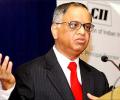
Murthy, the chief mentor of IT bluechip Infosys, said fairness, transparency and accountability were the "three pillars" of corporate ethics which companies should adhere to.
The lower sales growth rate is on account of single-digit growth in sales by Reliance Industries (6.3 per cent), Reliance Energy (9.53 per cent), Hero Honda (5.48 per cent) and Biocon (7.52 per cent). Companies that posted a decline in sales included two-wheeler giant Bajaj Auto (- 3.03 per cent), pharmaceutical major Ranbaxy (-4.79 per cent) and Madras Aluminium (-11.13 per cent).
Has liberalisation squeezed the personality out of India Inc's leaders?
At the Ficci meet, the Gujarat chief minister says 'tax terrorism' in the country is inherently venal; calls for discussion on economic reforms.
India Inc on Friday said it is looking forward to a repo rate cut in future as cost of funds has to come down in coming times, and expects continuation of accommodative policy stance by the Reserve Bank of India (RBI). The RBI decided to leave the benchmark interest rate unchanged at 4 per cent but maintained an accommodative stance, as the economy faces the brunt of the second COVID-19 wave. Sanjay Aggarwal, president of PHD Chamber of Commerce and Industry, said the RBI has maintained an accommodative stance as long as necessary to revive and sustain growth on a durable basis and to mitigate impact of COVID-19, apart from an aim to keep inflation within the target.

India Inc on Thursday pitched for continuation of reforms while ensuring tax and policy stability in the forthcoming Budget to prop up the economy hit hard by the COVID-19 pandemic. In the virtual pre-Budget consultation held with Finance Minister Nirmala Sitharaman, industry chambers said that government measures will help firmly entrench the nascent signs of recovery being currently seen in private investment. Capital expenditure by the government through enhanced infrastructure spending should in the meantime continue to support growth, CII president TV Narendran said.

RBI moves will further add to corporate woes. Harsh Mariwala, the president of industry body Ficci, said, "I am afraid that with such a hawkish monetary stand, the investment environment would become even more difficult. Growth and employment targets will certainly not be achieved."

Retail investors have become a force to reckon with in the last 10 years with their ownership of Indian equities rising 800 basis points, or 8 per cent, to 23.4 per cent during this period, suggests a recent note from Morgan Stanley. This number, Morgan Stanley said, is set to rise in the next few years as Indian households are still underinvested in equities. India's demographics, policy framework, investor education and modest positive real rates, it said, will fuel the 'equity cult' in India.

RIL, Capgemini, IndiGo among companies which have offered to pay their employees' vaccination cost.

The sales growth rate has been a 10-quarter low, dragged by slowdown in the key sectors -- capital goods, construction, infrastructure, non ferrous metals, steel and telecom -- that had contributed to India Inc's growth story in the past.
If viewed rationally, the report should, thus, somewhat defuse the panic around "unique levels" of corruption in India, revealing that the country and its private sector have relatively robust processes in place, allowing for the eventual revelation of corrupt practices.
With the hardening of global interest rates, India Inc appears to be less attracted to foreign currency convertible bonds and is instead looking to public issues in global and domestic markets to raise funds.
Despite optimism about export prospects, investments and recruitment in the next six months, India Inc's business confidence index fell in the fourth quarter of fiscal 2004-05 compared to the previous period, a FICCI survey said on Monday.

Corporates' forex borrowings have grown at a CAGR of 15.6% since 2008.

Transparency is more than welcome, but govt should not look vindictive.

Industry leaders, including Mahindra Group chairman Anand Mahindra, RPG Enterprises chairman Harsh Goenka and Biocon Ltd chairperson Kiran Mazumdar-Shaw on Monday came out in support of the Agnipath scheme, saying it has large potential for employment of youth in the corporate sector. Mahindra also expressed dismay over the violence against the scheme while asserting that the farm equipment to aerospace conglomerate welcomes the opportunity to recruit trained, capable and young people under the programme. The Agnipath scheme, announced on June 14, provides for the recruitment of youths between the age bracket of 17-and-half years to 21 for only four years with a provision to retain 25 per cent of them for 15 more years.
