
Investors sinking lump sum money in equities seem to have applied the brakes.

Poor quality of education is one of the most important reasons for high unemployment in India, says Kavita Nigam.

'Instead of doing reforms and restructuring, the present government is busy with the perception that everything is fine and the economy is hunky-dory.' 'Such hollow perceptions are very dangerous for the Indian economy in the long run.' 'The real risk to India is the lack of decent employment opportunities for youth in general and educated youth in particular.'

Subramanian's paper comes at a time when concerns have been raised in various quarters about the official economic growth numbers. The Economic Advisory Council-PM said the Base Year of India's income calculations were shifted to 2011-12 on the basis of recommendations of several committees with experts in national income accounting.

'The economy will pick up in 2020 or a little later... When it picks up, will it reach 10%, 8% or still lower? It all depends on how realistic are the diagnosis and the prescriptions that follow,' says Professor K J Joseph.

The gates of NRG Stadium will open at 6 am to accommodate and seat 50,000 people by 9 am, after which cultural programme will begin and continue till 10:30 am, and will be broadcast live in Hindi, English and Spanish languages followed by the address of the two leaders.

'The current crisis is one of incomes, driven by poor job growth, agrarian distress and poor investment sentiment,' notes Harsh Pati Singhania, director, JK Organisation.

Mukherjee's statement comes in the backdrop of a sharp decline in Indian stock markets.

Among the 30-share basket, 27 stocks led by Bajaj Auto and Bharti Airtel ended with losses.

The government was planning to come up with a new fiscal model giving 'special incentives' for fields that were given out on nomination to ONGC and Oil India, reports Shine Jacob.

Investor sentiment got a boost after the IMF said India will see its growth picking up to 7.4 per cent in 2018-19 to regain the status of the world's fastest growing major economy.
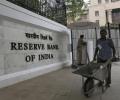
In all, RBI has cut interest rates by 110 bps this year. But this has not yet led to a boost in economic activity. While the growth rate has slowed to a five-year low, consumer confidence is waning and foreign direct investment has plateaued.

The Indian economy was on an impressive growth path through the first decade of this century till it was brought to an abrupt halt by the policy inertia during UPA2 and the Modi government's inability to restore economic and financial momentum. Fascinating glimpses of what went wrong from Puja Mehra's must-read book The Lost Decade: How India's Growth Story Devolved Into Growth Without A Story.

While rising food inflation is a matter of grave concern for a significant chunk of the population and for policy makers as well, it marks a turnaround in the fortunes of the farmer, reports Sanjeeb Mukherjee.

He said India has also opened its defence industry 'like never before' and sought investments in the sector.

Turning tables on Congress and left thinkers, Finance Minister Arun Jaitley on Sunday accused them of practising "ideological intolerance" towards the Bharatiya Janata Party and Prime Minister Narendra Modi and trying to project India as an intolerant society through structured and organised propaganda.

ADB projected China's growth to decelerate from 7.4 per cent

IMF cut its 2016 global growth forecast for the fourth time in the past year to 3.2 per cent, citing China's slowdown.
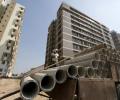
The report cautioned that low capacity utilisation and stressed balance sheets of banks and businesses will prevent a strong investment revival in the short term.
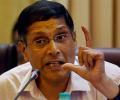
India's gross domestic product product (GDP) growth rate between 2011-12 and 2016-17 should be about 4.5 per cent instead of the official estimate of close to 7 per cent, he said in a research paper published at Harvard University. "The Indian policy automobile has been navigated with a faulty, possibly broken, speedometer," he says in the paper.

India's growth presents a win-win partnership for the country and the US, and American companies have a great opportunity to contribute to that, Modi told the CEOs.

China, it said, is projected to grow at 6.6 per cent in the current year which will moderate to 6.4 per cent next year.

The North-West is expected to be hit the most.
The temporary disruptions (primarily to private consumption) caused by cash shortages accompanying the currency exchange initiative are expected to gradually dissipate in 2017 as cash shortages ease, the International Monetary Fund said in its regional economic outlook.

Rajan, who has also served as chief economist at the International Monetary Fund (IMF), said he had no idea what statistics are pointing at currently and "a revamp" was needed "to really figure out what India's true growth rate is".

At the same time, the UN said in a report, the performance of private investment remains a key macroeconomic concern.

The International Monetary Fund on Thursday raised India's growth forecast for 2010 to 9.5 per cent, stating that favourable financing conditions and robust corporate profits will accelerate economic expansion.

The RBI has cut key rates to boost the economy.

'We are at $2.7 trillion and 2024 is not far away.' 'The country will need to grow by 9% every year for 5 years continuously and raise the aggregate investment rate to 38% of GDP to achieve the government's target of turning India into a $5 trillion economy.' 'Given the fact that we are only growing at about 5% and our investment rates are only about 30%, it may take a number of years before we can reach that targeted level.'

Increasing US shale gas production should stabilise oil prices, in contrast to the spike of the past.
.jpg)
Indian economy is seeing signs of upward momentum helped by gradual reduction of inflationary pressure though the country's growth still remains "relatively weak", according to Paris-based think tank OECD.

A new dimension will be added to the India's growth story by Bharti Airtel's acquisition of Kuwait's Zain Telecom, besides enhancing the country's brand equity
'The world's economy is booming and growing at 3%. But even in this environment, India's growth has declined.' 'This is because of the deliberate slowing down induced by eccentric actions like demonetisation,' argues Aakar Patel.
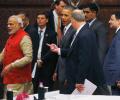
As per a PMO statement, Modi told the investors that "he believes in a fair, predictable and consistent tax system
A number of things need checking and for good reason. Read on to know why, so that you don't have regrets later.

India's growth rate, which slowed down to 6.5 per cent this fiscal because of global financial meltdown, is expected to get back to around 9 per cent within two years.

The hostile environment towards outsiders under the Trump government is a major reason, say experts.
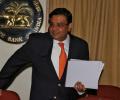
Fitch said the full implications of Patel's resignation will only become clearer once there is some indication of the RBI's policy approach under his replacement, Shaktikanta Das
Ahluwalia said that emerging markets would need to focus more on FDI and bonds among other measures to make up for the fall in bank credit.

Stating that a weak fiscal position continues to constrain India's sovereign ratings, Fitch said the next government's medium-term fiscal policy will be of particular importance from a rating perspective.
 © 2026 Rediff.com - Investor Information - Advertise with us - Disclaimer - Privacy Policy - Sitemap - Feedback - About us - Terms of use - Grievances