
'Many estimates by international agencies suggest that the 21st century will be ruled by three industries -- agriculture, food processing and textiles. And in these three critical industries, UP, surely, has more advantages than any other location in the world -- this is the Gangetic belt,' says Professor Arvind Mohan, who is bullish about the Uttar Pradesh economy.

As the country faces the possibility of a fractured mandate after the 2014 general elections, Planning Commission Deputy Chairman Montek Singh Ahluwalia is of the view that in an era of coalition governments, special steps are needed to build consensus around policies or else, India will not be able to grow at its full potential.
He was addressing the Madhya Pradesh Assembly while marking the start of its golden jubilee celebrations.\n
Macroeconomic data announcement, Omicron situation and global trends will be the major driving factors for the equity market in the first week of the new year 2022, according to analysts. In what turned out to be a historic year, the Indian stock indices went past multiple milestones and the 30-share Sensex made an annual gain of 10,502.49 points or 21.99 per cent in 2021. Religare Broking Vice-President (Research) Ajit Mishra said, "This week marks the beginning of a new month and participants will be closely eyeing some crucial high-frequency data like monthly auto sales, India manufacturing PMI and India services PMI. "Besides, updates on the COVID-19 situation and performance of global markets will also be critical."

Equity mutual funds attracted an all-time high net inflow of Rs 28,463 crore in March, on continued interest by retail and HNI investors, who used market correction as a good buying opportunity.

"I am confident that Indians living overseas will join in the endeavour to contribute to India's growth. As members of the Indian diaspora, you know better than others the challenges and opportunities that a resurgent India represents," Patil, who is the first Indian Head of State to visit the UK in the last 20 years, said.

The coronavirus pandemic has not impacted India's long-term growth trajectory although it has delayed it and in this decade, the country will lead the global growth rates, Tata group chairman N Chandrasekaran said on Tuesday. Speaking at tech giant Microsoft's annual flagship event, Future Ready, he said it should be a national priority to enable access to healthcare and education using digital infrastructure for all in the country, considering how the acceleration of digital adoption during the pandemic has created a divide as many people, who do not have the means and access, have been left behind. "There are many things going for India. I think as the economy fully opens up post the pandemic, I believe that our growth will continue to get stronger.
The Indian economy is likely to slow down a little to 7.6 per cent in the fiscal year 2006 and 7.8 per cent in 2007 as consumption and investment may get affected due to higher inflation, Asian Development Bank said on Thursday.

"The stronger-than-expected start of the fiscal year has prompted . . . to revise India's annual growth forecast from 6.2 per cent to 6.4 per cent," Moody's economy.com, a research arm of Moody's, said in a release.
.jpg)
The global brokerage firm in March had trimmed the growth forecast to 6 per cent and in June again it revised the growth estimate to 5.8 per cent.

India's economic growth rate is expected to be at least 6 per cent in the 2013-14 fiscal, Prime Minister's Economic Advisory Council (PMEAC) Chairman C Rangarajan said.
"We have appointed SBI Caps. Soon, we would be getting feedback on what would be the short-, medium- and long-term restructuring required for Air India," Civil Aviation Minister Praful Patel said while speaking at an event on India Aviation 2010 international exhibition in New Delhi on Wednesday.
The World Bank on Monday forecast India's economy to expand by 5.1 per cent this fiscal, the slowest in six years, although the country has consistently outperformed the multilateral funder's estimates in the past.
It further said that as the trends in inflation have remained benign, it does expect any significant changes in monetary policy. The Reserve Bank of India also took monetary easing measures by infusing more than Rs 4,00,000 crore (Rs 4,000 billion) since October.

Omkeshwar Singh, Head, Rank MF, a mutual fund investment platform, answers your queries.

India's economy is capable of absorbing $50 billion in foreign direct investment per year, feels FM.
Instead of worrying about imported gold, FM should broaden the tax base to dispel concerns about govt-driven inflation.
'Human society is a conflict-prone society... You cannot have complete peace of the graveyard... Switzerland had 500 years of peace and what did they produce? The Cuckoo Clock... Italy had always been in turmoil and they produced Michelangelo, Leonardo da Vinci and the Renaissance.' Meghalaya Governor Ranjit Shekhar Mooshahary, a former head of the BSF and NSG, in a rare and candid interview with Rediff.com's Archana Masih.
Growth has no meaning unless India deals with 300 million people living on one dollar and 600 million people on just $2 a day, he said. Lord Paul reaffirmed his commitment to India and said that he would not suspend operations here due to lack of confidence in India's economic future.

The Indian economy is likely to witness close to double-digit growth in the current fiscal year despite the second COVID-19 wave ravaging the country, Principal Economic Adviser (PEA) Sanjeev Sanyal said on Wednesday. The economy is slowly getting back to normalcy as the number of COVID-19 cases is declining, he said while participating in India Global Forum event. "We are probably going to see close to double-digit, if not double-digit (growth) in this financial year," he said.
In the last one month, the RBI has infused liquidity of Rs 2,70,000 crore (Rs 2,700 billion) by cutting the Cash Reserve Ratio (the amount banks must keep with the apex lender) by 350 basis points and Statutory Liquidity Ratio by 100 basis points. RBI has also reduced the short term lending rate (repo) by 150 basis points to 7.5 per cent from 9 per cent last month.
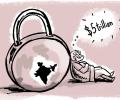
India's growth and success is guaranteed, he said propagating his idea of making the country self-reliant by cutting imports.

Omkeshwar Singh, head, Rank MF, a mutual fund investment platform, answers your queries.

Unseasonal rains and hailstorm are likely to disrupt supplies.
Given the new policy challenges, the Budget will have a difficult time restoring people's confidence in the economy.
Soaring inflation and high interest rates are expected to take a toll on the Indian economy, which is expected to witness a growth rate of 7.5 per cent this financial year against 9 per cent in 2007-08, according to Germany based Dresdner Bank.

The BJP calling the Congress a "torn old party" moving towards a stage where its relevance and necessity will be completely lost.
According to the report, the global economy is projected to strengthen this year, with growth picking up in developing countries.
Wipro founder-chairman Azim Premji believes the Indian IT industry revenues will grow in double digits in the current financial year. Throughout the pandemic, which saw lockdown measures to curtail the spread of the virus, the information technology industry has kept the world running and has also adapted to the changes, Premji said, speaking at an event of the Bombay Chartered Accountants' Society on Tuesday evening. As per Nasscom, the IT industry revenues stood at $194 billion in FY21. The lobby group has ceased giving estimates of the topline growth a few years ago.

India will see a gradual growth acceleration with its GDP expected to reach 5.9 per cent this year.
The Asian Development Bank on Thursday revised upwards its growth projection of Indian economy to 6.7 per cent in 2003, but cautioned that GDP was expected to grow by 6.3-6.4 per cent next year.
The Prime Minister's Economic Advisory Council has scaled down its growth projection for the Indian economy for 2007-08 to 8.9 per cent from 9 per cent on account of slow expansion in manufacturing and energy generation. Dr C Rangarajan, head of the group of economists released the review of the economy of 2007-08 and said that the economic growth of India would be hovering around 8.5 per cent during 2008-09.
The World Bank on Wednesday warned that natural disasters pose a major threat to India's economic development, inflicting losses amounting to $13.8 billion during 1996-2001 and eroding two per cent of the country's GDP.\n\n\n\n

India needs more public investment, to sustain upwards of 9 per cent national income growth and also to fuel private sector dynamism.

'I think RBI has been phenomenally responsive to ensure there is ample liquidity in the system.'

Omkeshwar Singh, head, Rank MF, a mutual fund investment platform, answers your queries.
 © 2026 Rediff.com - Investor Information - Advertise with us - Disclaimer - Privacy Policy - Sitemap - Feedback - About us - Terms of use - Grievances