
From the Sensex pack, Zomato, IndusInd Bank, NTPC, Infosys, HCL Technologies, Titan, Power Grid, Hindustan Unilever, Tech Mahindra and ITC were among the gainers. On the other hand, Reliance Industries, Nestle India, Tata Motors, Adani Ports, Tata Steel, UltraTech Cement and Kotak Mahindra Bank were the laggards.
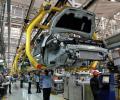
Auto parts exports from India may see a slight slowdown as US President Donald Trump's 25 per cent tariff could increase car prices for buyers by 8-25 per cent, thereby affecting demand, experts believe.

From the 30-share Sensex pack, NTPC, Asian Paints, HDFC Bank, State Bank of India, Tata Motors, JSW Steel, Maruti and Power Grid were among the major laggards. On the other hand, Sun Pharma, Infosys and ICICI Bank were the gainers.

A sharp fall in the equity market made investors poorer by Rs 5.29 lakh crore on Tuesday when the BSE benchmark Sensex tumbled over 800 points. A host of negative triggers -- muted quarterly earnings, continuous foreign fund outflows and weak trends in Asian and European markets -- dragged the benchmark indices lower. The BSE benchmark gauge tumbled 820.97 points or 1.03 per cent to settle at 78,675.18.
From the Sensex stocks, Maruti Suzuki India, Tata Motors, JSW Steel, Larsen & Toubro, Tata Steel, Mahindra and Mahindra, Tata Consultancy Services, Tech Mahindra, HCL Technologies and Infosys were the laggards. HDFC Bank, Sun Pharmaceuticals, Kotak Mahindra Bank, Nestle India and Asian Paints were among the gainers.
Equity benchmark BSE Sensex tumbled nearly 700 points to sink below the 79,000 level on Tuesday, extending its losses for the second straight day due to selling pressure in HDFC Bank, SBI and ITC amid fresh foreign capital outflows. The 30-share BSE Sensex tumbled 692.89 points or 0.87 per cent to settle at 78,956.03. During the day, it tanked 759.54 points or 0.95 per cent to 78,889.38.

From the Sensex pack, Tata Steel, Titan, Tech Mahindra, Wipro, Bajaj Finserv, Bajaj Finance, Nestle India, Tata Motors and JSW Steel were the biggest laggards. ICICI Bank, Axis Bank, HDFC Bank, State Bank of India and Kotak Mahindra Bank were the gainers.

Sun Pharma, Bajaj Finserv, Tata Consultancy Services, Infosys, Hindustan Unilever, JSW Steel, Wipro, Maruti, HCL Technologies, Tech Mahindra and ICICI Bank were the other major gainers. State Bank of India, Tata Motors, Axis Bank, Kotak Mahindra Bank, Bajaj Finance, Tata Steel, Nestle and HDFC Bank were the laggards.
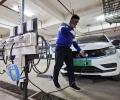
The government on Friday approved an electric-vehicle policy, under which duty concessions will be given to companies setting up manufacturing units in the country with a minimum investment of $500 million, a move aimed at attracting major global players like US-based Tesla. According to an official statement, the companies setting up manufacturing facilities for e-vehicles will be allowed to import a limited number of cars at lower customs duty. The policy seeks to promote India as a manufacturing destination for EVs and attract investment from reputed global EV manufacturers, it added.

India will not tailor its policies to suit US EV maker Tesla, and its laws and tariff rules will be formulated to attract all-electric vehicle manufacturers from across the world to set up a base in the world's fastest-growing economy, Commerce and Industry Minister Piyush Goyal said. Tesla has been seeking an initial tariff concession that would allow it to offset 70 per cent customs duty for cars priced less than $40,000, and 100 per cent for cars of higher value.
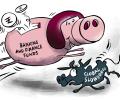
Even as banks and finance companies are reporting record-high earnings, their weighting in the benchmark National Stock Exchange Nifty50 Index has seen a downward trajectory. Investors expect a stronger performance from other sectors in the new year. Currently, banking, financial services and insurance (BFSI) companies collectively hold a weighting of 34.5 per cent, down from 36.7 per cent at the end of December 2022 and a record high of 40.6 per cent at the end of December 2019. This represents the sector's lowest weighting in the index since December 2021 when it stood at 33.7 per cent.

The market capitalisation of BSE-listed firms jumped to an all-time high of Rs 304.53 lakh crore on Wednesday, buoyed by an unprecedented rally in equities where the BSE benchmark Sensex ended over the 67,000-mark for the first time ever. Rallying for the fifth day running, the 30-share BSE Sensex climbed 302.30 points, or 0.45 per cent, to end at its lifetime closing high of 67,097.44 points. During the day, it jumped 376.24 points, or 0.56 per cent, to reach its all-time intra-day peak of 67,171.38 points.

Among the Sensex firms, Axis Bank, Power Grid, Maruti, State Bank of India, Tata Motors, ITC, Nestle and Mahindra & Mahindra were the major gainers. Bajaj Finance and Larsen & Toubro were the laggards.

From the Sensex pack, NTPC, Bajaj Finance, IndusInd Bank, UltraTech Cement, Bajaj Finserv, State Bank of India, Tata Motors, ITC, Power Grid and Larsen & Toubro were the biggest gainers. IndusInd Bank climbed 2 per cent after the company on Tuesday reported a 30 per cent jump in consolidated net profit in April-June quarter at Rs 2,124.50 crore, helped by core income growth and lower bad loan provisions.

Passenger vehicle sales in India touched a record high of 41.08 lakh units in 2023, growing by 8.3 per cent over the previous year driven by SUVs, which accounted for almost half of the total dispatches from manufacturers to dealers. The record sales have been achieved despite an increase in the average price of vehicles to Rs 11.5 lakh last year as compared to Rs 10.58 lakh in 2022. Market leader Maruti Suzuki, Hyundai Motor India, Tata Motors and Toyota Kirloskar Motor reported their best-ever annual sales in 2023.

The promoter entities of JSW Group are in talks with several electric-car manufacturers in China to launch an electric car for the Indian market at Rs 15-20 lakh, a source close to the development said.

More and more women are making their presence felt in jobs related to sciences, technology, and engineering across organisations.

Maruti will launch its first electric vehicle (EV) in the next financial year (FY24), and will roll out six EVs in the country by FY30, the automaker's parent firm Suzuki said on Thursday.

Auto Expo 2023 may not trigger a fresh rally in automobile stocks, say analysts, as this year's edition lacks participation from major listed players. It is also owing to the focus on electric vehicles (EVs), a segment where four-wheelers have minuscule market share. "In the passenger vehicles (PV) segment, Maruti Suzuki India and Tata Motors are the only listed players.

By 2025, Uber projects that 25,000-30,000 cars -- or 12 to 16 per cent of vehicle additions -- would be EVs, reports Surajeet Das Gupta.
IndusInd Bank was the biggest gainer in the Sensex pack, rallying 4.84 per cent, followed by Sun Pharma, Bajaj Auto, Bharti Airtel, Coal India, Tata Motors, SBI, ICICI Bank, Hero MotoCorp, ONGC, HDFC, Vedanta, L&T, Kotak Bank, Maruti and Axis Bank, ending up to 2.92 per cent higher.

Top losers in the Sensex pack included Tata Steel, Vedanta, Maruti, SBI, Coal India, Tata Motors, Sun Pharma, HUL, RIL, IndusInd Bank, Axis Bank, HDFC duo, ICICI Bank, M&M, Kotak Bank, and Infosys, falling up to 2.89 per cent.
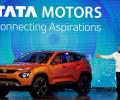
Homegrown auto major Tata Motors on Tuesday said it will raise $1 billion (Rs 7,500 crore) in its passenger electric vehicle business from TPG Rise Climate at a valuation of up to $9.1 billion. Tata Motors Ltd (TML) and TPG Rise Climate, the dedicated climate investing strategy of private investment firm TPG, have entered into a binding agreement in this regard. Under the agreement, TPG Rise Climate along with its co-investor ADQ, will invest in a subsidiary of Tata Motors that will be newly incorporated, the company said in a statement.

Karl Slym, managing director of India's Tata Motors Ltd, died after falling from a hotel room in Bangkok in what police said on Monday could be possible suicide.

It will also double employment at the site to around 1,400.

This is the third consecutive monthly slide.

With entry-level cars being preferred amid the pandemic, market leader Maruti Suzuki has strengthened its hold, along with Hyundai Motor India.
However, raised prices of its sport-utility vehicles by up to Rs 11,000.

Shelving its expansion plans in Thailand and opting for fast-growing Indonesia, India's Tata Motors is in talks with a leading Indonesian automobile company to produce its popular no-frills Nano car.

Tata has recently developed the Pixel city car, which the company is targeting at European drivers.

The tiny Nano car made by India's Tata Motors has been described by company director Jamshed J. Irani as having huge potential. Even as analysts claim that the Nano could rock the international auto industry and put millions of new Indian drivers on the road, Irani told The Washington Post in an interview that while Tata is producing only about 100 units a day at present, it hopes to ramp up to about 1,000 vehicles a day next year.

The first spending item on the chopping block is capital expenditure, followed by operating costs and overheads, including sales and marketing expenses.
India's Tata Motors could sign a deal with Ford to buy the US carmaker's Jaguar and Land Rover marques as early as next Wednesday or Thursday, people familiar with the deal said on Tuesday.
Honda's chief executive on Sunday disputed the low-cost business model championed by India's Tata Motors, saying that bad roads and high petrol prices would keep many emerging market travellers on motorcycles for years to come.
The announcement comes close on the heels of the US publication Conde Nast Portfolio's report that 'Nano' would not be sold in the US. "The model (Nano) won't be sold in the US but has the potential to radically alter the market for manufacturers in India. Tata-inspired followers are already revving up their engines," Conde Nast Portfolio said.
American auto giant Ford is likely to retain a stake and continue supplying engines and some of the components for Jaguar and Land Rover, even after the sale of the two British luxury brands, media reports said in the United Kingdom.
A-Star has been developed by Maruti Udyog and its Japanese parent, Suzuki Motor Corporation for the global markets.
Ford Motor Co on Wednesday said it expects the sale of its two European marques Jaguar and Land Rover, in which India's Tata Motors has evinced interest, to be through either by this year-end or early next year.

Recently, Suzuki Motor Corp (SMC) in an investor presentation expressed strong intent to enter the electric vehicle (EV) space. This is part of a larger strategy the Hamamatsu-based firm has drawn up in developing electrification of technologies as it seeks to achieve carbon neutrality. The significance of this presentation is that it marked the first time that the Japanese carmaker spelt out its EV strategy with well-defined timelines. SMC plans to develop electrification technologies by 2025, fully implement them in products from the same year, and make a full-scale quantitative increase from 2030.
This will ensure its vehicles reach dealers much faster and delivered to buyers in a maximum of three days, reports Shally Seth Mohile.
 © 2026 Rediff.com - Investor Information - Advertise with us - Disclaimer - Privacy Policy - Sitemap - Feedback - About us - Terms of use - Grievances