
Mopeds are sought by people with smaller businesses, with their weight-carrying and haulage ability beside being lighter and easy to manoeuvre in traffic.

Budget expectations and the subsequent fall in purchases resulted in a 4.23 per cent drop in passenger car sales during February, 2005
Japan's Honda Motor Co, the world's top motorcycle maker, said on Tuesday it will renew for 10 years a pact to supply technology to its Indian joint venture company Hero Honda when the current agreement expires in 2004.

The BS-VI norms are expected to increase the price of two-wheelers by 10-14 per cent.
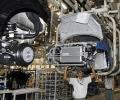
Hyundai Motor and Toyota Kirloskar Motor have announced the suspension of manufacturing operations at their respective plants amid coronavirus outbreak. On Sunday, various automakers like Maruti Suzuki India, Honda Cars, Mahindra & Mahindra and Fiat announced a temporary halt in manufacturing operations at their respective facilities.
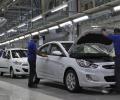
As the second wave of the Covid-19 pandemic abates, India's automakers are hopeful of a quick recovery in sales volumes, led by better rural sentiment, low interest rates, improved availability of finance and a gradual uptick in business and economic activity. In fact, companies have started to ramp up production already, encouraged by high order books and the growing preference for private transport in both rural and urban areas as a means to avoid infections. In early April, the industry had been bullish as the sales trend for March showed that the effects of the Covid-19 pandemic had been left behind. The total vehicle sales had grown by 77 per cent, albeit on a lower base, and for the past few months, sales had consistently touched 300,000 units per month.

Vehicle prices have gone up as manufacturers gear up for the transition to stricter emission norm BS-VI from BS-IV beginning April 1.
The strike, however, had no impact on production of auto majors Maruti Suzuki India, Hero MotoCorp, Honda Cars India, Mahindra & Mahindra, Tata Motors and Hyundai Motors India as their plants in various parts of the country functioned normally.

The Interceptor 650 and Continental GT 650 have been game changers in the upper part of the mid-size segment, with compelling style and highway capability.

Passenger vehicle wholesales in India increased by 17 per cent in the second quarter of the current fiscal year as buying sentiment improved and companies stocked up to cater to enhanced demand in the festive season, auto industry body SIAM said on Friday. According to the latest data by the Society of Indian Automobile Manufacturers (SIAM), passenger vehicles sales in the July-September quarter increased to 726,232 units from 620,620 units in the same period last year. Similarly, two-wheeler sales during the September quarter this fiscal rose marginally to 46,90,565 units as compared with 46,82,571 units in the same period last fiscal. However, commercial vehicles sales saw a dip of 20.13 per cent at 133,524 units in the quarter under review as compared with 167,173 units in July-September 2019.
Alleging misconduct by its permanent workers, labour unions and contract staff, the plant management informed all stakeholders, through a notice, that starting Monday "normal operations" at the plant are being suspended.

The Honda NAVI is completely customisable as per the customer's choice.
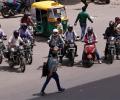
This is the first time a state is asking for PAN card for two-wheelers

Honda Cars India approached the Gujarat government with a proposal to set up a car manufacturing plant in the state.
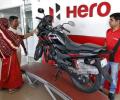
Besides regular buyers, there is lot of interest among those in essential services, such as health, banking, and IT. The sales will be helped by social distancing becoming the new normal in both urban and rural regions as people will be averse to using public transport.
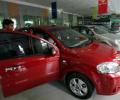
Data issued by Siam shows sale of PVs (cars, vans and utility vehicles) grew 14.3 per cent to 275,417 vehicles.

The All India Tennis Association, often accused of being lax in dealing with age fraud, had no clear answers to what transpired at CLTA.

So, how is it different from the 150cc Honda CB Unicorn? Naveen Soni reports on what the Unicorn 160 has to offer!
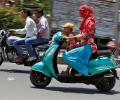
Dealers attribute the sluggishness in sales to distress in rural India as well as tepid sentiment in urban markets.

According to the data released by Society of Indian Automobile Manufacturers (SIAM), domestic car sales in October this year stood at 1,59,036 units as compared to 1,63,199 units in the same month of 2013.

Sales of commercial vehicles rose 8.59 per cent to 56,140 units in September, SIAM said.

Honda has invested Rs 3,526 crore in its Rajasthan unit.

This crisis has arisen just as demand in India's auto sector started seeing some sort of revival after the nationwide lockdown in March/April.

As per SIAM data, vehicle sales across categories, including passenger vehicles and two-wheelers and commercial vehicles stood at 18,21,490 units last month as against 23,82,436 units in August 2018, a fall of 23.55 per cent.
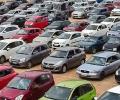
Leading automakers Maruti Suzuki India, Hyundai Motor, Kia Motors and Tata Motors reported sales growth in the domestic market in November, aided by robust offtakes amid the festival season. While Maruti Suzuki India reported marginal growth, Hyundai logged in its highest ever monthly sales in November. Others like Honda Cars India, Toyota Kirloskar Motor, Mahindra & Mahindra and MG Motor India also reported sales growth in November as compared with the same month last year.

Domestic passenger vehicle sales declined 0.84 per cent to 2,63,773 units in November from 2,66,000 units in the year-ago period. Motorcycle sales, too, declined 14.87 per cent to 8,93,538 units. Vehicle sales across categories registered a decline of 12.05 per cent to 17,92,415 units from 20,38,007 units in November 2018.

The two-acre office complex under construction on the outskirts of Delhi will be home to about eight hundred company executives. Special care is being given to air purification and the building will be equipped with a three-stage air filter system.

The key beneficiary of this expansion in the motorcycle market happens to be Bajaj Auto.
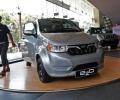
Gujarat, Telangana to roll out policies to encourage manufacturing

Vehicle sales across categories registered a decline of 8.62 per cent to 20,86,358 units from 22,83,262 units in May 2018.

Honda Motorcycle and Scooter India (HMSI) Ltd. has finally launched the new 110cc commuter bike Livo at an introductory price of Rs 58,000 (on-road) in the country.

Honda has grown from 15% in FY12 to 27% now; Yamaha has doubled share to 5% in five years.
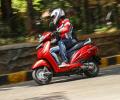
Sales, which were growing impressively in the first seven months of the year, decline in November. Ajay Modi reports.
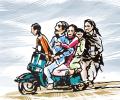
Five companies get more volumes from scooters than motorcycles.

Two-wheeler prices are likely to rise by 10-25 per cent on account of higher premiums on insurance and commodity prices, mandatory safety regulations and BS-VI emissions that kick in from April 1, 2020.

Analysts say Bajaj's move to correct prices can potentially disrupt the market.

Take out Maruti Suzuki and Honda, and the auto sector's prospects suddenly don't look all that rosy.

Reflecting the woes of the Indian automobile industry, the country's car exports remained flat at 550,466 units in 2013-14, during which domestic sales fell for the second consecutive year.
 © 2026 Rediff.com - Advertise with us - Disclaimer - Privacy Policy - Sitemap - Feedback - About us - Terms of use - Grievances