
The new labour Codes, notified by the central government in November 2025, have pushed up employee costs for private-sector banks and insurance companies, with these firms reporting higher operating expenses in the October-December quarter (Q3FY26) due to the statutory impact of the new labour Codes.

Companies would have to recognise the increase in gratuity liability arising from new labour codes in their interim financial statements and results for the period ending December 31, the Institute of Chartered Accountants of India (ICAI) has said in its FAQs on the new labour codes.
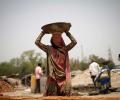
In a historic decision, the government on Friday announced the implementation of the four Labour Codes, which rationalised 29 existing labour laws, with immediate effect. The four labour codes are -- the Code on Wages, 2019, the Industrial Relations Code, 2020, the Code on Social Security, 2020 and the Occupational Safety, Health and Working Conditions Code, 2020.

'It will increase the contribution to gratuity, which is something the employer has to give.'

'Companies will need to revisit compensation structures, contracts, staffing models, and human resources system.'

From appointment letters becoming mandatory to gig workers receiving social security to enhanced rights for women and contract labour, the changes reflect India's attempt to balance ease of doing business with stronger worker welfare.

'In India, managers and the leadership almost glorify overworking.'
The four labour codes on wages, social security, industrial relations and occupation safety, health and working conditions are likely to be implemented by the next fiscal year as at least 13 states have pre-published draft rules on these laws, a senior official said. The Centre has already finalised the rules under these codes and now states are required to frame regulations on their part as labour is a concurrent subject. A senior official said that the four labour codes are likely to be implemented by the next fiscal year.

Day 6 of Parliament's monsoon session 2020. Watch all the action in both houses LIVE here.
Ushering in a big wave of reforms by implementing the four labour codes, setting up the national social security fund to cover over 38 crore informal sector workers and improving the ease of doing business will top the agenda of the labour ministry in the New Year. In a major move, the ministry launched the e-Shram portal on August 26, 2021 for creating a national database of over 38 crore informal sector workers. It will help the government to ensure last-mile delivery of benefits of various social security schemes to the informal-sector workers.
Union Labour Minister Bhupender Yadav has exuded confidence that four labour codes, which would bring another wave of reforms, will soon be implemented as around 90 per cent of states have already come out with draft rules. In 2019 and 2020, 29 central labour laws were amalgamated, rationalised and simplified into four labour codes, viz, the Code on Wages, 2019; the Industrial Relations Code, 2020; the Code on Social Security, 2020; and the Occupational Safety, Health & Working Conditions Code, 2020, noted the Survey. During an interaction, Yadav told reporters that around 90 per cent of the states have already published draft rules on four labour codes and he expects the four legislations would become operational soon.

The government has introduced the Code on Wages Bill 2019 and the Occupational Safety, Health and Working Conditions Code Bill 2019 in Lok Sabha on July 23.

Labour Minister Santosh Gangwar said, the purpose of labour reforms is to provide a transparent system to suit the changed business environment.

The norms, say industry experts, are not sufficient to weed out fly-by-night contractors.
All four labour codes are likely to be implemented in one go from April 1, the beginning of the next fiscal year, labour secretary Apurva Chandra said on Wednesday. The parliament in its just concluded session passed three labour code bills: the Industrial Relations (IR) Code, the Social Security Code, and the Occupational Safety, Health and Working Conditions Code (OSH). The Wage Code Bill, 2019 was passed by the parliament last year.

The move will help industries in pushing authorities for exemption under various labour laws at a micro-level, along with demanding changes to bring greater flexibility in their operations related to retrenchment, safety standards, and collective bargaining.

As per the recommendations of the 2nd National Commission on Labour, the ministry is codifying existing 44 central labour laws into four codes by simplifying, amalgamating and rationalising the relevant provisions of the legislations.

 © 2026 Rediff.com - Investor Information - Advertise with us - Disclaimer - Privacy Policy - Sitemap - Feedback - About us - Terms of use - Grievances