
To help revive the economy battered by COVID-19, Finance Minister Nirmala Sitharaman on Monday announced a slew of measures, including Rs 1.1 lakh crore credit guarantee scheme for improving health infrastructure, and enhancing the limit under the ECLGS by 50 per cent to Rs 4.5 lakh crore for the MSME sector facing liquidity crunch. Sharing the details of stimulus package, the finance minister said this comprises eight relief measures and other eight measures to support the economic growth. She announced Rs 1.1 lakh crore loan guarantee scheme for COVID-affected sectors, including health sector, which includes guarantee cover for expansion or for new projects. Besides, she said, additional Rs 1.5 lakh crore limit enhancement done for Emergency Credit Line Guarantee Scheme (ECLGS) scheme.

This is first time in 25 years that a benchmark equity index in India is trading at a P/E multiple of 40x or higher.

Analysts attribute the surge to a host of factors, particularly the interest shown by the retail investors in these two market segments.

Top losers in the Sensex pack included Yes Bank, Vedanta, IndusInd Bank, Tata Steel, L&T, SBI, NTPC, Kotak Bank, HDFC, HDFC Bank, PowerGrid, Infosys and ITC, falling up to 4.18 per cent.

In the manufacturing sector, output is expected to decline by about 70 per cent as only food-processing, and drugs and pharma industries are allowed to operate while other segments, such as engineering and metals, have shut operations.

Given the developments, analysts expect fiscal and monetary support from the government and RBI to revive sentiment. However, recovery, they say, from these levels will be slow and painful.

Among IT services firm, Cognizant witnessed over 60 per cent of its initial applications rejected, followed by Capgemini, Accenture, Wipro, and Infosys. In 2018, the top six Indian firms got just 16 per cent or 2,145 H1B work permits.

The current valuation is 38 per cent higher than the 10-year average of 22x and over 50 per cent higher than the 20-year average of around 20x.

Top gainers in the Sensex pack include SBI, Yes Bank, Tata Motors, L&T, ICICI Bank, IndusInd Bank, ONGC, Maruti, M&M, Axis Bank, RIL, Hero MotoCorp, HDFC, Vedanta, Asian Paints, Tata Steel and Bajaj Finance, rising up to 7 per cent.

The biggest losers of the session include Reliance, Infosys, TCS, ICICI Bank, HDFC twins, ITC, Maruti, L&T, HUL, Axis Bank, Wipro and IndusInd Bank, cracking up to 4 per cent.

In the Sensex pack, Yes Bank, IndusInd Bank, Infosys, ICICI Bank, TCS, SBI, Reliance Industries, ONGC, Axis Bank and NTPC rose up to 2.66 per cent.

TCS and Infosys were the top losers in the Sensex pack, falling up to 3.39 per cent.
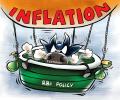
Currently, the retail inflation is well below the RBI's comfort level. The government has asked the central bank to keep inflation in the range of 4 per cent.
Other losers included HCL Tech, Yes Bank, IndusInd Bank, TCS, ONGC, Bajaj Finance, PowerGrid, Vedanta, Asian Paints, NTPC and Hero MotoCorp, which shed up to 4.07 per cent.
In the Sensex pack, Axis Bank, Tata Motors, Infosys, Kotak Bank, HDFC Bank, RIL, Bajaj Auto, SBI, HUL, Tata Steel, Vedanta, HFDC, TCS, ITC and Sun Pharma jumped up to 4.64 per cent.

Top gainers of the session included Bajaj Auto, Kotak Bank, M&M, Vedanta, IndusInd Bank, Asian Paints, HDFC Bank, Reliance Industries, HUL, HDFC, ITC, Tata Steel and Tata Motors, rallying up to 5 per cent.
Kotak Bank was the top gainer in the Sensex pack, ending 4.31 per cent higher. PowerGrid, TCS, ICICI Bank, SBI, HCL Tech, NTPC, Infosys, Bajaj Finance, HDFC duo, ONGC, Vedanta and IndusInd Bank too rose up to 2.84 per cent.

From its all-time peak of 38,989.65 scaled on August 29 this year, the Sensex has fallen by 2,921.32 points, or 7.5 per cent, to 36,068.33.

Regular use of smartphones may have a negative effect on the development of figural memory performance in adolescents.

Developers often quote high prices but they would be more than willing to give discounts.

All sectoral indices on the BSE and NSE ended in the red, led by realty, banking, metal, pharma, pharma and financial stocks.

Fund redemption and rising import bills would continue to put pressure on the Indian currency.

Among Sensex components, shares of Reliance Industries, India's largest company by market value, stole the show by surging 1.61 per cent to their highest in over three months.
In the Sensex kitty, ITC turned star performer by surging 2.45 per cent, followed by NTPC rising 2.19 per cent.
Vivek Mahajan expects a populist Budget and says there could be a rollback of economic stimulus package.
We also expect undertaking policy reforms to support growth like addressing the challenges to land acquisition, infrastructure bottlenecks and infrastructure financing, among others.

Government officials be under confusion.

The fall was led by L&T, IndusInd Bank, PowerGrid, NTPC, TCS, ICICI Bank, Axis Bank, Hero MotoCorp, Bharti Airtel and SBI, declining up to 2.64 per cent.
Among Sensex constituents, HCL Tech suffered the most by diving 2.26 per cent, followed by HDFC shedding 2.10 per cent.

The proportion of women to men falls radically after the mid-management level.

India, per se, is witnessing more promising growth.

Cascading effect of rising raw materials will result in inflation, high rates, slow capex

A weaker rupee could aid corporate earnings through its positive impact on export intensive sectors such as information technology services, pharmaceuticals and commodity producers such as metal and mining, and oil and gas companies.
.jpg)
After surging 2.5 per cent to Rs 2,563.45 in intra-day trade, the stock ended at Rs 2,526.75, up 1.03 per cent.

"India's GDP is likely to grow at (an) average 12 per cent in nominal terms. Hence, India will be a $2-trillion economy by 2014-15," Enam Securities head-research, Nandan Chakraborty, and economist Sachchidanand Shukla said in a report titled 'India Strategy' released on Monday.

In the case of Indian equities specifically, all eyes will now be on the next RBI monetary policy scheduled for September 29.

Investment trend by foreign investors will also be closely watched for stock movement

Most NBFCs will have to slow down their loan growth. Some of the most leveraged will have to sell a part of their assets (or loan book) to banks to raise incremental capital. Others may have to knock on the door of their deep-pocketed parents.

HUL, ITC, Nestle, Colgate, Dabur, Britannia, Asian Paints, P&G are trading at nearly 48 times. The previous record high was 53 times at the end of March 1994.

75 per cent of new Internet users will come from rural areas
 © 2026 Rediff.com - Investor Information - Advertise with us - Disclaimer - Privacy Policy - Sitemap - Feedback - About us - Terms of use - Grievances