In the quarter gone by (Q3 of FY22), private lender HDFC Bank issued around 950,000 credit cards, its highest ever credit card issuance in any single quarter. Since the Reserve Bank of India (RBI) revoked the embargo on it in August 2021 to issue new credit cards, the lender has issued 1.37 million credit cards. This is according to a senior bank executive, who was present in an analysts' call after the lender's Q3 earnings. In Q3, we achieved the highest ever issuance, with 950,000 card issuances.

Ask rediffGURU and PF expert Milind Vadjikar your insurance, stocks, mutual fund and personal finance-related questions.

From the 30-share Sensex pack, Bajaj Finance, Nestle India, Bajaj Finserv, Asian Paints, UltraTech Cement, Infosys, Maruti, Bharti Airtel and Hindustan Unilever were among the gainers. JSW Steel, Adani Ports, NTPC, State Bank of India, Reliance Industries, Tech Mahindra, Axis Bank, Titan and HDFC Bank were the laggards.
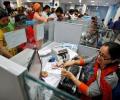
Commercial banks in India reported a sixth consecutive year of rise in their net profits in 2023-24 while bad loans continued to fall, according to the Reserve Bank of India's (RBI's) annual publication "Trends and Progress of Banking in India", released on Thursday. "Banks' profitability rose for the sixth consecutive year in 2023-24 and continued to rise in H1:2024-25 with the return on assets (RoA) at 1.4 per cent and return on equity (RoE) at 14.6 per cent," the report said.

The Indian equity markets will soon account for over a fifth of a key emerging market (EM) benchmark tracked by funds with assets exceeding $500 billion. This development is expected to funnel as much as $3 billion into the domestic markets. Following the latest review undertaken by global index provider MSCI, India's weighting in the MSCI EM index will surpass 20 per cent for the first time, narrowing its gap with the current top-weighted China to fewer than 400 basis points.
Bank credit growth is expected to moderate this financial year after a robust 16 per cent estimated for last financial year, driven by strong economic activity and retail credit demand. There are three reasons for this: a statistical high-base effect given the strong growth seen last financial year, revision in risk weights by the Reserve Bank of India (RBI), and relatively slower economic activity.
The Securities Appellate Tribunal (SAT) has stayed a Sebi order which imposed a fine of Rs 1 crore on HDFC Bank for invoking securities pledged by stock broker BRH Wealth Kreators, till further orders. Sebi had imposed the fine and also directed the bank on January 21 to transfer Rs 158.68 crore along with 7 per cent interest per annum into an escrow account till the issue of settlement of clients' securities is reconciled. "The fact that the circulars have been violated or not and whether the securities have been rightly invoked by the appellant requires consideration," the tribunal said in an order dated February 19 while giving three weeks time to Sebi to file a reply.

Citing some news reports about alleged unfair business practices, and that the lender had also missed analysts' estimates on profits for the first quarter ended June FY21, Rosen Law Firm said it is preparing a securities lawsuit.

Gold prices rallied Rs 910 to hit a fresh all-time high of Rs 83,750 per 10 grams in the national capital on Wednesday due to heavy buying from jewellers and retailers, according to the All India Sarafa Association. The precious metal of 99.9 per cent purity had settled at Rs 82,840 per 10 grams in the previous trading session.

Mukesh Ambani, accompanied by younger son Anant and younger daughter-in-law Radhika Merchant Ambani, were among the many celebrities who attended Devendra Fadnavis' swearing in at Azad Maidan on Thursday afternoon.

From the 30-share blue-chip pack, Adani Ports, UltraTech Cement, Larsen & Toubro, Sun Pharma, HDFC Bank, ICICI Bank, NTPC and State Bank of India were the major laggards. Tata Consultancy Services, Reliance Industries, ITC, Asian Paints, HCL Tech and Maruti were among the gainers.

India needs another shot of difficult reform, of the kind only possible at gunpoint. Mr Trump holds that gun to our heads now. A drastic reduction in tariff protection, other elements of sarkari wet-nursing will force entrepreneurial India to become competitive again, argues Shekhar Gupta.
With the banking regulator lifting restrictions on HDFC Bank's digital initiatives, the largest private sector lender is now girding up to launch a clutch of customer-facing applications (apps), which will act as stepping stones in its journey to morph into a technology (tech)-led bank from a conventional one. Following repeated outages in its digital offerings, the Reserve Bank of India (RBI) had barred HDFC Bank from issuing new credit cards in December 2020 and prevented it from going ahead with its digital launches. The embargo on issuing credit cards was lifted in August 2021 and the ban on digital launches was lifted last week.

The last time this happened was in 1996.
While HDFC Bank has vowed to recoup its lost market share in the credit card segment in three to four quarters by aggressively sourcing new cards, brokerages believe it is a little hard to come by, given how competitive the landscape has become, with other players in the market becoming equally aggressive to gain market share. Kotak Institutional Equities in its report on Monday said, "We would like to believe that the recovery in market share is likely to be gradual, if any. "All the key players, including Axis Bank, are now willing to expand their credit card portfolios as they have tested quite well against Covid-19."
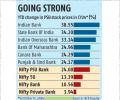
Stock Market News today, PSU banks: The year 2024 was a roller-coaster ride for Indian stock markets, marked by volatility driven by the Lok Sabha elections, Union Budget 2024, a slowdown in corporate earnings, and sticky inflation. Geopolitical tensions - particularly between Israel and Iran in West Asia - along with various stimulus announcements by China and yen carry trade rocked the equity markets throughout the year.

Asset management companies launched 239 new fund offerings (NFOs) mobilising Rs 1.18 lakh crore in 2024, with sectoral or thematic equity funds emerging as the top choice of investors, according to a report by Germinate Investor Services Research. This was higher than 212 NFOs collecting Rs 63,854 crore in 2023 and 228 NFOs garnering Rs 62,187 crore in 2022.

From the 30-share pack, Asian Paints, Reliance Industries Limited, Bajaj Finance, Mahindra & Mahindra, Indusind Bank, Bajaj Finserv, Maruti Suzuki, HDFC Bank and UltraTech Cement were the major gainers, jumping up to 5.56 per cent.

The new business premium (NBP) of life insurance companies dropped 21.7 per cent year-on-year (Y-o-Y) to Rs 30,218.71 crore in December 2024 on the back of a steep fall in business. According to data published by the Life Insurance Council, LIC's premium dropped 41.15 per cent Y-o-Y to Rs 13,523.87 crore while private insurers reported 7 per cent growth in NBP to Rs 16,694.85 crore as the industry absorbs the impact of the revised surrender value norms.
Gold prices rallied by Rs 630 to a lifetime high of Rs 82,700 per 10 grams in the national capital on Wednesday following persistent buying by jewellers and retailers amid strong global trends, according to the All India Sarafa Association. Rallying for the sixth straight session, gold of 99.5 per cent purity appreciated by Rs 630 to hit a lifetime high of Rs 82,330 per 10 grams.
Ask rediffGURU and PF expert Milind Vadjikar your insurance, stocks, mutual fund and personal finance-related questions.
From the 30-share pack, Titan, Tech Mahindra, Maruti Suzuki India, Wipro, Nestle India, TCS, Larsen & Toubro, HCL Technologies, Tata Steel and HDFC Bank were among the major laggards. NSE Nifty declined 69.75 points to settle at 17,153.

The combined market valuation of eight of the top-10 most valued firms surged Rs 1,21,270.83 crore last week, with Reliance Industries becoming the biggest gainer, in line with an outstanding rally in benchmark equity indices. Last week, the BSE benchmark jumped 1,027.54 points or 1.21 per cent. The BSE Sensex hit its record high of 85,978.25 on Friday.

All sectoral indices ended lower. BSE Telecommunication tanked 2.18 per cent, metal (1.77 per cent), auto (1.70 per cent), energy (1.64 per cent), oil & gas (1.59 per cent), commodities (1.39 per cent) and financial services (1.37 per cent) were the major laggards.

Equity benchmark indices Sensex and Nifty settled lower for the sixth straight session on Monday due to heavy selling in bellwether stocks including HDFC Bank and Reliance Industries amid mixed trends in the global markets and outflow of foreign funds. Falling for the sixth consecutive session, the BSE Sensex tumbled 638.45 points or 0.78 per cent to settle at 81,050. During the day, it plummeted 962.39 points or 1.17 per cent to 80,726.06. The NSE Nifty slumped 218.85 points or 0.87 per cent to end at 24,795.75.

From the 30-share Sensex pack, Mahindra & Mahindra, Infosys, HCL Technologies, Adani Ports, Bajaj Finance, Tech Mahindra, Titan, Tata Consultancy Services, Reliance Industries and Power Grid were among the laggards. On the other hand, State Bank of India was the only gainer.

Bajaj Finance was the top gainer in the Sensex pack, surging around 5 per cent, followed by Bajaj Finserv, HDFC, Tech Mahindra, HDFC Bank, UltraTech Cement and Tata Steel. On the other hand, HUL, Nestle India, ICICI Bank, Axis Bank, SBI, TCS and ITC were among the laggards.

Gold prices hit a fresh record high of Rs 84,900 per 10 grams in the national capital on Friday, driven by robust domestic demand and strong global cues, according to the All India Sarafa Association. The precious metal of 99.9 per cent purity continued its ascent for the third straight session, jumping by Rs 1,100 to hit a new peak of Rs 84,900 per 10 grams.
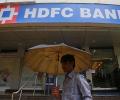
HDFC Bank on Tuesday said the Reserve Bank of India (RBI) has appointed an external IT firm for carrying out a special audit of its IT infrastructure in the aftermath of repeated service outages at the country's largest private sector lender over the past two years. "RBI has appointed an external professional IT firm for carrying out a special audit of the entire IT infrastructure of the bank under Section 30 (1-B) of the Banking Regulation Act, 1949..., at the cost of the Bank under Section 30 (1-C) of the Act.

Puri gave up the comforts of Citibank to set up a new-age bank from a rat-infested room in the Kamala Mills Compound in Worli, Mumbai and build a marquee brand. A look at his 26-year stint as HDFC Bank's boss.
Looking to regain lost ground in the credit cards segment, HDFC Bank on Monday announced a tie-up with leading payments company Paytm to start selling co-branded plastics before the onset of the festive season. The credit cards will be powered by Visa and will include offerings targeted at millennials, business owners and merchants, an official statement said. Paytm has a reach of over 330 million consumers and 21 million merchants, while HDFC Bank has over 5 million debit, credit and prepaid cards, and serves 2 million merchants through its offerings.
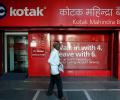
Kotak Mahindra Bank's net interest margin is likely to swell after the Reserve Bank of India (RBI) lifted its restrictions on the private lender that barred it from issuing fresh credit cards and onboarding new customers through digital mode, brokerages said on Thursday. The bank's net interest margin (NIM) has seen a decline of over 35 basis points (bps) since the restrictions were imposed by the regulator in April 2024.
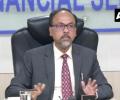
New India Assurance and Niva Bupa have invested in the Bima Sugam India Federation.

Benchmark Sensex bounced back from early lows and closed higher by nearly 376 points on Monday, snapping its four-day losing run following a rally in blue-chips ICICI Bank, HUL and HDFC Bank. The 30-share BSE Sensex rebounded 375.61 points or 0.46 per cent to settle at 81,559.54. The index opened lower and hit a low of 80,895.05 points in early trade.

From the 30-share Sensex pack, Adani Ports surged 6 per cent. NTPC, HDFC Bank, Bajaj Finance, Maruti and Axis Bank were among the other gainers. In contrast, Titan, State Bank of India, Asian Paints, Tata Consultancy Services, HCL Tech, Sun Pharma, IndusInd Bank and ICICI Bank were among the laggards.

Sebi on Thursday imposed a penalty of Rs 1 crore on HDFC Bank for invoking securities pledged by stock broker BRH Wealth Kreators in violation of the regulator's interim directions. In addition, the bank has been directed to transfer Rs 158.68 crore along with 7 per cent interest per annum into an escrow account till the issue of settlement of clients' securities is reconciled, Sebi said in an order. The instant proceedings have essentially arisen on account of non-conformity by HDFC Bank with the directions contained in the interim order issued by Sebi against BRH Wealth Kreators and other entities on October 7, 2019.

Tech Mahindra was the top gainer in the Sensex pack, rising around 4 per cent, followed by HDFC, Infosys, Bajaj Finserv, Asian Paints and Bajaj Finance. Nifty rose 229.15 points to 18,102.75.

Quarterly earnings from corporates, global trends, and trading activity of foreign investors will guide market sentiment this week, analysts said, adding that benchmark indices may face volatile trends. "The upcoming release of Q2 results will be closely watched, providing insights into corporate performance. "Meanwhile, the escalating tensions between Israel and Iran introduce a significant geopolitical risk, potentially leading to increased oil prices and market volatility.
HDFC was the top gainer in the Sensex pack, surging over 5 per cent, followed by M&M, L&T, Tata Steel, Bajaj Finance, HDFC Bank and Sun Pharma. On the other hand, IndusInd Bank, Hero MotoCorp, Bharti Airtel and Asian Paints finished in the red.
The mobile banking app of the largest private sector lender HDFC Bank, which has been under the regulatory lens for network outages, was down for an hour on Tuesday due to unspecified issues. The city headquartered bank said the issues were faced for an hour late in the morning on Tuesday and the same was resolved in an hour. It urged customers to use the net banking alternative to transact in the interim.
