
Among the Sensex constituents, Eternal, Tata Steel, Kotak Mahindra Bank, UltraTech Cement, Maruti Suzuki India, Sun Pharmaceuticals, Tech Mahindra, HDFC Bank, Tata Motors Passenger Vehicles, Infosys, Trent, Mahindra & Mahindra, Reliance Industries and HCL Technologies were the gainers. However, Asian Paints, Bharti Airtel, Bajaj Finance, PowerGrid, Axis Bank, ICICI Bank and Titan were among the laggards.
The merger of housing finance major HDFC with the country's largest private lender HDFC Bank will be effective from July 1, HDFC chairman Deepak Parekh said on Tuesday. The boards of HDFC and the private bank will meet on June 30 post to clear and approve the merger, Parekh told reporters in Mumbai. The merger of the corporation with HDFC Bank will be effective July 1, Parekh said.

Among Sensex firms, Bajaj Finance, ICICI Bank, Hindustan Unilever, Bajaj Finserv, HCL Tech and HDFC Bank were the major gainers. However, Maruti, Eternal, UltraTech Cement and State Bank of India were among the laggards.

While 28,141 applicants accepted internship in round one, in the second phase this was down to 24,638.
M&M was the biggest gainer in the Sensex chart, rising 6.51 per cent, followed by NTPC, PowerGrid, SBI, HDFC Bank, Asian Paints and Wipro. In contrast, Axis Bank, ITC, HUL, Nestle India and Sun Pharma were among the laggards.

Among Sensex firms, Bajaj Finance, Bajaj Finserv, Reliance Industries, HDFC Bank, Tech Mahindra and Axis Bank were the major gainers. However, Asian Paints, HCL Tech, Titan and Hindustan Unilever were among the laggards.

Among Sensex stocks, Tata Motors Passenger Vehicles, Trent, Infosys, Power Grid, HDFC Bank, HCL Tech, Kotak Mahindra Bank, ICICI Bank and Bajaj Finance were the major laggards. However, Bharat Electronics, State Bank of India, Tata Steel, Eternal, Bharti Airtel and Reliance Industries were the gainers.
From the Sensex pack, Tata Motors, NTPC, Bajaj Finserv, Power Grid Corp, Titan, Asian Paints, IndusInd Bank, Maruti Suzuki India and Tata Steel were among the biggest gainers. Sun Pharmaceuticals, ITC, Hindustan Unilever, Bharti Airtel, UltraTech Cement and Reliance Industries were among the laggards.

Sashidhar Jagdishan, managing director and chief executive officer of HDFC Bank, the largest private-sector lender of the country, has just completed his first term. The period October 2020-October 2023 was a roller coaster, and the second one, which started on October 27, could be more interesting as the lender absorbs the impact of the merger of HDFC, which was integrated on July 1, and moves to the next growth phase. Soon after he took over the reins from Aditya Puri on October 27, 2020, the Reserve Bank of India (RBI) debarred HDFC Bank from enrolling new credit card customers and launching new products under the Digital 2.0 programme due to repeated outages on its mobile-banking and internet-banking platforms.

Among Sensex firms, HCL Tech, ICICI Bank, Titan, Trent, Kotak Mahindra Bank, Hindustan Unilever, Mahindra & Mahindra and HDFC Bank were the major laggards. However, Adani Ports, Bharti Airtel, SBI, NTPC and Sun Pharma were among the gainers.
Having successfully executed the merger with parent HDFC, HDFC Bank's managing director and chief executive Sashidhar Jagdishan on Saturday said the country's largest lender aims to double every four years. In a letter to the over 4,000 employees from HDFC who joined the bank's rolls on Saturday, Jagdishan said the future is bright, and the work on realising the potential of the merger starts now. "The runway for financial services and mortgage, which are so underserved and under penetrated, is going to be very large. HDFC Bank - the combined entity - with a large and growing distribution and customer franchise, more than adequate capital, healthy asset quality and profitability, will be best positioned to capture growth.

From the Sensex pack, Eternal, Maruti Suzuki India, Kotak Mahindra Bank, Mahindra & Mahindra, Tech Mahindra, Titan, HDFC Bank, PowerGrid, Bajaj Finserv, HCL Technologies, Bajaj Finance and Larsen & Toubro were among the gainers. On the other hand, Tata Motors Passenger Vehicles, Asian Paints, UltraTech Cement, Bharat Electronics Ltd, Tata Steel, Adani Ports, Hindustan Unilever, ITC, Tata Consultancy Services and Reliance Industries were the only laggards.
In a mixed bag for HDFC Bank ahead of the parent HDFC's merger with itself, the Reserve Bank of India has declined to make exceptions on certain aspects, and has offered some leeway on others. The country's largest private sector lender, which is aiming to conclude the merger with the home finance major by July, had written to the central bank seeking certain forbearances after announcing the $40-billion merger in April last year. In an exchange filing this evening, HDFC Bank said it received a response from RBI on Thursday and also said that there are a few pending issues.

Among the Sensex firms, Power Grid, HDFC Bank, Kotak Mahindra Bank, Reliance Industries, NTPC, State Bank of India, Tata Steel and Bharti Airtel were the major gainers. Bajaj Finance, Axis Bank, HCL Tech and Mahindra & Mahindra were among the major laggards.
The country's most valuable lender HDFC Bank can perhaps no longer claim to be a favourite of foreign portfolio investors (FPIs). Two data indicators, both somewhat interconnected, point to this - the diminishing premium of HDFC Bank's American depositary receipts (ADRs) compared to local shares, and the ample investment opportunities available to FPIs in the domestic market. The ADR premium has shrunk to below 5 per cent, down from over 30 per cent in March 2021, and even lower than recent levels.

Sectoral funds, focused exclusively on public sector banks (PSBs), have delivered the strongest returns among domestic mutual fund (MF) categories over the past six months. However, active banking funds have significantly lagged because of their heavy tilt towards private lenders.

From the Sensex firms, Eternal, NTPC, Kotak Mahindra Bank, ICICI Bank, Bajaj Finserv, Power Grid, Trent and HDFC Bank were among the major laggards. However, Bharat Electronics, Larsen & Toubro, Tata Consultancy Services, ITC and State Bank of India were the gainers.
Shares of HDFC Bank will witness massive inflows totalling $600 million from passive trackers this week, predict analysts. This influx is attributed to the rebalancing activities in the S&B BSE Sensex and the Financial Times Stock Exchange (FTSE) indices. The Sensex is set for its quarterly rebalancing act on September 15 (date of adjustment), resulting in inflows of $102 million (approximately Rs 850 crore).
Among the Sensex shares, Infosys, Tata Motors, Axis Bank, Adani Ports, Mahindra & Mahindra, HDFC Bank, Larsen & Toubro, Tata Steel, BEL and Power Grid were among the lead gainers. Kotak Mahindra Bank, ICICI Bank, Bharti Airtel, Asian Paints, Bajaj Finserv, and Titan were the among the laggards.
Largest private sector lender HDFC Bank on Tuesday reported a 34 per cent jump in its standalone net profit to Rs 16,373 crore for the third quarter ended December 2023. The bank had earned a net profit of Rs 12,259 crore in the corresponding quarter of the previous fiscal year.

From the Sensex pack, Jio Financial Services fell the most by 4.99 per cent. Reliance Industries, Power Grid, Larsen & Toubro, JSW Steel, HCL Technologies, NTPC, Tata Steel, Wipro, Tata Consultancy Services and HDFC Bank also declined. IndusInd Bank, Infosys, UltraTech Cement, ICICI Bank, Nestle and Axis Bank were among the gainers.

The Reserve Bank of India (RBI) on Tuesday announced a fresh round of liquidity measures through open-market operations (OMOs) and a foreign exchange buy-sell swap, under which it will inject close to Rs 3 trillion into the banking system. The central bank said it would purchase Government of India securities worth Rs 2 trillion through OMOs, spread across four tranches of Rs 50,000 crore each to be conducted on December 29, January 5, January 12 and January 22.

Among Sensex firms, Bharti Airtel, Reliance Industries, Eternal, State Bank of India, Tata Steel and HDFC Bank were the major gainers. However, Kotak Mahindra Bank, Bharat Electronics, Infosys and Bajaj Finance were among the laggards.
This will be the lender's first result after its merger with HDFC Ltd, effective from July 1, and will keep analysts glued to the management's earnings growth guidance for the merged financial behemoth.

The pickup was driven partly by fresh corporate investment but more by higher working-capital demand.
The Securities Appellate Tribunal (SAT) has quashed a Sebi order against HDFC Bank, whereby the regulator had imposed a penalty of Rs 1 crore on the lender in a case pertaining to invoking securities pledged by stockbroker BRH Wealth Kreators. In addition, the regulator had directed to transfer Rs 158.68 crore along with seven per cent interest per annum into an escrow account till the issue of settlement of clients' securities is reconciled. These directions were issued by Sebi in January 2021 as HDFC Bank invoked securities pledged by BRH Wealth Kreators in violation of the regulator's interim order passed in October 2019.
HDFC Bank has reshuffled the portfolios of its senior management team. This is the first major rejig after the amalgamation of HDFC Ltd on July 1. "The runway for our growth is large. This change is being done to bring in a very sharp focus on leveraging what we have built and for enhanced execution," said Sashidhar Jagdishan, managing director and chief executive of HDFC Bank, explaining the reason for this overhaul.

The Reserve Bank of India (RBI) has given HDFC Bank six months to migrate HDFC's home loan customers to external benchmark linked lending rate (EBLR), top sources in the bank told Business Standard. Almost half of HDFC's 5.4 million customers are home loan customers. It is mandatory for banks to link retail loans and loans to micro, medium and small enterprises to an external benchmark. Non-banking financial companies do not have such a mandate.
With the merger between HDFC Bank and HDFC Ltd complete, analysts said the next key monitorable for the Street would be successful resolution of merger-related hiccups, including employee-related churn and roll out of complete banking services across branches. At the bourses, they expect the stock to perform in-line with the benchmark indices in the near-term. "There's usually an initial period of consolidation after a merger as the entities work towards integration.

Among the 30 Sensex companies, JSW Steel, Tata Steel, Axis Bank, Reliance Industries, ICICI Bank, Hindustan Unilever, Kotak Mahindra Bank and Asian Paints were among the biggest gainers. In contrast, Mahindra & Mahindra, Sun Pharma, NTPC, Wipro, State Bank of India and Power Grid were among the laggards.
HDFC Bank on Monday reported a consolidated net profit of Rs 16,811 crore for the September quarter, its maiden quarterly earnings announcement after merging parent HDFC with itself. On a standalone basis, the largest private sector lender reported a net profit of Rs 15,976 crore. In the year-ago period, the net profit of the merged entity would have been Rs 11,162 crore on a consolidated level while the same on a standalone basis would have been Rs 10,606 crore.
Weakness in HDFC Bank's net interest margin (NIM) might have bottomed out in the July-September quarter (Q2-FY24), analysts said on Tuesday, as most of the merger-related one-time adjustments have been done. The bank, they believe, should be able to grow from here on, allowing the stock to reverse its underperformance. "The weak NIM print was not unexpected given the merger and regulatory impact caused by the incremental cash reserve ratio (ICRR; 5-10 bps for the quarter).

From the Sensex firms, Kotak Mahindra Bank, Titan, Axis Bank, Adani Ports, Mahindra & Mahindra, Reliance Industries, Tata Motors and HDFC Bank were among the major gainers. However, Eternal and Infosys were the laggards.
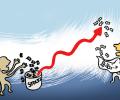
Foreign portfolio investors (FPIs) sold shares worth Rs 20,170 crore ($2.4 billion) recently. This marked the fifth-highest weekly outflow from overseas funds since the beginning of 2008 and the largest since the last week of March 2020. Due to the Covid scare, FPIs had sold shares worth Rs 21,951 crore during that week, causing the market to decline by nearly 20 per cent.

Among the Sensex firms, State Bank of India, Maruti Suzuki India, Axis Bank, NTPC, BEL, Adani Ports, Eternal, Sun Pharmaceuticals, Power Grid, ITC, UltraTech Cement, Trent, HCL Technologies, Mahindra & Mahindra, and HDFC Bank were the major gainers. On the other hand, Tata Steel, Tata Consultancy Services, Tech Mahindra, Titan, Bajaj Finserv, Tata Motors, Bharti Airtel and Bajaj Finance were among the laggards.

Banks and NBFCs are launching festival offers, including lower loan rates, cashback, EMI schemes and GST-linked benefits to tap rising demand ahead of Diwali

After a subdued first quarter of 2025-26 (Q1FY26), banks are now betting big on the festive season, rolling out attractive loan offers to boost credit growth in the second half of the current financial year (H2FY26) - a trend likely to be further accentuated by the second-order effects of the good services tax (GST) cuts.
HDFC Bank Q4 review: HDFC Bank's January-March quarter (Q4) results, for financial year 2022-23 (FY23), brought no cheer to investors as elevated costs, and merger-related uncertainties continue to dent the sentiment. Moreover, analysts fear that merger-related costs may put pressure on margins and cost to income ratio in the near-term, while the return on equity could moderate owing to low leverage of the parent. Analysts, therefore, opine that the stock's re-rating may be some time away. "While the risk of a de-rating on a standalone basis appears to be quite low given that the business performance is holding up well, we believe a re-rating in the stock would happen as and when more clarity emerges on the smooth transition (merger)," said a report by Sharekhan.

The banking, financial services and insurance (BFSI) sector has moved back into focus for investors this calendar year, after lagging the broader market for two consecutive years. BFSI stocks have outperformed benchmark indices in 2025 so far, driving a steady rise in the sector's weighting within the Nifty 50 index.
ICICI Bank has reversed its decision to raise the minimum monthly average balance (MAB) for new savings accounts in metro and urban locations to Rs 50,000, revising it instead to Rs 15,000, effective August 1. The MAB for new savings accounts in semi-urban locations has been revised from Rs 25,000 to Rs 7,500, and for rural locations from Rs 10,000 to Rs 2,500.
