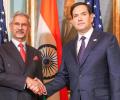
This will be the first face-to-face meeting between Rubio and Jaishankar following President Donald Trump's imposition of an additional 25 per cent tariff on India for Delhi's purchases of Russian oil, taking the total levies imposed on India by the Trump White House to 50 per cent.

The US has received sufficient number of applications needed to reach the Congressionally mandated 65,000 H1-B visa cap for the fiscal year 2023, the country's federal agency for immigration services said on Tuesday. The H-1B visa is a non-immigrant visa that allows US companies to employ foreign workers in speciality occupations that require theoretical or technical expertise. Technology companies depend on it to hire thousands of employees each year from countries like India and China.

A US Homeland Security official says America will continue using the H-1B visa programme, emphasizing integrity and vetting, while highlighting increased naturalization rates under the Trump administration.
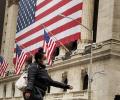
In a huge relief for H-1B visa holders, a White House-backed bipartisan deal has been unveiled under which automatic work authorisation would be granted to about 100,000 H-4 visa holders, who are spouses and children of a certain category of H-1B visa holders. The National Security Agreement that was announced on Sunday after long negotiations between the Republican and the Democratic leadership in the US Senate also provides a solution to about 250,000 aged-out children of H-1B visa holders. The move comes as good news for hundreds and thousands of Indian technology professionals who are waiting in a painstakingly long wait for a Green Card, in the absence of which their spouses cannot work and their aged-out children face the threat of deportation.
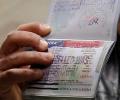
US lawmakers have expressed concerns that policies enacted by the Trump administration, such as the H1B visa fee and tariffs on India, are detrimental to American businesses and threaten the relationship between the United States and India.
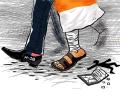
India's $280-billion IT industry heads into 2026, balancing visa-related headwinds and global trade uncertainty against its biggest-ever push into artificial intelligence and the rapid expansion of global capability centres (GCCs). Heightened scrutiny of the US H-1B visa programme - including a proposed $100,000 fee for new visas and concerns over a potential 25 per cent outsourcing tax - has complicated cross-border delivery for Indian firms, even as companies accelerate efforts to reduce reliance on onsite staffing.

Ramaswamy's stance on H-1B visas is reminiscent of the 2016 Trump campaign, when then-candidate Donald Trump, who has also hired a number of foreign workers under H-1B visas for his businesses, took a hardline stance on these foreign workers before later softening his rhetoric.

Ayan Pramanik and Shivani Shinde Nadhe report on the uncertainties that have dragged down shares of TCS, Tech Mahindra and HCL Technologies.
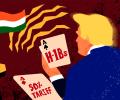
The US government will fight lawsuits aimed at blocking the USD 100,000 fee imposed on new H-1B visa petitions, asserting that the system was spammed with fraud and must be overhauled to prioritise American workers.

From the 30-Sensex firms, Tata Steel, Asian Paints, Trent, State Bank of India, Hindustan Unilever, UltraTech Cement, ICICI Bank and Bharti Airtel were among the gainers. On the other hand, Infosys, Bajaj Finance, Bharat Electronics, Larsen & Toubro and HDFC Bank were the laggards.

The share of Indian students pursuing OPT has nearly doubled from 22.12 per cent in 2006-07 to over 40 per cent in 2023-24.

'I expect IT stocks to trade lower for some time. They are unlikely to make money for investors.'

If the Indian government is indeed serious about reversing brain drain, it needs to put much more emphasis on research and innovation, especially in areas that will determine the future, asserts Prosenjit Datta.

The magnitude of the new H-1B visa application fee for fresh petitions - math of which works out to USD 500 million in case of 5,000 filings - may nudge IT companies to expand offshore delivery or increase local hiring, according to Motilal Oswal Financial Services.

The US has received enough petitions needed to reach the Congressionally-mandated 65,000 H-1B visa cap for the fiscal year 2021 and successful candidates for the most sought-after work visa among foreign professionals, including Indians, would be decided by a computerised draw of lots. The H-1B visa is a non-immigrant visa that allows the US companies to employ foreign workers in speciality occupations that require theoretical or technical expertise. The technology companies depend on it to hire tens of thousands of employees each year from countries like India and China.

India is a global leader in software development services, IT enabled services, knowledge process outsourcing services and contract R&D services relating to software development, Sitharaman said noting these business segments are quite inter-connected with each other.

US lawmakers have urged President Donald Trump to reconsider his proclamation on H1-B visas, including the USD 100,000 fee, asserting that Indian nationals are central to American leadership in IT and AI, and the restrictions will negatively impact US-India ties.
Shares of information technology (IT) companies were in demand on Friday, with the National Stock Exchange's (NSE's) Nifty IT index rallying 3.3 per cent on . This came after Infosys reported steady sequential growth, driven by health care boost and large deal rampup in a seasonally weak quarter (Q3FY26).

The US has received enough electronic applications during the initial registration period to reach the 2022 fiscal year cap for the H-1B foreign workers visa, the most sought-after work visa among Indian professionals. The US Citizenship and Immigration Services, the federal agency which screens and allocates H-1B applications, said it was randomly selected from among the registrations properly submitted to reach the cap. The H-1B visa is a non-immigrant visa that allows the US companies to employ foreign workers in speciality occupations that require theoretical or technical expertise. The technology companies depend on it to hire tens of thousands of employees each year from countries like India and China.

Immigration attorneys and companies are advising H-1B visa holders to return to the US immediately due to concerns over President Trump's plan to impose a USD 100,000 fee on the work visas.

An influential immigration advocacy group representing Indian-Americans on Thursday urged the Biden administration not to issue the most sought-after H-1B work visa to any individual born in India, till the time the discriminatory country-cap on green cards or permanent legal residency is removed. The current per-country cap on issuing of green cards in the US has resulted in Indian professionals, mostly from the IT sector, having to wait for decades for their legal permanent residency. Issuing new H-1B visas to more Indians would add to this agonising painful wait for green cards, Immigration Voice said in a statement.

The US President said that companies have to bring people to "get those plants opened, we want you to do that, and we want those people to teach our people how to make computer chips and how to make other things."

Gor also announced that India will be a member of the Pax Silica alliance.

Indian-American executive Srini Gopalan has been appointed chief executive officer of telecom operator T-Mobile, amid ongoing debates over H-1B visa policies. Gopalan's appointment, effective from November 1, 2025, comes as US President Donald Trump signed a proclamation imposing a staggering $100,000 fee on new H-1B visas, triggering widespread panic, concern and fear among Indian professionals on work visa.

According to Republican Senator Charles Grassley and Democratic Senator Richard Durbin, more companies are now using H-1B visas to displace qualified American workers.
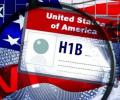
The H-1B visa is a non-immigrant visa that allows US companies to employ foreign workers in speciality occupations that require theoretical or technical expertise.

In the past five years, the US has seen nearly two dozen Bills on employment visas introduced without success. But this time it is different, industry sources tell Ayan Pramanik.

Nasscom on Monday said the US clarification that the H-1B visa fee hike will not affect current visa holders and will apply as a one-time fee only to fresh petitions has helped address the immediate ambiguity surrounding eligibility and timelines.

A deep dive into Trump's new policy and what it means for Indian professionals and companies.
Even as the strong anti-outsourcing lobby in the US is forcing US lawmakers to take a relook at their H1-B visa strategy amid huge job losses, Infosys Technologies which holds the largest number of H1-B visas among all the Indian IT services companies has started reducing the number as a part of the company's policy to reduce its 'overseas bench' strength.
The US has received enough petitions needed to reach the congressionally mandated 65,000 H-1B visa cap for the fiscal year 2022, a federal agency has announced. The H-1B visa is a non-immigrant visa that allows US companies to employ foreign workers in speciality occupations that require theoretical or technical expertise. Technology companies depend on it to hire tens of thousands of employees each year from countries like India and China.

India has expressed concerns over the potential humanitarian consequences of the Trump administration's new restrictions on the H1B visa program, particularly the disruption to families. The government hopes the US authorities will address these issues.

Amid headwinds across global markets, US issues fresh restrictions on H-1B visas. Ayan Pramanik & Raghu Krishnan list out the many ways in which this impacts the Indian IT industry.

'...are young Indians with aspiration to go to the US.' 'The dream has to be more about working in India...'

The decision to hike US H-1B visa application fee to $100,000, trade talks and the GST rate cut will be the key drivers for stock market movement this week, analysts said.

With discretionary spending still under pressure, the information technology (IT) services industry continued to face an uncertain demand environment in the third quarter of 2025-26 (Q3FY26).
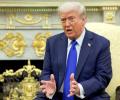
The US Representative criticised the administration's new USD 100,000 fee on H-1B visas, observing that Indians hold 70 per cent of these visas and saying the change directly harms workers who have long supported US innovation across technology, science and medicine.

Among Sensex firms, Trent, Power Grid, Tata Motors, Tata Consultancy Services, Asian Paints, NTPC, Adani Ports and Bajaj Finance were the laggards. However, Bharat Electronics, Axis Bank and Bharti Airtel were the major gainers.
In a big relief for thousands of stranded Indian professionals in America due to the coronavirus pandemic, the US government has decided to allow applications by H-1B visa holders for an extended stay in the country. The US department of homeland security in a new notification has said it recognises that there are immigration-related challenges as a direct result of the coronavirus pandemic.
 © 2026 Rediff.com - Advertise with us - Disclaimer - Privacy Policy - Sitemap - Feedback - About us - Terms of use - Grievances