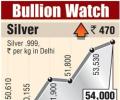
Traders said sluggish demand at prevailing higher levels amid a weak trend in Asian region mainly led to decline in gold prices while increased industrial demand helped silver to trade higher.
Gold-silver ratio indicates more upsurge possible for the white metal.

A report from the World Gold Council says that rising demand for luxury goods from India and China may drive the gold prices to a new peak in the next year.

In Singapore, gold prices have risen by 0.46 per cent to $ 1,294.20 from $ 1,288 per ounce in last one fortnight.
According to the latest statistics from the Association of Mutual Funds of India, gold ETFs have lost 18 per cent of their investor base since May.

Traders said stockists selling against fall in demand at prevailing higher levels mainly pulled down gold prices.

On the domestic front, gold of 99.9 and 99.5 per cent purity fell by Rs 30 each to Rs 28,445 and Rs 28,245 per 10 grams, respectively after gaining Rs 655 in last three days. Sovereigns, however, remained stable at Rs 24,400 per piece of eight grams in restricted buying activity.
Let's take a look at some commodities and see how they are expected to perform in the next two years.
Govt raises import duties again, misses the point.

Marketmen said emergence of low level buying by stockists and retailers for the wedding season amid a firm global trend mainly helped gold prices to rebound.
Gold has lost some lustre over the past year and this is unlikely to return so soon, resulting in erosion of interest among investors.

Industry estimates over 30 tonnes of gold were sold on Akshaya Tritiya this time.

Such an economic environment tends to be positive for gold, the ultimate safe-haven asset. Since gold cannot be debased by central banks, it naturally gains in value.
Gold demand fell 15 percent in 2013 as huge outflows from physically backed investment funds outweighed record consumer demand, but that heavy disinvestment is tailing off this year, pointing to a recovery, the World Gold Council said.
Gold demand fell 15 percent in 2013 as huge outflows from physically backed investment funds outweighed record consumer demand, but that heavy disinvestment is tailing off this year, pointing to a recovery, the World Gold Council said.

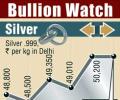
However, silver rose for the third straight session by adding Rs 375 to Rs 48,800 per kg on increased offtake by industrial units and coin makers.
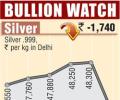
Traders said stockists booking profits at prevailing higher levels following a rise of Rs 350 against sluggish demand mainly kept pressure on gold prices.

Gold prices are already moving fast to the key level of Rs 30,000 per 10 gms

Traders said buying activity in gold picked as stockists enlarged their positions for the rising wedding season demand.
Gold prices in Mumbai hit a five-month low at Rs 8,800 (99.5) and Rs 8,850 (99.9) per 10 gram on Thursday following a decline in the global prices and falling demand in the domestic market.
Extending gains for the fifth straight session, gold prices on Thursday rose by Rs 30 to Rs 26,830 per 10 grams in the national capital on increased buying by stockists and investors on the back of rising demand amid a firming global trend.

Traders said fresh buying by stockists and jewellers to meet the coming 'Navratras' and marriage season demand amid a strong global trend mainly led the recovery in gold prices.

The import tariff value -- base price at which customs duty is determined to prevent under-invoicing -- is revised on a fortnightly basis.

Silver managed to recover some grounds.

Silver also fell by Rs 400 to Rs 41,000 per kg on poor offtake by industrial units and coin makers.
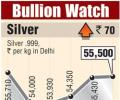
Silver also rose for the third day by adding Rs 70 to Rs 55,500 per kg on increased offtake by industrial units and coin makers.

Spot gold was bid lower at $ 1,298 an ounce in early European trade.

Global gold demand hit an 11-year low in 2020 at 3,759.6 tonnes, mainly due to a weak October-December quarter and the COVID-19 related disruptions across the world driving a muted consumer sentiment throughout the year, the World Gold Council (WGC) said in a report. The overall consumer demand during 2019 was at 4,386.4 tonnes, while in 2009 the overall demand was at 3,385.8 tonnes, according the WGC's 2020 Gold Demand Trends report. Global gold demand dropped by 28 per cent year-on-year (YoY) to 783.4 tonnes in the fourth quarter compared to 1,082.9 tonnes during the October-December period of 2019, the report stated.
The precious metal spurted to regain Rs 27,000 level after June 24 as it rose in global markets following Federal Reserve Chairman Ben S Bernanke backed sustained stimulus for the for some time.

The government on Wednesday hiked the import tariff value on gold and silver to $431 per 10 grams and $646 per kg, respectively, taking firm global cues.

The price of gold in India seems to have bottomed out.

Silver, however, fell for the third straight session by losing Rs 200 to Rs 43,800 per kg on lack of buying support from coin makers and industrial units.
In our view, gold is a must in every portfolio. However, the extent to which you should be invested in it should depend on your overall asset allocation.

However, silver snapped two-day rising trend and declined by Rs 215 to Rs 49,100 per kg on reduced offtake at prevailing higher levels.

Extending losses for the third straight day, gold prices dropped Rs 220 to Rs 31,710 per ten gram in New Delhi on Wednesday on sustained selling by stockists amid sluggish demand coupled with weakening global trend.
Traders said increased buying of gold by stockists and jewellers to meet the rising festive and marriage season demand, amid firming global trend, influenced the sentiment.
Riding high on a firm trend in overseas market, gold prices today added Rs 610 to touch an all-time high of Rs 25,840 per 10 grams, as the turmoil in global financial markets increased the metal's demand as protection on wealth.
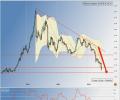
Ratio trading in gold and silver prices is a trading tool.

The total market capitalisation of BSE-listed companies fell by Rs 1.36 lakh crore to Rs 93.33 lakh crore.
While choosing this, approach local jewellers to avoid high deductions by branded jewellers.
 © 2026 Rediff.com - Investor Information - Advertise with us - Disclaimer - Privacy Policy - Sitemap - Feedback - About us - Terms of use - Grievances