
The country received FDI of $14.6 billion during April-August 2008 against $6.5 billion a year ago. The FDI target for 2008-09 is 35 billion dollar, while the actual inflows during the previous year were $24.57 billion.

While a coordinated aggressive monetary easing from the central banks is most likely to offer some respite in the near-term, it is unlikely to improve the sentiments.

VIX is meant to indicate investors' perception of the annual market volatility over the next 30 calendar days. The higher the value, the higher is the expected volatility and vice versa. VIX touched its historical peak of 85.13 on November 17, 2008, in the aftermath of the collapse of Lehman Brothers. In the past five years, it has stayed below 30.
In fact, only two out of India's top five export destinations witnessed an increase in exports during the period. Total exports from the country had expanded 17.5 per cent during the period and stood at $118.25 billion.
The rupee has given the economy a roller coaster ride for nearly two years now, relegating the stability of 2006 to a distant dream.
The economy contracted by 1.5 per cent between October and December, more than the quarterly declines seen during the recession in the 1990s. The last quarter decline came on top of a 0.6 per cent slump in the third quarter of 2008. Two or more consecutive quarters of contraction are regarded as a recession.

To be able to tide over the current crisis, automobile manufacturers have waged a war against all cost heads.
Billions of dollars, pounds and euros may have been lost in the global financial crisis, but most of Europe's leading soccer clubs are still poised to spend big when the winter transfer window opens on New Year's Day. Manchester City have been linked with more than 50 players in the build-up to January 1 including Thierry Henry and Lionel Messi of Barcelona, Kolo Toure of Arsenal and Roque Santa Cruz of Blackburn Rovers.
At malls, the owners are facing problems to attract customers but at the same time the shopkeepers are expecting to generate good business in the coming days. Kishore Biyani-led Future Group that owns Big Bazaar, has seen good business because of its on-going festival - 'The Great Indian Shopping Festival' at the mall.
Flavio Briatore will leave Formula One in two years, the Renault team boss said on Saturday. Briatore also hailed Formula One's agreement to cut costs during the global financial crisis.
For those of you looking to migrate to the Australia, this is not a good time, as the global financial crisis has left job seekers searching for opportunities.
The various associate banks for which SBI is looking to recruit the staff include State Bank of Bikaner and Jaipur, State Bank of hyderabad, State Bank of Mysore, State Bank of Indore, State Bank of Patiala and State Bank of Travancore. There are more than 1,000 vacancies each with State Bank of Hyderabad, State Bank of Patiala and State Bank of Travancore.
Prime Minister Manmohan Singh on Sunday said he expected India's economy to grow by a healthy 7 to 7.5 per cent in 2009, despite the global financial crisis eroding output across sectors."Due to the current financial crisis, growth rate may come down somewhat next year, but I am still confident that we will be able to achieve a rate of between 7-7.5 per cent," he said while addressing the Indian community in Oman.
Raghuram Rajan, the PM's honorary economic advisor, said in 2006, 'It is important for India to exchange its paternalistic, directive government, which seeks to remedy every wrong through a subsidy, a quota, or a scheme, for one that creates an enabling environment for the people and unleashes their entrepreneurial zeal.' Two years later, his words seem prescient. But how much of what he says should be done will be done by the government in the limited tenure it has left.
This will be the first such deal since the global financial crisis caused the Indian stock markets to crash a record 23 per cent in October.
Few market participants will stick their neck out to give a target for the Sensex during Samvat 2065, a stark change from the last year, which reflects the overall mood in the Indian equity markets.
Oil producer ONGC on Friday said the fall in international oil prices would not change the company's bid for acquisition of UK-listed Imperial Energy.
Gold prices zoomed to an all-time high of Rs 13,850 per 10 gram in the national capital on Wednesday as plunging stock markets and deepening global financial crisis spurred demand for the metal as a safe hedge.
"We can end this year with a growth rate of 8 per cent. I am confident that in 2009-10, the growth rate will bounce back to 9 per cent," said the finance minister said.

By the end of the June quarter, the top four - TCS, Infosys, Wipro and HCL Tech employed 10,15,000 employees - down by 9,144 employees over the previous quarter.
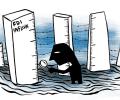
Foreign Direct Investment into India rose by 13 per cent in 2020, boosted by interest in the digital sector, and while fund flows "declined most strongly" in major economies such as the UK, the US and Russia due to the Covid-19 pandemic, India and China "bucked the trend", the UN has said.
Sensex crashed more than 1,000 points in opening trade. Asian stocks plunged too on Friday.
Given the developments, analysts expect fiscal and monetary support from the government and RBI to revive sentiment. However, recovery, they say, from these levels will be slow and painful.

The Indian regulatory framework forced Citi to hibernate -- contrary to the claim that it never sleeps!

The government may have to resort, eventually and however unwillingly, to printing money, abandoned as policy and practice in the 1990, predicts T N Ninan.

Gold, which was hovering around $1,321 an ounce in January 2019, has already breached $1,600 per ounce in the past few sessions to a seven-year high.

The new IIP series based on the new base year, is expected to lead to better capturing of ground data

the 2015 figure also showed how developers had absorbed some of the increased holding costs.
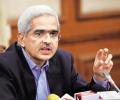
Softening inflation, Das said would make available more policy space to the central bank to address risks to the growth going forward.
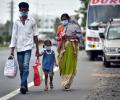
The year 2020 could see the worst global economic fallout since the Great Depression in the 1930s, with over 170 countries likely to experience negative per capita income growth due to the raging coronavirus pandemic, IMF Managing Director Kristalina Georgieva said on Thursday. Georgieva made the remarks during her address on 'Confronting the Crisis: Priorities for the Global Economy' in Washington, DC, ahead of next week's annual spring meeting of the International Monetary Fund and the World Bank.

History would indicate that a recession is not that far off.

In 2009, the UPA government, had announced a slew of measures to boost liquidity in NBFCs. These included a scheme for providing liquidity support to NBFCs having assets size of over Rs 100 crore through a SPV.

Industry players said they were indeed seeing a serious fall in capacity usage, though some sectors were seeming to prevent further fall in the overall capacity utilisation.

'The book captures Rana Kapoor's hunger for real estate leading to bungalows in Delhi, Mumbai, London and other cities; the multiple companies -- over 100 -- to fund his family's various ventures; the attempt to game the system by showing lower non-performing assets,' notes Joydeep Ghosh.

What do the fluctuating gold-silver price ratio portend?

'Without appropriate supervisory constraints in place, banks are in a position to delay the recognition of losses and engage in ever-greening or zombie lending, which is essentially the rolling over of debts of unviable borrowers that would have otherwise defaulted,' points out RBI Deputy Governor Viral Acharya.

When asked if he sees himself back in Chicago, he said, "Yeah, Chicago has been kind to me over my history".

Both the Asian giants were among the top three countries spending more on armaments, according to a new report by the Stockholm International Peace Research Institute.
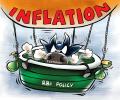
RBI Governor Shaktikanta Das on Friday said that inflation is on a declining trajectory, as it has fallen by 170 basis points from its January 2020 peak. Retail inflation fell to four-month low of 5.91 per cent in March over the previous month, mainly due to easing food prices.

India attracted an estimated $49 billion FDI in 2019, a 16 per cent increase from the $42 billion recorded in 2018.
 © 2026 Rediff.com - Advertise with us - Disclaimer - Privacy Policy - Sitemap - Feedback - About us - Terms of use - Grievances