
Markets face risk of a prolonged bear phase as oil shocks and geopolitical tensions test inflation, growth and investor confidence globally, points out Debashis Basu.

'When we start describing somebody as an enemy that is the start of politics and emotion after which no business can take place.' 'We need to get out of this, allow Indian businessmen to do business with China.'

India should not stay on the margins of this initiative. There should be a serious debate about what would be in India's best interests asserts former foreign secretary Shyam Saran.

Do not get trapped in the fear-and-greed cycle. Let time and discipline do the heavy lifting, points out Harsh Roongta.

What is the reason behind this drying up of talent for the top post in private banks?

If the conflict continues for a prolonged period, State-run oil companies may have to review retail fuel prices accordingly.

Dubai's core promise -- that it is an oasis untouched by regional storms -- has been tested in full public view. The coming months will show whether investors view the attacks as a short-lived disruption or a deeper signal of lasting risk, points out Asif Ullah Khan.

Is the parabolic rise in silver running out of steam or just getting started? Ramalingam Kalirajan offers his take on if you should invest in silver now?

When it comes to multibagger stocks, patience trumps market timing. Investors who stay invested in fundamentally strong stocks build wealth in the long term, and investors who wait for perfect entry points usually end up confused, late, or out of the market. Here, we will explore the role of patience in multibagger stock investments.

There are vexing questions around the disconnect between Nifty returns and portfolio returns, between economic growth and earnings growth, and finally, between earnings growth and market returns, points out Debashis Basu.

'An asset must generate income. Equities yield dividends, bonds pay coupons, deposits give interest, and real estate earns rent.' 'Gold, silver, and even Bitcoin produce no income, they merely store value. So, they should not be compared to productive assets.'

'The informal sector can grow at a 100 per cent rate -- we have to plan big.'

These changes certainly bring India's GST a lot closer to what an ideal GST would look like, points out Karan Bhasin.

Breaking his silence after nine years, Vijay Mallya said he may return to India if assured a fair trial.

The big risk is a possible repeat of what happened in 1996: Projects that are halfway to completion, or companies that are stuck with cash flow issues on businesses that are yet to reach break even, will run out of cash.

'We will be able to anticipate the full picture of the impact after August, which is also the time when demand for a year begins to peak ahead of the December holidays and Valentine's Day.'

Trump is confident the US will eventually emerge the winner from whatever turmoil his policies cause, notes T T Ram Mohan.

Data since 2005 show that the five years with the highest rainfall saw average market returns of 8.98 per cent, while the five driest years returned 25.7 per cent on average.

'Investors should continue with their SIPs, especially during market corrections.' 'For those looking to start new SIPs, beginning with large-cap funds is a prudent strategy, followed by flexi-cap and value-oriented approaches.'

Global fund managers witnessed one of their largest-ever declines in assets under custody (AUC) during the ongoing correction in the Indian markets, as stocks came under pressure from foreign outflows and the weakening rupee.

In response to the panic triggered by Trump's trade policies, the RBI net sold approximately $43 billion in the second half of FY25 to curb volatility, as the rupee plunged to a low of 87.95 per dollar in February this year.

Why try to time the market when time in the market works better? History shows that patient investors who stay the course often walk away with the real rewards, says Ramalingam Kalirajan.

The controlling shareholders of smaller and mid-sized companies are reducing their stakes at levels seldom seen since the 2008 global financial crisis. Over 20 per cent of companies listed on BSE MidCap and BSE SmallCap have seen a decline in promoter holdings for five consecutive quarters, reveals data from DSP Mutual Fund, shared with Business Standard. In the latest June quarter, the figure stood at 22.6 per cent.
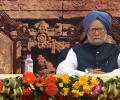
'He will be remembered more for what he did as finance minister -- as someone who functioned well when the political fallout was taken care of.'
The various official growth forecasts for the year have moved from 8 per cent-plus to 8 per cent-minus, with only the pessimists saying it will fall to as low as 7 per cent -- which the country can live with in a downturn.

The ideal time to invest in sector funds, is during a downturn so that investors can capitalise on a turnaround in 1.5 to 2 years.

Union Finance Minister Nirmala Sitharaman on Friday tore into United Progressive Alliance accusing it of economic mismanagement during the 2008 global financial crisis, saying the Congress put the 'first family first' and brought the economy down to 'fragile five'.

Households are likely to remain the primary net lenders to the economy in the coming decades.

'Mrs Gandhi had nothing to do in the day-to-day working of Dr Singh's government.' 'People say Mrs Gandhi's office used to give orders, which is nonsense.'
The reality is that this is an unprecedented time, and the environment far murkier than usual. While a trading rally is clear, it is to my mind premature to make any statement beyond that. While it is probably dangerous to have very high cash levels, I find it difficult to be fully invested, either, says Akash Prakash.

'The race is now on for Indian IT firms to develop their AI prowess and focus on a software-first approach to services as the people element becomes more complicated with Trump's expected new regulations.'

Whether she will pare the fiscal deficit target of 5.1 per cent of GDP, using the record dividend received from the RBI, or expand flagship government programmes will be keenly watched.
In the ongoing World Economic Forum, Kamal Nath asserted that US recession will not slow down India's economic growth.

Unemployment has been rising among the young, with authorities suspending data disclosures after youth unemployment crossed 20 per cent.

US's terrible political and economic leadership will ultimately cost the dollar its value. India must act early to avoid being dragged down, suggests R Jagannathan.

'...similar to the 2008 global financial crisis, the 2012 taper tantrum, or the 2018 midcap crash.' 'This could lead to a substantial decline in activity and revenues for the broking industry.' 'When this will happen is uncertain, but as brokers, we must be prepared for such a downturn.'

There was no smooth surge in middle class prosperity for foreign businesses to tap into because of the Indian economy was mismanaged, argues Debashis Basu.

'The prime minister's comment on 'revdi culture' was welcome. But I am disappointed he did not follow up on that.' 'All political parties, including the BJP, have been guilty of this.' 'Now, Modi's guarantees, the Congress's 'nyay' path and both ruling and Opposition parties are vying with each other for freebies in my home state Andhra Pradesh.'

Of the eight RBI governors who have held office since the 1991 economic liberalisation, Bimal Jalan had the longest stint and S Venkitaramanan, the shortest. Current Governor Shaktikanta Das will overtake Bimal Jalan before completing his second term in December, points out Tamal Bandyopadhyay.

Finance Minister Nirmala Sitharaman will present her sixth straight Budget ahead of the Parliamentary elections, matching the record of former Prime Minister Morarji Desai. Sitharaman in her pre-election Budget, which technically is a vote on account and popularly termed an interim Budget, will seek Parliament's nod for a grant in advance to meet the central government's essential expenditure for the first four months of the new fiscal year that starts in April. A new government elected after the April/May general elections will present the full Budget, likely in July.
 © 2026 Rediff.com - Advertise with us - Disclaimer - Privacy Policy - Sitemap - Feedback - About us - Terms of use - Grievances