
India's gross domestic product (GDP) growth slowed to 4.1 per cent in January-March 2022 period, while for the full year 2021-22 the growth stood at 8.7 per cent, according to the government data released on Tuesday. GDP at constant (2011-12) prices in Q4 2021-22 is estimated at Rs 40.78 lakh crore, as against Rs 39.18 lakh crore in Q4 2020-21, showing a growth of 4.1 per cent, as per the National Statistical Office (NSO) data. India's GDP growth has slowed for the third straight quarter.

The average cost of data breaches in India reached $2.18 million in 2023, marking a 28 per cent increase since 2020, according to the Reserve Bank of India's (RBI) Currency and Finance report for 2023-24. The report said that India's average data breach cost was still below the global average. The most common attacks in India are phishing which was at 22 per cent and stolen or compromised credentials was 16 per cent. The automotive industry is highly vulnerable to cyber attacks, whereas the banking and financial services sector, benefiting from stringent regulations, enjoys comparatively stronger protection.

Citing the massive surge in Omicron infections and the resultant impact on overall economic activities in the March quarter, Swiss brokerage UBS Securities has revised downwards its India's growth forecast for the current financial year to 9.1 per cent from 9.5 per cent earlier. However, UBS Securities does not see the third wave impact extending to the next financial year as it has revised upwards its real GDP forecast to 8.2 per cent, up from 7.7 per cent earlier, expecting the real GDP growth to remain well above the historical average. The World Bank pegs it at 8.3 per cent, unchanged from its June assessment, saying the recovery is not broad-based yet.

Among the 30 Sensex companies, Mahindra & Mahindra, Power Grid, Sun Pharma, Nestle, UltraTech Cement, NTPC, ITC, ICICI Bank, Titan, Bajaj Finserv, Bharti Airtel, and HDFC Bank were among the biggest gainers. IndusInd Bank, Adani Ports, Tata Steel, Reliance Industries, Axis Bank and Bajaj Finance were among the laggards.

It's always been a struggle for economists and statisticians to forecast India's gross domestic product (GDP) correctly, and say where the economy is headed before the official numbers come out. If estimating the GDP is tough, forecasting it in real time is complicated. It involves looking at tens of indicators, such as industrial production, electricity consumption and exports, to arrive at a number.

Growth rate in per capita income is projected to fall to the lowest in 21 years this financial year - except for the financial years 2019-20 (FY20) and 2020-21 (FY21) - according to the first advance estimates. During the last 21 years, the two periods - FY20 and FY21 - saw growth rates in per capita income lower than 7.9 per cent, seen during FY24. This was despite the real gross domestic product (GDP) being projected to grow by 7.3 per cent in the current financial year by the first advance estimates.
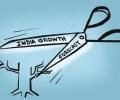
The International Monetary Fund (IMF), in its latest World Economic Outlook report, has slashed its forecast for India's FY23 gross domestic product growth to 8.2 per cent from 9 per cent, saying that higher commodity prices will weigh on private consumption and investment. This was one of the steepest cuts for emerging economies compared to the IMF's January WEO forecasts. Saying that global economic prospects have worsened significantly due to commodity price volatility and disruption of supply chains caused by the war in Europe, IMF cut its global growth outlook for calendar year 2022 to 3.6 per cent from 4.4 per cent, and said both Russia and Ukraine could experience large GDP contractions.

India has already become the world's fifth largest economy in the 75th year of Independence and will reach the $3.5 trillion mark by end-March, said the Economic Survey tabled in Parliament on Tuesday. In real terms, the economy is expected to grow at 7 per cent for the year ending March 2023. This follows an 8.7 per cent growth in the previous financial year.

India's current account slipped into a deficit of $9.6 billion or 1.3 per cent of GDP in the September quarter, the Reserve Bank said on Friday. The current account, which records the value of exports and imports of both goods and services along with international transfers of capital, was in a surplus mode both in the quarter-ago and year-ago periods. India's current account surplus had stood at $6.6 billion or 0.9 per cent of GDP in the April-June 2021 quarter, while in the year-ago period (Q2FY22), the surplus had stood at $15.3 billion or 2.4 per cent of the GDP, the data said.

Among the 30 Sensex companies, Power Grid, Axis Bank, State Bank of India, Bajaj Finserv, Reliance Industries and NTPC were the biggest gainers. Tech Mahindra, Infosys, Wipro, HCL Technologies and Titan were among the laggards.
The country's gross domestic product (GDP) is likely to grow at 5.8 per cent in the third quarter of fiscal 2022, according to an SBI's research report- Ecowrap. The country's economy expanded by 8.4 per cent in the second quarter of 2021-22, to cross pre-pandemic levels. However, the GDP growth in July-September period was slower than the 20.1 per cent expansion in the previous quarter.

Gold seems to be losing its glitter in India due to a rise in prices. Demand in Q2CY24 was 149.7 tonnes - a 5 per cent drop compared to 158.1 tonnes in the same period last year, according to a report by the World Gold Council (WGC). Demand by value in April-June 2024 stood at Rs 93,850 crore, up by 14 per cent compared to Rs 82,530 crore in the same period last year.

'India's output contraction in the previous year was among the worst in the world!'

The pre-budget Economic Survey, which is tabled in Parliament ahead of the Union Budget to present the state of the economy and suggest policy prescriptions, quite often misses on the GDP forecast, sometimes by a significant margin. This time, Finance Minister Nirmala Sitharaman will table the Economic Survey for 2021-22 in the Lok Sabha on Monday soon after the President's address to both Houses of Parliament. She will present the Union Budget for the next financial year beginning April 1, 2022, on Tuesday.

China's GDP grew by 4.9 per cent in the third quarter, down from 7.9 per cent in the second, confirming the slowdown of the world's second-largest economy which was under pressure from the crisis-hit property sector, curbs on energy and tardy recovery from the Covid-19 pandemic.

Profits of India's top listed companies have been growing at a faster pace than those of their American peers, but when it comes to revenue growth, the order has reversed recently. The combined net profit of the S&P 500 companies was up 14.1 per cent year-on-year (Y-o-Y) during the trailing 12 months (TTM) ended December 2023, as against 17.4 per cent profit growth logged by the BSE 500 companies in the same period. This is the second consecutive year of faster profit growth for the BSE 500 companies.

Among the 30 Sensex companies, Axis Bank, ICICI Bank, HDFC Bank, Tech Mahindra, Larsen & Toubro, Bajaj Finserv, State Bank of India, Reliance Industries and Infosys were the biggest gainers. Power Grid, Asian Paints, Tata Steel, Nestle, Maruti and JSW Steel were among the laggards.

However, the SBI report said it will take almost seven-quarters from Q4 FY21 to reach the pre-pandemic level in nominal terms and there will be a permanent output loss of around 9 per cent of GDP.

Highlights of the Union Budget 2024-25 presented by Finance Minister Nirmala Sitharaman in Lok Sabha on Tuesday.

Equity markets will take cues from global trends and trading activity of foreign investors, while in the latter part of the week the first quarter earnings from IT majors TCS and HCL Technologies would guide investor sentiments, analysts said. Markets may consolidate after the record rally last week, experts added. "On the domestic front, the Q1 earnings season begins this week. Key companies such as TCS and HCL Technologies will release their earnings on July 11 and 12, 2024, respectively.
Global rating agency Moody's on Monday raised India's growth forecast for 2024 calendar year to 6.8 per cent, from 6.1 per cent estimated earlier, on the back of 'stronger-than-expected' economic data of 2023 and fading global economic headwinds. India's real GDP expanded 8.4 per cent year-over-year in the fourth quarter of calendar year 2023, resulting in a 7.7 per cent growth for full-year 2023. Capital spending by the government and strong manufacturing activity have meaningfully contributed to the robust growth outcomes in 2023, Moody's Investors Service said.

'The Indian government is better prepared this time and has reached out to all contenders and not putting all eggs in one basket.'

Domestic ratings agency Icra on Monday forecast a 2 per cent GDP growth in the fourth quarter of 2020-21, and a 7.3 per cent contraction for the full fiscal year. From a GVA or gross value added perspective, the agency pegs Q4 growth at 3 per cent and the full year contraction at 6.3 per cent. According to the agency, the 2 per cent projected GDP growth will help the economy avoid a double-dip recession as indicated by the National Statistical Office (NSO) for Q4. Icra's projection is better than the 8 per cent contraction forecast by the NSO as it sees Q4 growth at only 1.1 per cent.

Alloting more funds for MNREGA and PM-KISAN could wipe out the entire additional money that the Centre may have for FY25.

Make minimum payments on all debts, then use extra funds to tackle the smallest debt first.

Thrust on infrastructure and capital expenditure is expected to continue in the Union Budget for FY25.

India's first $1 trillion company by market capitalisation (mcap) is achievable by 2032 and HDFC Bank and Reliance Industries (RIL) are seen as lead contenders, ICICI Securities said in a note on Monday. To achieve this, the shares of both the firms will have to appreciate at least 20 per cent annually for the next decade. ICICI Securities believes this is possible if India's gross domestic product (GDP) growth accelerates to 9 per cent per annum and corporate profitability cycle peaks. "Our calculations suggest that India's first $1 trillion mcap stock could emerge by 2032.

After two months of net outflow, foreign investors turned buyers in June, infusing Rs 26,565 crore in Indian equities, driven by political stability and a sharp rebound in markets. Looking ahead, attention will gradually shift towards the budget and Q1 FY25 earnings, which could determine the sustainability of FPI flows, Vipul Bhowar, Director, Listed Investments, Waterfield Advisors, said.

US's terrible political and economic leadership will ultimately cost the dollar its value. India must act early to avoid being dragged down, suggests R Jagannathan.
Moody's Investors Service on Thursday slashed India's economic growth projection for 2022 to 7.7 per cent, saying that rising interest rates, uneven monsoon, and slowing global growth will dampen economic momentum on a sequential basis.

The size of Budget 2024-25 has increased 6.1 per cent to Rs 47.66 lakh crore because of the rise in expenditure and higher allocation for capital expenditure and social sector schemes.

American brokerage firm Morgan Stanley on Thursday sharply cut its India FY23 real GDP growth estimate to 7.9 per cent, mainly due to the impact of the Russia-Ukraine conflict on oil prices. Analysts at the brokerage also raised their inflation forecast to 6 per cent - the upper end of the tolerance band for the RBI - and flagged stagflation risks because of the ongoing events. "We believe that the ongoing geopolitical tensions exacerbate external risks and impart a stagflationary impulse to the economy," they said. It can be noted that stagflation involves a stagnancy in output or growth, coupled with high inflation.

The country's gross domestic product (GDP) is expected to grow at around 18.5 per cent with an upward bias in the first quarter of the current financial year, according to SBI research report Ecowrap. This estimate is lower than the Reserve Bank of India's GDP growth projection of 21.4 per cent for the April-June quarter. "Based on our 'Nowcasting' model, the forecasted GDP growth for Q1 FY22 would be around 18.5 per cent (with upward bias)," the report said. Higher growth in Q1 FY22 is mainly on account of a low base.

Dominic Xavier asks if it is right to blame coronavirus and the lockdown for India's economic decline.

Moody's Ratings on Thursday raised India's GDP growth forecast for FY24 to around 8 per cent from 6.6 per cent on the back of strong domestic consumption and capital expenditure. The estimate comes a day after RBI Governor Shaktikanta Das said the economic growth in the current financial year could be close to 8 per cent in view of the third quarter GDP data released by the government. The latest estimate of Moody's is about 140 basis points higher than the earlier projection of 6.6 per cent made in November 2023.

Crisil Ratings on Wednesday projected India's GDP growth at 6.8 per cent in the next fiscal and said the country will become an upper middle-income nation by 2031 with the economy doubling to $7 trillion. In its India Outlook report, Crisil said the Indian economy will take support from domestic structural reforms and cyclical levers and can retain -- perhaps even improve -- its growth prospects to become the third largest economy by 2031. "After a better-than-expected 7.6 per cent this fiscal, India's real GDP growth will likely moderate to 6.8 per cent in fiscal 2025," said the Crisil India Outlook report.

Mortgage finance remains a structural growth opportunity in India with a policy focus on affordable housing, housing shortages, low mortgage penetration, and rising incomes as drivers. Affordable Housing Finance Companies (AHFCs) serve the mass market, low-income segments, which is the least-serviced category, and to operate in this segment, the mortgage provider needs good assessment skills. AHFCs and HFCs have also been increasing exposure in other mortgage segments (loan against property, developer loans among others).
India's GDP is estimated to grow at 7.4 per cent in the financial year 2022-23 with rising prices triggered by the Russia-Ukraine conflict posing as the biggest challenge to the global economic recovery, Ficci's Economic Outlook Survey released on Sunday said. According to the survey, the Reserve Bank of India (RBI) is likely to start a rate hike cycle in the second half of 2022, while a repo rate hike of 50-75 bps is expected by the end of the current fiscal. The RBI is expected to continue supporting the ongoing economic recovery by keeping the repo rate unchanged in its April policy review, the survey said.

Fiscal deficit for 2020-21 was at 9.3 per cent of the gross domestic product (GDP), lower than 9.5 per cent estimated by the finance ministry in the revised Budget estimates, according to the CGA data. Unveiling the revenue-expenditure data of the Union government for 2020-21, the Controller General of Accounts (CGA) on Monday said that the revenue deficit at the end of the fiscal was 7.42 per cent.

S&P Global Ratings on Wednesday upgraded India's sovereign rating outlook to positive from stable while retaining the rating at 'BBB-' on robust growth and improved quality of government expenditure. S&P said it could upgrade India's sovereign rating in the next 2 years if the country adopts a cautious fiscal and monetary policy that diminishes the government's elevated debt and interest burden while bolstering economic resilience.
 © 2026 Rediff.com - Investor Information - Advertise with us - Disclaimer - Privacy Policy - Sitemap - Feedback - About us - Terms of use - Grievances