
Hammad Albalawi, head of Saudi Arabia's 2034 World Cup bid unit, said his country welcomes all visitors, including LGBTQ people and their bid to host the 48-team showpiece event has nothing to do with 'sportswashing' their human rights record.

'A 10 to 15 per cent allocation to gold in portfolios reduces risk without compromising on potential returns.'
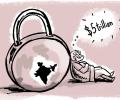
It would be a difficult task for the Indian economy to reach the $5-trillion mark a year before the International Monetary Fund (IMF) projection of 2026-27. Pankaj Chaudhary, minister of state for finance, said in the Rajya Sabha on Tuesday that the government is taking steps to make the country a $5-trillion economy at a date earlier than the IMF's projection. In that context, it would not be difficult to meet the projection in the third quarter of FY27.

The government will provide Rs 11.11 lakh crore for capital expenditure for 2024-25 and introduce viability gap funding to spur private investment in infrastructure, Finance Minister Nirmala Sitharaman said on Tuesday. Presenting the Union Budget for FY2024-25, she said that the government will endeavour to maintain strong fiscal support for infrastructure over the next five years, in conjunction with imperatives of other priorities and fiscal consolidation.

Indian companies are generating more cash than ever. The net cash flow from listed firms' operations hit a new high of Rs 11.1 trillion in financial year 2023-24 (FY24), crossing the Rs 10-trillion mark for the first time, according to the Centre for Monitoring Indian Economy (CMIE) data going back to 1990-91. The FY24 figure represents a 19.3 per cent jump over the previous year, even as quite a few companies are yet to release their numbers.

Trading in the equity market will largely depend on two major events this week - general elections result and the RBI interest rate decision - analysts said, adding that the benchmark indices may rally on Monday on exit polls' prediction of a massive win for the BJP-led NDA and strong GDP data. Exit polls on Saturday predicted that Prime Minister Narendra Modi will retain power for a third straight term, with the NDA expected to win a big majority in the polls. Counting of votes will take place on June 4.
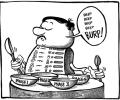
Indian food services sector is expected to grow at a CAGR (compounded annual growth rate) of 8.1 per cent between 2024 and 2028 on the back of rapid urbanisation, robust GDP growth, a rising younger population, and greater exposure among consumers, said a new report. The India Food Services Report-2024, brought out by the National Restaurants Association of India (NRAI), states that the sector contributes 1.9 per cent to India's GDP and is projected to grow to Rs 7.76 trillion by 2028 from Rs 5.69 trillion currently.

Research and development (R&D) spending by BSE 100 companies has grown steadily, rising from 0.89 per cent of revenue in FY20 to 1.32 per cent in FY24, averaging around 1 per cent over the period in-between, according to data compiled from Bloomberg and company annual reports. Also, these companies more than doubled their R&D spending in absolute terms over these five years: From Rs 25,041 crore to Rs 63,072 crore. While this reflects a prioritisation of innovation, corporate R&D investment remains relatively conservative.

Stock markets will be driven by domestic inflation data, ongoing quarterly earnings from corporates and global trends this week, analysts said. News flows around the general election would also be tracked by investors, market experts said.

The share of total health expenditure as part of the gross domestic product (GDP) went down to 3.3 per cent in 2017-18 from 3.8 per cent in the previous two years, according to the national health account data released on Monday by the health ministry. The share of government expenditure as part of total expenditure as well as GDP has gone up from from 3.78 per cent to 5.12 per cent between 2013-14 and 2017-18, which could also explain a decline seen in out of pocket expenditure in 2017-18. Health ministry also emphasised the increase in the government health expenditure as part of the total GDP from 1.15 per cent in 2013-14 to 1.35 per cent in 2017-18.

Prime Minister Narendra Modi's goal of making India a high-income economy by 2047 is unlikely to be achieved, but the country should become an upper middle-income nation by then, Financial Times chief economics commentator Martin Wolf said on Friday. Wolf further said that India would also become a superpower by 2047. "India wishes to become a high-income country by 2047.
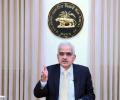
The challenge for the RBI in 2024 is likely to be less about containing elevated inflation and more about curbing excessive financial market exuberance and a 'problem of plenty', notes Sajjid Chinoy, Chief India Economist JP Morgan.

India's economy grew 6.1 per cent in the fourth quarter of 2022-23, pushing up the annual growth rate to 7.2 per cent, official data showed on Wednesday.

'This debate is going on all over the world and everybody is saying that only GDP cannot estimate the real (economic) situation of a country.'

'We have essentially tried to set out an agenda for the next five years and it, in essence, represents the political commitment to that agenda.'

S&P Global Ratings on Friday said it will watch the fiscal numbers for the next 1-2 years, besides pro-growth policies of the new government, before deciding on India's sovereign rating upgrade. S&P, which earlier this week upgraded India's outlook to positive while retaining the sovereign rating at BBB-, expects the new government to continue with pro-growth policies, infrastructure investment and commitment to fiscal consolidation.

IT and interest rate-sensitive bank, realty, and auto stocks ended with sharp gains.

The US Fed interest rate decision, ongoing quarterly earnings, macroeconomic data and FII trading activity are the major triggers that will drive stock markets this week, analysts said. Investors would also track global market trends and the movement in global oil prices for further cues. "This week, the focus will shift to global cues, particularly the US markets," Santosh Meena, Head of Research, Swastika Investmart Ltd said.

An average Indian couple spends around 2x on weddings versus education (pre-primary to graduation).

India's net oil import bill could widen to $101-104 billion in current fiscal from $96.1 billion in 2023-24 and any escalation in the Iran-Israel conflict could impart an upward pressure on the value of imports, ICRA said on Tuesday. The domestic rating agency said based on its analysis, lower value of Russian oil imports is estimated to have led to savings of $7.9 billion in 11 months (April-February) of 2023-24, up from $5.1 billion in 2022-23.

The Indian economy is likely to post better than anticipated growth in the second quarter (July-September) owing to robust urban consumption and expansion in services, a Business Standard analysis of high-frequency indicators showed. While gross domestic product growth in the September quarter is expected to come below the 7.8 per cent print in the June quarter due to a favourable base fading, analysts say the print will be much closer to 7 per cent than the 6.5 per cent anticipated earlier. While the Reserve Bank of India (RBI) had estimated 6.5 per cent growth for July-September, last month Governor Shaktikanta Das said the growth figure would surprise on the upside.

China on Saturday lowered its GDP target to 5.5 per cent for this year bringing it down from last year's 6.1 per cent. The new target for the second-largest economy was announced by Premier Li Keqiang in his work report presented to the National People's Congress (NPC), the country's Parliament which opened its annual session in Beijing on Saturday. In 2021, China's economy grew by 8.1 per cent 2021 to about $18 trillion stated to be the best in a decade.

The first wave of COVID-19 last year impacted households as their financial savings moderated to 8.2 per cent of GDP in December quarter from 10.4 per cent in the previous three-month period, revealed an RBI data released on Wednesday. The preliminary estimate of household financial savings is placed at 8.2 per cent of GDP in October-December 2020-21, exhibiting a sequential moderation for the second consecutive quarter after having spiked in the pandemic-hit June quarter, RBI said in a release. "The moderation was driven by a significant weakening in the flow of household financial assets, which more than offset the moderation in the flow of household financial liabilities," it said.

>Bihar (18 days) has the most number of heatwave days in 2023, followed by Andhra Pradesh (15 days), Odisha (15 days), Jharkhand (13 days), West Bengal (8 days) and Tamil Nadu (6 days).

The outlook for India's financial sector appears bright, but it needs to brace for likely vulnerabilities, said Economic Survey 2023-24 tabled in Parliament on Monday. The Indian financial sector is at a "turnpike moment", it said, adding that the dominance of banking support to credit is being reduced, and the role of capital markets is rising. For a country that aspires to be a developed nation by 2047, this is a long-awaited and welcome development, it said.

I am happy I didn't knock anyone down, driving recklessly or trying to show off. However, in one instance of road rage (the consequence of arguing with a driver who disrespected my right to cross the road peacefully) I did find a man in a SUV taking his anger out on me by driving his vehicle over my feet, recalls Shyam G Menon.

Chief Economic Advisor V Anantha Nageswaran on Thursday said the economy is expected to grow at 6.5 per cent in the current fiscal notwithstanding deficient rains in August. India recorded economic growth of 7.8 per cent in the April-June quarter of 2023-24 against 13.1 per cent in the year-ago period. India's economy in Q1 grew at the fastest pace in a year, on the shoulders of a boost in capital expenditure both at central and state levels, along with stronger consumption demand, especially in rural areas, and improved performance in the services sector, he said.

The Budget should use the extra RBI surplus to better effect, suggests A K Bhattacharya.

Warning that the new year will be riskier than the previous two in terms of growth, inflation and the perils of monetary policy normalisation on consumption demand in particular, along with other external risks, a Wall Street brokerage has pencilled in an 8.2 per cent GDP growth next fiscal, with more downside risks to the projection. The biggest risk to the projection is a derailed consumption demand that has been the main growth driver in the past many years, said the Bank of America Securities India house economists who still believe that consumption demand will remain the key driver of growth next fiscal as well.

All eyes will be on whether Sitharaman will deliver a populist budget leaving more money in hands of the common man or push the reform agenda by staying on the fiscal glide path to lower the fiscal deficit to 4.5 per cent of GDP by 2025-26.

Fiscal deficit for 2021-22 worked out to be 6.71 per cent of the gross domestic product (GDP), lower than 6.9 per cent projected by the Finance Ministry in the revised Budget Estimates, according to government data released on Tuesday. Unveiling the revenue-expenditure data of the Union government for 2020-21, the Controller General of Accounts (CGA) said that the fiscal deficit in the absolute terms was be Rs 15,86,537 crore (provisional).

Large investors track high-frequency data that is immediately available today. That data has been bullish, points out Debashis Basu.

The country's GDP is likely to grow at 1.3 per cent in the fourth quarter of 2020-21 and may see a contraction of around 7.3 per cent for the full financial year, according to an SBI research report 'Ecowrap'. The e-National Statistical Office (NSO) will release the GDP estimates for the March 2021 quarter and provisional annual estimates for the year 2020-21 on May 31. "Based on our 'nowcasting model', the forecasted GDP growth for Q4 would be around 1.3 per cent (with downward bias) as against NSO (National Statistical Office) projection of a negative (-)1 per cent," the research report said.

The government may relax the requirement of making payments to MSMEs within 45 days of buying goods and services to check large corporate from looking at other sourcing avenues, sources said. The announcement to this effect could be made in the Budget likely to be presented on July 23. The government is considering suggestions regarding changes to Section 43B(h) of the Income Tax Act made by MSMEs during pre-Budget consultations, sources said.

Capital markets are becoming more prominent in India's growth story, with an expanding share in capital formation and investment landscape on the back of technology, innovation and digitisation, according to the Economic Survey 2023-24 tabled in Parliament on Monday. Further, Indian markets are resilient to global geo-political and economic shocks, it added. "Despite heightened geo-political risks, rising interest rates and volatile commodity prices, Indian capital markets have been one of the best performing among emerging markets in FY24," the Economic Survey said.

India's services sector growth recorded another month of robust expansion in July, albeit at a slightly slower pace than in June, largely supported by robust demand conditions and investment in technology, a monthly survey said on Monday. The seasonally adjusted HSBC India Services Business Activity Index was at 60.3 in July, down only fractionally from 60.5 in June. In the Purchasing Managers' Index (PMI) parlance, a print above 50 means expansion, while a score below 50 denotes contraction.

The Asian Development Bank (ADB) on Wednesday slashed India's GDP growth forecast for FY23 to 7 per cent from the earlier estimate of 7.2 per cent mainly on account of higher inflation and a tight monetary policy. India's economy grew 13.5 per cent year-on-year in the first quarter of 2022-23, reflecting strong growth in services, ADB said in its second supplement to Asian Development Outlook Report 2022 (ADO 2022). "However, GDP growth is revised down from ADO 2022's forecasts to 7 per cent for FY2022 (ending March 2023) and 7.2 per cent for FY2023 (ending March 2024) as price pressures are expected to adversely impact domestic consumption, and sluggish global demand and elevated oil prices will likely be a drag on net exports," ADB said.

India's foreign exchange reserves have jumped to an all-time high of $651.5 billion as of May 31, Reserve Bank Governor Shaktikanta Das said on Friday. This means the overall kitty has increased by $4.83 billion since the last reported number of $646.673 billion on May 24 this year.

'Alongside economic growth and the Asian century, stress has become an Asian caravan.' 'But stress doesn't arrive in one's country as invitation to taste exhaustion. It comes dressed as a challenge.' 'Its evangelists ask: Are you man enough to shoulder stress?' points out Shyam G Menon.

'If you look at where inflation (headline and core) is today in India and where the rates are, there's clearly room to cut rates.'
 © 2026 Rediff.com - Investor Information - Advertise with us - Disclaimer - Privacy Policy - Sitemap - Feedback - About us - Terms of use - Grievances