
Between FY09 and FY25, 101 IAF fighter jets have crashed, costing the lives of 28 pilots.

Real estate company Sobha Developers' net profit has more than halved for the 2009 financial year, as property sales dipped sharply in the country, leading to dropping revenues and profits.
The industrial GDP growth looks set to average at 4.6 per cent during FY 09, significantly lower than the 8.1 per cent in FY 08, Dun & Bradstreet said in its Economy Outlook 2009-10 report in Mumbai.
At a time when global auto majors are struggling, carmakers in India have been able to expand their overseas presence with exports from the country registering whopping 57.04 per cent growth in the last fiscal.
Rating agency Crisil has revised downwards the Indian GDP growth forecast for FY09 to 8.1 per cent, from the earlier 8.5 per cent, in view of the high inflationary conditions, interest rate and global growth outlook.However, despite the growth deceleration, Crisil expects inflation to stabilise at an average 5.5 per cent in 2008-09 in a normal monsoon scenario, the agency said.
The brokerage lowered its GDP growth numbers for FY09 to 6.7 per cent from 7.5 per cent and for FY10 to 5.8 per cent from 7 per cent, Goldman said in a research note on Monday. Goldman Sachs said the gathering financial crisis over the past several weeks has affected India's financial sector significantly, with both domestic and external liquidity drying up. This has impacted the financing for corporates, loans for households, and trade credit for exporters.

The post-Covid pandemic boom in corporate revenues appeared to have faded away in 2023-24. Yet, companies have reported a sharp recovery in their profits in FY24, driven by high margins. Their combined net sales, including gross interest income for lenders, rose by a modest 4.8 per cent year-on-year (Y-o-Y) in FY24.
India's real GDP is expected to grow at an impressive 9.5 per cent in FY'09, the Centre for Monitoring Indian Economy said in its monthly review in Mumbai. The Indian economy is heading towards the fourth consecutive year of an over 9 per cent growth and like in the last five years, growth this year too was expected to be driven by capital investments happening in India, CMIE said.

Whether nominal or real, India's investment rate needs to increase by 3 to 4 percentage points of GDP to support 8 per cent real growth, recommends Nikhil Gupta.

Stimulus was given in phases after Chidambaram had left the finance ministry to head the home ministry in December 2008.
As many as 5,532 complaints were received by the regulator in January, an 80 per cent increase over the number of complaints filed in the previous month.

Survey shows pessimism on operating parameters and overall economy's prospects has risen sharply; companies want measures to revive growth
The Indian auto industry, which was heading towards negative growth territory, managed to stay in the positive zone in the fiscal ended March 31, thanks to the government's stimulus packages, recording a 0.71 per cent increase in total vehicle sales.
India Inc's net profit as a percentage of the country's gross domestic product (GDP) is just shy of reaching 5 per cent, bolstered by strong earnings growth in the second quarter of 2023-24. Analysts interpret this as an indication that a corporate profit upcycle is in progress, with projections suggesting that this share could exceed 8 per cent within the next five years, driven by bullish earnings growth expectations. "We believe we are only halfway through a profit cycle, with the profit share in GDP rising from a low of 2 per cent in 2020 to about 5 per cent currently, and likely heading to 8 per cent in the coming four to five years. "This implies about 20 per cent compounding of earnings growth. "Underscoring this forecast is the start of a new private capex cycle, under-geared balance sheets, a healthy banking system, lower corporate tax rates, improving terms of trade, and structural consumption demand outlook albeit somewhat offset by likely consolidation in government deficit," said Ridham Desai, managing director, head of research, Morgan Stanley India in a note.
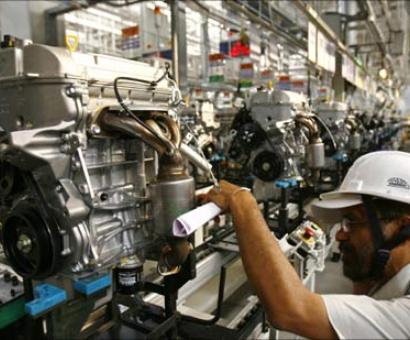
The declining output of the manufacturing sector pulled down the economic growth rate in the fourth quarter of 2008-09 to 5.8 per cent and 6.7 per cent in the entire fiscal.
The combined market valuation of all the listed companies in the country dropped to Rs 30,86,075 crore (Rs 30,860.75 billion) on the last day of this fiscal as against Rs 49,72,953.37 crore (Rs 49,729.53 billion) on March 31, 2008, leading to a loss of over Rs 18,86,000 crore (Rs 18,860 billion) during the period.

Questions will be raised over why those changes take place and whether non-economic factors are at play, says A K Bhattacharya.
While banks are busy firming up business plans for 2008-09, some of them have already conveyed to the Reserve Bank of India about prospects of a moderation in the credit growth. In March, many banks held talks with RBI on resource conditions and growth prospects. In fact, Bank of India has already scaled down the estimate for the current financial year to 17-18 per cent compared with the 24 per cent rise it had targeted in the just-concluded financial year.

This is lower than the country's growth rate of 6.7 per cent for the financial year 2008-09.
The declining output of the manufacturing sector pulled down the economic growth rate in the fourth quarter of 2008-09 to 5.8 per cent and 6.7 per cent in the entire fiscal.
The fall in the equity markets was to put some pressure on the balance sheets of the top five asset management companies (AMCs) in the country. But, two of them have managed to buck the trend, thanks to the rise in their average assets under management (AAUM).
After four years of growth at 40 per cent or more, capital expenditure (capex) by India Inc in the current financial year (2008-09) may drop almost 30 per cent.
Services and personal loans pulled down the non-food bank credit growth to 19.5 per cent at the end of February 27, 2009 as against 22 per cent a year ago.
At a time when retrenchment has almost become synonymous with financial companies, state-run Union Bank of India is looking to hire 5,000 people at different levels to support its branch expansion plans.
The sector has grown at a mere 5% rate in the first six months.
"We forecast 7.3 per cent GDP growth (current financial year). We expect fundamentals to improve next year, propelling a recovery in H2 FY10," Lehman Brothers said in a report. For the first quarter ended June 2008, the economy registered a growth of 7.9 per cent against 9.2 per cent in the same period last year.

The government lost Rs 71,255 crore (Rs 712.55 billion) on tax rebates and exemptions awarded to corporates and non-corporates in the 2008-09 fiscal, Minister of State for Finance S S Palanimanickam told Rajya Sabha.

Anil Ambani group firm Reliance Communications on Monday said its consolidated net profit rose by 11.91 per cent to Rs 6,044.93 crore (Rs 60.44 billion) for the year ended March 31, 2009, over the same period last year.
Highways regulator the National Highways Authority of India (NHAI) has exceeded its toll revenue target in the fiscal 2008-09, collecting taxes to the tune of Rs 1,702 crore (Rs 17.02 billion).

Market concentration in the country's telecom sector continues to scale new heights despite government bailouts of public-sector Bharat Sanchar Nigam Ltd (BSNL) and Mahanagar Telephone Nigam Ltd (MTNL), and private-sector Vodafone Idea. The combined revenue (or net sales) share of the country's top two telecom operators - Bharti Airtel and Reliance Jio - in the sector's total reached an all-time high of nearly 72 per cent in FY23 from 70.4 per cent in FY22 and around 60 per cent in FY20. The net sales of Reliance Jio and Bharti Airtel India were Rs 1.67 trillion in FY23, up 18.6 per cent from the Rs 1.4 trillion a year earlier.
This year, the import would be higher because Reliance Petroleum's export oriented 29 MT refinery is set for commissioning in August-September. The government had increased petrol and diesel prices on June 5, but oil marketing companies are still selling these fuels below cost price.

If that happens, India's economic size will be just shy of $20 trillion and its annual per capita income will be about $10,000, when the country celebrates its centenary of independence.

A weak margin outlook in the near term and lack of fresh triggers may keep the Godrej Consumer Products (GCPL) stock under pressure. The stock, after tepid September quarter (Q2) results and marginal downward revision in earnings estimates, declined 3.5 per cent in trade on Friday. Though consolidated sales of the company, which owns the Goodknight and Cinthol brands, grew 8.5 per cent year-on-year (YoY), its operating profit declined because of the sharp contraction in margins.
Extend tax holiday for refineries in private sectors, reduce excise duty on Naphtha from 16%, exempt excise duty for captive consumption of intermediate products within the refinery for manufacture of exempted products.
India's savings rate which has shown a sharp jump in the last few years is expected to decline to 34 per cent in FY'09, the Centre for Monitoring Indian Economy said in its monthly review.
The Indian economy would continue to clock a robust over 9 per cent growth in FY 09, the Centre for Monitoring Indian Economy said in its monthly report on Monday.
A spiralling inflation is likely to force the Reserve Bank of India to up the Cash Reserve Ratio by 0.75 per cent in FY 09, along with a 1 per cent hike in repo and reverse repo rates, global financial services major, StanChart said.

Radhakishan S Damani, investor and promoter of the D-Mart supermarket chain, has broken into the elite club of the top 100 global billionaires. Damani, who grew up in a single-room apartment in Mumbai, is now ranked 98th on the Bloomberg Billionaires Index with $19.2 billion as his net worth. The index is a daily ranking of the world's richest people. The other Indians on the top 100 rich list ahead of Damani are Mukesh Ambani, Gautam Adani, Azim Premji, Shiv Nadar, and Lakshmi Mittal.

Some analysts see more upside in FMCG stocks given the performance gap between the sector and the market.
 © 2026 Rediff.com - Investor Information - Advertise with us - Disclaimer - Privacy Policy - Sitemap - Feedback - About us - Terms of use - Grievances