
Almost no legislative business was transacted making it the worst session of Parliament ever. Devika Malik lists the options out of the current impasse
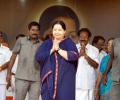
Charging the Congress-led UPA government with not incorporating the amendments suggested by her in the Food Security Bill, Tamil Nadu Chief Minister J Jayalalithaa on Sunday said her party AIADMK will vote against it in the Lok Sabha on Monday.

The much-touted Food Security Bill was taken up in Rajya Sabha, with opposition terming it as a "gimmick" with an eye on elections and accusing government of violating constitutional norms by issuing an ordinance when Parliament session was less than a month away.
A slew of Bills that will have a significant effect on India's financial landscape are likely to come up in the Monsoon session of Parliament.
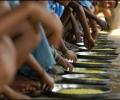
There is a vast grey area between a bill that promises to ensure that no one goes hungry and the political economy of producing food, writes Rajni Bakshi.

Slamming opposition parties for creating hurdles in passing of the Food Security Bill, Congress President Sonia Gandhi on Thursday accused them of creating instability in the country to grab power at any cost.
The government is likely to firm up next week a view on how to go about the food security bill. Indications to this effect were available on Wednesday with the government sources saying a decision will be taken only after Agriculture Minister Sharad Pawar's return from Rome where he has gone to attend Food and Agriculture Organisation conference.
A much stronger focus was required on irrigation and water management. The FM merely acknowledged that it was a problem.
A Parliamentary panel suggested scrapping separate foodgrain rate and quota for poor and general public and said the UPA's ambitious Food Bill should guarantee 5 kg of rice and wheat to all beneficiaries at uniform price of Rs 3 and Rs 2 per kg, respectively.
Both the Congress and the UPA government are racing against time to try and revamp their image with the people. The new direct benefit transfer schemes, the proposed food security bill, the land acquisition bill and perhaps the women's reservation bill are among the vehicles that the Congress intends to use to reach out to the people, says Saroj Nagi.
Earlier this week, the Empowered Group of Ministers approved the draft of the Food Security Bill, which will entitle 75 per cent of rural households and 50 per cent of urban households to subsidised foodgrain.
Food Security Act will be fully provided for and subsidy to be 2 per cent of GDP for next two years.
Is she, like the AIADMK's Jayalalithaa with the Vajpayee government in 1998, playing bully to a government that she knows cannot survive without her Parliamentary support? Or is there a greater scheme behind her erratic actions? Discussing the mercurial Mamata Banerjee on the Rediff Chat is Senior Editor Indrani Roy, a long-time watcher of Bengal and Mamata politics.

The two-day conference, which saw participation of ministers and senior officials from all the states, was marked by brainstorming in the run up to the expected enactment of the government's ambitious Food Security Bill.

Critics have slammed a bloated subsidy that has been proposed for the food security bill, but officials in the government strongly believe that the resultant additional burden will not be above Rs 27,000 crore to meet the commitments under the proposed legislation.
Opposition to FDI in retail is misguided, says Pranab Bardhan, professor of economics in University of California, Berkeley.
It is unusual for Congress chief ministers to say no to Congress Party President Sonia Gandhi, but some of them have gathered the courage to oppose Gandhi's dream project.
India's fiscal policy is not supportive of monetary measures that the country's central bank is employing to fight rampant inflation, the prime minister's honorary economic advisor and former International Monetary Fund chief economist Raghuram Rajan said, while singling out the proposed Food Security Bill as a particular cause for concern.
Concerned over poor budget allocation for the farm sector, Agriculture Minister Sharad Pawar on Sunday said it may be difficult to implement the proposed Food Security Bill without adequate funds to boost agri-output, a must for increased foodgrain requirement.
Draft bill seeks to provide grains to households in both priority and general categories and cooked meals to all others.

The two major changes include: keeping an option open for supplying more than 3 kg of subsidised foodgrains to general households and widening its reach to include lactating women, destitute and aged people and providing nutritious food to children.

Congress President Sonia Gandhi, who has been spearheading the UPA's ambitious Food Security Bill, left the Lok Sabha while the voting was underway on Monday night on various amendments moved by the Opposition.
If the Food Security Bill is enacted as per the draft, then women shall be considered the 'head of the household' and the potential implications are staggering, says T V R Shenoy.

The government on Wednesday sought public comments on the draft National Food Security Bill, which seeks to provide a legal entitlement to subsidised foodgrains to 75 per cent of the country's rural population and 50 per cent of urban India.

Union Cabinet committee on accommodation has allotted 6 Krishna Menon Marg -- the prestigious type 8 bungalow -- to the Jagjivan Ram Foundation.
In the first sign of dissent within the ruling UPA government, Agriculture & Food Minister Sharad Pawar on Wednesday indicated that covering two-thirds of the population under the proposed Food Security Bill was not feasible.
Main difference has been on including people above the poverty line in the Food Security Bill.
The food security Bill is likely to adopt a three-pronged strategy to ensure food for all, particularly for the most vulnerable sections of the society. The National Advisory Council (NAC) in its initial discussions on the Bill had talked about a universalised scheme.
The foodgrain guarantee is part of the proposed National Food Security Bill.
Congress president Sonia Gandhi has said the government has a "very active agenda" for Parliament in the coming months when bills on land acquisition, food security and changes in income tax laws will be taken up.

Charging the Central Bureau of Investigation for not probing role of a Pakistan-based terror outfit Lashkar-e-Tayiba in the Ishrat Jahan encounter case, the Bharatiya Janata P Party on Thursday alleged that the agency was acting at the behest of the Congress with a one-point agenda to frame the Gujarat Chief Minister Narendra Modi.

The Prime Minister's expert committee on National Food Security Bill on Thursday recommended that the assured delivery of wheat at Rs 2/kg and rice at Rs 3/kg could be given only to poor and expressed difficulty in accommodating general category in view of projected food availability.

The National Advisory Council, chaired by Congress party president Sonia Gandhi, met for the second time on Thursday after its recent revival and unanimously endorsed the idea of universal access to the public distribution system (PDS) in rural areas.

The Budget is likely to implement the Congress's poll promise of a Food Security Bill, apart from increasing funds for schemes under the Mahatma Gandhi National Rural Employment Guarantee Act, earlier known as NREGA.
The National Advisory Council, chaired by Congress party president Sonia Gandhi, met for the second time on Thursday after its recent revival and unanimously endorsed the idea of universal access to the public distribution system in rural areas. It was agreed that a universalised PDS should be implemented initially in 150 districts, a member said.

Congress President Sonia Gandhi on Monday left for the US for medical check-up.

Congress President Sonia Gandhi on Saturday expressed anguish over the gruesome gangrape of a 23-year-old photojournalist in Mumbai.

The government had pegged food subsidy at Rs 90,000 crore (Rs 900 billion) in the 2013-14 Union Budget.
The government may table the two key Bills on women's reservation and food security soon in Parliament to take the wind out of the Opposition sails.The Women's Reservation Bill, aimed at providing one-third reservation to women candidates in state Assemblies and Parliament, is bound to split the Opposition. The Food Security Bill, which will provide 25 kg of rice or wheat at Rs 3 per month to families below the poverty line, will be showcased as the government's effort.
Rajni Bakshi on why eco-friendly farming while indispensable cannot immediately ensure self-sufficiency in food production for the entire nation.
