
Food inflation, which has declined 7 weeks in a row, was at 10.15 per cent for the week ended November 13.

Faced with the dichotomy of overflowing granaries and rising commodity prices, Prime Minister Manmohan Singh on Tuesday said the government will do 'everything possible' to put the lid on food inflation.

"Food prices have softened in recent weeks and I expect this to continue," he told the chief ministers, who voiced serious concern over the rising prices. In a stern warning to hoarders, the prime minister said powers under the Essential Commodities Act would be used against them to stop artificial scarcity.

Though a range of essential items still continue to be expensive, the rate of price rise has been falling for some time now.

Food inflation, as measured by the Wholesale Price Index, stood at 6.6 per cent in the previous week.
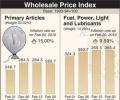
The food inflation in the previous week was at 17.58 per cent. On the annual basis, the prices of rice increased 10 per cent, wheat 14 per cent, pulses 35 per cent, onions 11 per cent and potatoes 28 per cent.

The three day MPC meeting began on Monday and the decision will be announced on Wednesday by RBI Governor Shaktikanta Das.

The surge from the last week, which was incidentally the lowest in a-year-and-half, is likely to put more pressure on the government looking bewildered after the overall inflation for March overshot its forecast of 8 per cent.

After a strong run in the midcap and smallcap indices, which surged 46 per cent and 43 per cent, respectively, on the National Stock Exchange (NSE) during Samvat 2080, analysts suggest that the rally in these segments may pause to catch its breath in Samvat 2081.

'Challenge is basically near-term growth as the outlook has turned a bit adverse.'

After a fortnight of being in single digits, food inflation for the week ended July 31 shot up to 11.4 per cent from 9.53 per cent the week earlier on the back of a spike in prices of cereals, milk and fruits.

Following widespread drought and floods in various parts of the country, food inflation climbed to more than a 10-year high of 19.95 per cent in December, driven mainly by higher prices of potato, other vegetables and pulses.

Retail inflation declined to a five-year low of 3.54 per cent in July mainly on account of subdued prices of food items, and base effect, according to official data released on Monday. The Consumer Price Index (CPI) based retail inflation was 5.08 per cent in June 2024 and 7.44 per cent in July 2023.
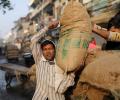
According to official data released on Thursday, onions grew cheaper by 59.04 per cent year-on-year during the week under review, while potato prices were down by 33.76 per cent.

Reserve Bank Governor Shaktikanta Das on Thursday said the fundamental drivers of the Indian economy are gaining momentum and the country is moving on a sustainable growth path. In the inaugural address at FIBAC 2024, the governor said that massive changes are taking shape in various economic sectors and markets, and the country is geared for orbital shifts.
The Reserve Bank is unlikely to cut the benchmark interest rate in its forthcoming bi-monthly monetary policy review later in the week as retail inflation is still a cause of concern, and there is a possibility of the Middle East crisis deteriorating further, impacting crude oil and commodity prices, say experts.

The Reserve Bank of India (RBI) has identified "climate shocks" as a risk to food inflation rates and overall price rise while stating that the outlook for the country's economic growth remains bright. In its Annual Report for 2023-24, released on Thursday, the central bank said easing supply-chain pressures, broad-based softening in core inflation, and early indications of an above-normal southwest monsoon meant well for the inflation outlook in 2024-25. "The increasing incidence of climate shocks, however, imparts considerable uncertainty to the food inflation and overall inflation outlook," said the RBI while noting headline inflation moderated by 1.3 percentage points on an annual average basis to 5.4 per cent in 2023-24.

To be out by October, it reflects weight of components in GDP.

Food inflation had softened to 10.05 per cent for the week ended August 14 against 10.35 per cent in the previous week.

Food inflation stood at 20.18 per cent in the comparable period last year.

The rate of price rise in food items, as calculated on the basis of the wholesale price index, was 8.53 per cent in the previous week and 21.46 per cent in the comparable period of 2010.

S&P Global Ratings on Tuesday retained India's growth forecast at 6.8 per cent for the current fiscal and said it expects the RBI to start cutting interest rates in its October monetary policy review. In the economic outlook of Asia Pacific, S&P Global Ratings also retained its GDP growth forecast for the 2025-26 fiscal at 6.9 per cent and said solid growth in India will allow the Reserve Bank to focus on bringing inflation in line with its target.
The price stabilisation fund will call for processing capacity for perishables.
Food inflation fell sharply to a near four-year low of 1.81 per cent for the week ended December 10 as prices of essential items like vegetables, onion, potato and wheat declined.
Reserve Bank on Thursday retained the growth and inflation projection at 7.2 per cent and 4.5 per cent respectively for the current fiscal amid expectations of a normal monsoon. In its last bi-monthly monetary policy review in June, RBI had projected real GDP growth and retail inflation at the same.

'Food inflation is important and if that is controlled, then consumption will go up.'

It will be the second Budget of the Modi 3.0 government and eighth straight Budget for Nirmala Sitharaman, rare in Indian polity.

Dabur's performance in the July-September quarter of the current financial year (Q2FY25) was weak but in line with consensus. Consolidated revenue declined 5 per cent year-on-year (Y-o-Y) due to a temporary adjustment in General Trade (GT) inventory. Indian revenue declined 7.6 per cent, while international business grew 13 per cent Y-o-Y in constant currency (CC) terms.
During the week ended August 13, fruits became dearer by 27.01 per cent and eggs, meat and fish by 13.37 per cent on an annual basis.

The Reserve Bank on Tuesday cautioned that continued uncertainty over monsoon could stoke food inflation, but expressed the hope that government policies will improve supplies in the coming months.
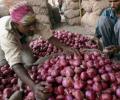
The Centre on Thursday began the first phase of retail sales of onion at a subsidised rate of Rs 35 per kg to provide relief to Delhi-NCR and Mumbai consumers from rising prices of the kitchen staple. NCCF and NAFED, which are maintaining a buffer stock of 4.7 lakh tonne onion on behalf of the government, will undertake the retail sale through their own stores and mobile vans. Onion will be sold at 38 retail points in Delhi-NCR and Parel and Malad in Mumbai.
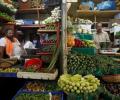
While rising food inflation is a matter of grave concern for a significant chunk of the population and for policy makers as well, it marks a turnaround in the fortunes of the farmer, reports Sanjeeb Mukherjee.

The day-long conference will be chaired by Finance Minister Arun Jaitely and presided over by both Food Minister Ram Vilas Paswan and Agriculture Minister Radha Mohan Singh.
The latest numbers likely to be seen by the government as a silver lining after the slowdown in economic growth during the first quarter.

In doing so, it further cemented the community's determination to support the opposition. But at the same time, it consolidated its Hindu vote bank like never before.

'I wonder if they will keep it up after the elections.' 'I fear they'll start questioning eligibility -- income, age, bank accounts -- and eventually stop the scheme altogether.'
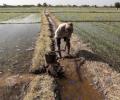
Gross Value Added (GVA) growth in agriculture and allied activities in the first quarter of the 2024-25 financial year (Q1FY25) dipped to 2.7 per cent at constant prices from 4.2 per cent in Q1FY24 due to a drop in output of some crops following heatwave in the main growing months. Low post-monsoon rains, which dried most of the reservoirs in several states across the country, also impacted the production of many crops. At current prices, the growth was estimated at 8.5 per cent as against 4.1 per cent in Q1FY24 due to a spike in food inflation during the April to June months of FY25.
Reserve Bank of India (RBI) Governor Shaktikanta Das has said the decision on interest rate moderation will be based on long-term inflation trajectory and not monthly data. The Monetary Policy Committee (MPC) headed by the RBI Governor is scheduled to meet between October 7 and 9 and take call on interest rate. The RBI kept the repo rate unchanged at 6.5 per cent for the ninth time in a row amid risks from higher food inflation.

'Investors can consider staying invested in long duration products as there is a possibility of rate cuts in the near term.' Positive macros - lower inflation, high forex reserves and favourable demand-supply dynamics for government bonds - make a strong case for rate cuts from December, says Devang Shah, head of fixed income, Axis Mutual Fund. In an interview with Abhishek Kumar in Mumbai, Shah says this view may not hold true if commodity prices go up sharply.
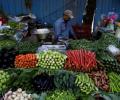
Retail inflation in August inched up to 3.65 per cent, though vegetables and pulses witnessed price rise in double digits, according to official data released on Thursday. The retail inflation based on the Consumer Price Index (CPI), however, remained below the Reserve Bank's median target of 4 per cent for the second month in a row. It was at a five-year low of 3.6 per cent in July.
 © 2026 Rediff.com - Advertise with us - Disclaimer - Privacy Policy - Sitemap - Feedback - About us - Terms of use - Grievances