
Food inflation had remained above the 16 per cent-level for most part of the year.

After being in single-digit for two weeks, food inflation shot up again to double digit at 11.40 per cent for the week ended July 31 as prices of cereals, milk and fruit went up.

Even as the high inflation figure for October has ruled out any possibility of a rate cut by the Reserve Bank of India's (RBI's) monetary policy committee (MPC) in December, a rate cut in February also looks uncertain due to global uncertainties. Economists told Business Standard that unless domestic growth slows markedly, the outlook on rate cut remains unclear. India's headline inflation touched a 14-month high of 6.2 per cent in October, breaching the MPC's upper tolerance band of 6 per cent.

Food inflation, which was 11.40 per cent for the week ended July 31, is in double digits for the second consecutive week, after it remained in single digit for a fortnight in mid-July.

Food Inflation rose to 16.49 per cent for the week ended May 8, mainly due to high prices of vegetables and fruits.
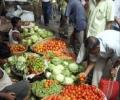
Food Inflation rose to 16.44 per cent for the week ended May 1, mainly due to high prices of fruits and vegetables.

On a yearly basis, potato became cheaper by over 45 per cent and onion by nearly 8 per cent.

The Nifty closed at 4,845, down 86 points. ONGC, ITC and HDFC Bank were the only gainers among the index stocks. And Gail and BPCL rose on hopes of deregulation in the prices of petroleum products.

Experts said onion prices, which are seeing deflation, are also headed to high-inflation territory in the coming months.

Higher food prices can accelerate broader inflation by pushing up wages, while negatively impacting the government finances and reducing monetary policy flexibility, Moody's said in a report.

The wholesale price-based inflation fell after rising for four consecutive weeks. Inflation was at 17.97 per cent in the previous week.

Retail sales of vehicles across categories in India grew by 11.21 per cent at 32,08,719 units in November, as compared to 28,85,317 units in the same month last year riding on two-wheeler demand, Federation of Automobile Dealers Associations said in Monday. Retail sales of two-wheelers were at 26,15,953 units last month, as compared to 22,58,970 units in November 2023, a growth of 15.8 per cent buoyed by the festive spillover.

Food inflation softened to 18.22 per cent as of the week ended December 26, although potato and pulses continued to cost high. The wholesale price based inflation was 19.83 per cent in the previous week.
Food inflation fell for the second straight week to a nine-week low of 11.05 per cent for the week ended February 5 as pulses, wheat and potato prices declined.
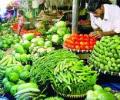
The annual rate of price rise of food items in the previous week was 16.12 per cent. Prices of pulses for the week were higher by 34.14 per cent over the corresponding week last year, while that of milk rose by 21.12 per cent on an annual basis.

Food inflation eased to 16.23 per cent for the week ended May 15 on account of a fall in prices of masur, fruits and vegetables.
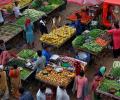
Retail inflation breached the Reserve Bank's upper tolerance level, soaring to a 14-month high of 6.21 per cent in October mainly on account of rising food prices. Inflation based on the consumer price index (CPI) was 5.49 per cent in September and 4.87 per cent in the year-ago month. Retail inflation trended below the RBI's upper tolerance band of 6 per cent since September last year.

The Reserve Bank on Friday raised the inflation projection for current fiscal year to 4.8 per cent from 4.5 per cent with Governor Shaktikanta Das saying lingering food price pressures are likely to keep headline inflation elevated in the December quarter. Consumer price index (CPI)-based inflation increased sharply in September and October 2024 led by an unanticipated increase in food prices.
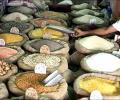
The inflation stood at four-month low of 16.22 per cent for the week ended March 13.

On an annual basis, potato prices more than doubled, pulses became expensive by over 35 per cent, while onions rose by 27 per cent.
The food inflation edged up to 13.68 per cent for the week ended October 31, from 13.39 per cent in the previous week mainly on account of soaring vegetable prices.

High vegetable prices are expected to keep food inflation firm in the months to come.
Food prices fell for the second consecutive week as food inflation remained in the negative zone at (-)2.90 per cent for the week ended December 31, 2011.
Snapping the downward trend of two consecutive weeks, food inflation inched up marginally to 15.57 per cent for the period ended January 15, on account of escalating vegetable prices, particularly, onions.

'If it doesn't, it will continue with measures to infuse liquidity, signalling a new cycle,' predicts Tamal Bandyopadhyay.

The decline could also be attributed to the high inflation figure of 18.56 per cent for the corresponding year-ago period, a phenomenon dubbed the 'high base effect' in economic parlance.

'The shifts in US involvement in global conflicts and geopolitical alliances could introduce uncertainties.'
As per data released by the government on Thursday, pulses became over 9 per cent cheaper year-on-year during the period under review.

From the outcome of the general elections and then Union Budget to tepid corporate earnings in the September 2024 quarter (Q2-FY25), sticky inflation and Reserve Bank of India's stance on interest rates, extreme weather conditions, Indian stock markets have braved it all in calendar year 2024.

This is the lowest rate of price rise in food items in the last 18 months, when separate data for food inflation first started coming in.
Food inflation soared to 17.05 per cent for the week ended January 22, rising for the second straight week, on the back of costlier vegetables, fruits and milk.
Food inflation in April stood at 6.08 per cent, while the overall WPI inflation fell to a three-year low of 4.89 per cent.
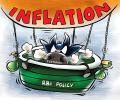
The Reserve Bank of India on Friday retained its projection for retail inflation at 4.5 per cent for the current fiscal assuming a normal monsoon, while emphasising that uncertainties related to food price outlook warrant a close monitoring. Consumer Price Index (CPI)-based retail inflation has been projected at 4.5 per cent with quarter-wise projections at 4.9 per cent in Q1 (April-June), 3.8 per cent in Q2, 4.6 per cent in Q3, and 4.5 per cent in Q4.

As food inflation spurted to a six-month high, Singh said the immediate challenge before the country is how to sustain a high growth path, while keeping inflation in check.

Week on week, food inflation climbed 0.36 percentage points from 15.10 per cent on September 4.
Snapping the two week rising trend, food inflation fell nearly 4 percentage points in the week from 17.05 per cent in the week ended January 22.

On a yearly basis, potatoes became cheaper by over 46 per cent and onions by over 10 per cent.

Food inflation rose to 18.32 per cent for the week ended December 25, because of rise in prices of food items like onion, milk and meat.

Overnight, in the US markets, fear returned to Wall Street.

For the month ended April, the overall inflation, which includes manufactured goods, stood at 9.59 per cent.
 © 2026 Rediff.com - Advertise with us - Disclaimer - Privacy Policy - Sitemap - Feedback - About us - Terms of use - Grievances