
There are various estimates of India's debt to GDP ratio, but the consensus is that that it would be over 80 per cent at the end of the current fiscal year.
The review will not only present data, trends but also list out the achievements of the Narendra Modi government

This is because the bond market has factored in the Rs 4.88-trillion gross borrowing for April-September 2020.

Among other things, the agenda is likely to focus on increasing private investment, employment generation and giving relief to the farm sector

'Given the 50 per cent or thereabouts increase in borrowing that has been announced, it is a reasonable estimate to say that at this time, an increase of 1.7-1.8 per cent on the 3.5 per cent budgeted fiscal deficit target is being anticipated,' Chief Economic Adviser Krishnamurthy Subramanian said on Friday.

The government further said the gross tax revenue as a per cent of GDP is expected to increase to 12.1 per cent of GDP in 2019-20 and stabilise at that level in 2020-21 before climbing up to a level of 12.2 per cent of GDP.

There are several welcome standalone reforms, but these do not add up to a coherent strategy to achieve a $5 trillion economy or secure Aatmanirbharta, observes Rathin Roy.
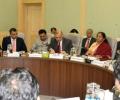
At a pre-Budget meeting, the FM was asked to ensure that NBFCs come out of the liquidity crisis they are facing with the help of RBI. They also spoke about the futility of trying to achieve a 3 per cent fiscal deficit target over the medium term.

Even with the possible expenditure roll-overs and off-budget financing, the fiscal deficit target will not be met. The FRBM Act, after its amendment in 2018, allows a fiscal deficit slippage of not more than 0.5 per cent for any given year, provided there are justifications. These justifications include war, national security, severe collapse in the agriculture sector, a major natural calamity, big structural economic reforms, or the decline in real output growth of a quarter by at least 3 percentage points below its average of the previous four quarters.

'The finance ministry's decision to accept the deficit target of 4.5 per cent in 2025-2026 appears to have emanated from its endorsement of the Finance Commission's view that the Indian economy will continue to remain impacted by the pandemic, adversely undermining its growth potential,' notes A K Bhattacharya.

Officials said there had been no official word or indication from the top yet. The expectation from officials is to do what they can, but it is understood that all fiscal and budgetary targets don't matter anymore.

Credit rating agencies have been raising red flag over high debt to GDP ratio of India.

Need of the hour is to spend to grow more, the study said.

The finance ministry on Wednesday said the government will borrow Rs 4.34 lakh crore in the second half of the current fiscal to meet its expenditure requirement amid COVID-19 crisis afflicting the country's economy.
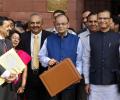
The FRBM report, to be submitted on Tuesday, is likely to have 'excuse clauses', absolving the government of meeting its fiscal commitments under certain conditions such as war or conflict, global economic meltdowns or natural disasters.

If the government cuts wasteful expenditure as it is trying now, the deficit would at most fall to 8 per cent, not less than that.
The panel may include or seek inputs from former RBI Governor Urjit Patel, former chief economic advisor Arvind Subramanian, Sajjid Chinoy of the PM-EAC, Rathin Roy, among others.
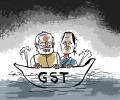
'Because of the COVID-19 pandemic situation today, the revenues of the states have gone down, the GST money is not coming and all the states combined have lost more than Rs 365,000 crore in revenue.' 'To make it worse, the Government of India is not compensating us for the shortfall, which it must as per its Constitutional obligations.'
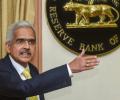
Expressing his satisfaction over the government's move to slash fiscal deficit target, Das said it will help improve investment by the private sector as crowding out impact will be less.

Member of Parliament Rajeev Chandrasekhar feels that the economy today is bankrupt due to big spending towards social welfare programmes such as NREGA.

India suffers from peak power deficit of three per cent.
This permission was given some time late last month, before the Reserve Bank of India (RBI) on March 31 issued the indicative borrowing calendar for the states for April-June and the one for the Centre for April-September.
The industrial output for the third month in a row remained in the negative territory, contracting 1.5% in January

The government should frame new policies to assure growth.
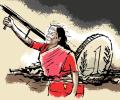
'But can it afford to present a scenario within the existing legal framework of fiscal consolidation?', asks A K Bhattacharya.
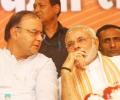
This move will enable it to incur higher-than-mandated borrowing, and possibly spending, till the 2024 Lok Sabha election cycle.

Finance Minister Nirmala Sitharaman will present her second Budget a little more than a month from now. Like any other FM, Sitharaman will depend on her team of bureaucrats and advisors to frame and present the Budget.
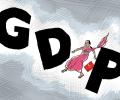
Fitch reaffirmed India's rating at 'BBB-' with a Stable Outlook saying the rating balances a still strong medium-term growth outlook compared with similar category peers and relative external resilience stemming from solid foreign-reserve buffers against high public debt, a weak financial sector and some lagging structural factors, including governance indicators and GDP per capita.

The govt said Rs 30,729 crore was required for waiving loans of small and marginal farmers.

The extra borrowing implies Jaitley will have extra spending space in the Union Budget for FY19, the last full one before the 2019 general election

BJP's reversals in rural Gujarat has prompted many policy watchers to predict that the Budget would have incentives for the agriculture sector and the rural economy.

'One way of doing this could be offering credit guarantee to the banks, say 10 per cent, for fresh loans given to micro, small and medium enterprises,' observes Tamal Bandyopadhyay.

IThe fiscal deficit target for 2020-2021 was originally set at 3.5 per cent of GDP. But the government's revenues have collapsed and its expenditure burden will only increase over the Budget estimates.' With the government having already planned for an additional borrowing of over Rs 4 trillion, the fiscal deficit for the current year would be much higher than the Budget estimate, notes A K Bhattacharya.
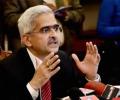
'No one cares about fiscal deficit now. Or for that matter, inflation.' 'The focus is on growth and growth alone.' 'RBI needs to break the risk aversion of banks and infuse adrenaline in their veins', says Tamal Bandyopadhyay.

'Most of the measures the finance minister announced will take effect after the lockdown.' 'By that time, millions of people will be starving.'

'Event management can distract from, but not permanently mask, execution failures,' points out Rathin Roy, director, National Institute of Public Finance and Policy.

'When you start distributing wealth, you end up distributing poverty.'
PM's announcement were focused on those most affected by the note ban.

'... the government provides adequate cash and kind support for the poorest of the poor for survival... ...conditional cash and skilling support for the economically poor to raise their incomes to adequate levels... ...and make functional arrangements for providing unemployment allowance to the vulnerable poor during disasters like the present one.'

Kerala has seen one of the worst floods in its history during this monsoon. From August 8 to 20, nearly 223 people have lost their lives, 33 are missing and around 1.2 million individuals from 3,02,441 families are in 3,941 relief camps. Initial losses are estimated to be around Rs 200 billion (Rs 20,000 crore). With the rescue measures in its last leg, the Kerala government is looking at raising funds to rebuild the state. In an interaction with Gireesh Babu and T E Narasimhan, Kerala Finance Minister T M Thomas Isaac says he has a three-pronged strategy to raise funds. Edited Excerpts.
 © 2026 Rediff.com - Investor Information - Advertise with us - Disclaimer - Privacy Policy - Sitemap - Feedback - About us - Terms of use - Grievances