
The Union government will soon make amendments to the foreign trade policy (FTP) to enable exporters to claim export benefits for settling trade in rupees. These benefits are, so far, available for export payments received in foreign currencies. After the Reserve Bank of India (RBI) unveiled a mechanism to settle international trade transactions in the local currency on Monday, exporters have been demanding that the Ministry of Commerce and Industry come up with a clarification on the matter.

Subdued demand from developed countries and blocs like the US and EU is impacting exports of key sectors including engineering, gems and jewellery and may have implications on India's exports in case the global situation does not improve in coming months. Global inflation, Russia-Ukraine war, simmering China-Taiwan crisis and supply disruptions are hurting economic growth worldwide, leading to poor demand, experts say. The world merchandise trade volume is expected to grow 3 per cent in 2022 against the earlier forecast of 4.7 per cent, mainly due to the ongoing war between Russia and Ukraine, according to the World Trade Organization forecast, released in April.
India's exports rose by 43 per cent to $35.65 billion in October while trade deficit widened to $19.73 billion during the month, according to the official data released on Monday. Imports soared by 62.51 per cent to $55.37 billion, widening the trade deficit. Export sectors which recorded positive growth during October include petroleum, coffee, engineering goods, cotton yarn/fabs./made-ups, gems and jewellery, chemicals plastic and linoleum and marine products, the data showed.

India needs to make use of this opportunity to significantly enhance its exports especially in information and communications technology and the automotive sector.
The government may roll out a new foreign trade policy (FTP) of a shorter term of two-three years in a bid to keep pace with the fast-evolving scenarios in international trade which have been triggered by recent disruptions, such as the pandemic and the Russia-Ukraine war. An FTP is an elaborate policy guideline and strategy to promote the export of goods and services, with a duration of five years usually. The existing policy came into force on April 1, 2015, and was valid for five years, before multiple extensions.

India's exports may have touched an all-time high of $422 billion in 2021-22 but recession in key western markets and geo-political crisis due to the Russia-Ukraine war are expected to impact the growth of the country's outbound shipments in 2023. All the global trade promoting factors like political stability, movement of goods, adequate availability of containers and shipping lines, demand, stable currency and smooth banking systems are in disarray. Adding to the woes, COVID cases have again started rising in countries like China, Japan, South Korea and the US.

As uncertainty looms large in Afghanistan, Indian pharma exporters are apprehensive to send goods to the war-torn country and the target of exporting $126 million worth of pharmaceutical goods to the Taliban-ruling nation now depends on the future outcome. Udaya Bhaskar, director general of Pharmaceuticals Export Promotion Council of India (Pharmexcil) body under the Department of Commerce on Tuesday said as the situation is grim over there and India pharma exporters have cordial relations with Afghanistan. "The projected target for 2021-22 is $126.22 million.
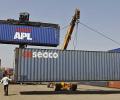
India's exports to China have increased by 16.15 per cent to USD 20.87 billion in 2020 from USD 17.9 billion in the previous year on account of healthy growth in the shipments of ores, iron and steel, aluminum and copper, according to the data of the commerce ministry.

Nepal's decision to ban the import of non-essential items amid depleting forex reserves may hit Indian exports. The country's central bank - Nepal Rastra Bank - last week instructed commercial banks not to open letters of credit (LCs) for importing non-essential items. This is to prevent further decline of the country's foreign exchange reserves. However, it has not issued any formal communication yet.

The primary and immediate impact of a depreciating rupee is on the importers who will have to shell out more for the same quantity and price. However, it is a boon for the exporters as they receive more rupees in exchange for dollars. The rupee depreciation has wiped away some of the gains that would have accrued to India from international oil and fuel prices dropping to pre-Ukraine war levels.

The country's exports in December surged 37 per cent on an annual basis to $37.29 billion, the highest-ever monthly figure, government data showed on Monday.

Domestic exporters may soon start shipments of mangoes, such as 'Dasheri' and 'Langda', to the US as America will start accepting testing certificates of specified agencies of India, a senior government official said on Tuesday. India has not exported mangoes to the US for the last two years. The set protocol involves the arrival of the US phytosanitary inspector, who monitors the process, which is called pre-clearance operations before exports. They have not visited India during the summer of 2020 and 2021.
After contracting for six months in a row, the country's exports grew by 5.27 per cent to $27.4 billion in September, Commerce and Industry Minister Piyush Goyal said on Thursday.
The country's exports rose by 48.34 per cent to $32.5 billion on account of healthy growth in shipments of petroleum products, gems and jewellery, and chemicals, leather and marine goods, according to the data released by the Commerce Ministry on Thursday. Imports in June too rose by 98.31 per cent to $41.87 billion, leaving a trade deficit of $9.37 billion as against a trade surplus of $0.79 billion in the same month last year. During April-June 2021, the exports increased by 85.88 per cent to $95.39 billion.

Sectors like IT and energy have the potential to raise the value of India's exports to $1 trillion, or 5 per cent of the global trade, by 2020, but the government needs to devise a concerted strategy, FIEO said.
The country's exports grew by 47.19 per cent to $35.17 billion on account of healthy growth in the outbound shipments of petroleum, engineering, and gems and jewellery, according to the provisional data of the commerce ministry. Imports during the month also rose by 59.38 per cent to $46.40 billion, leaving a trade deficit of $11.23 billion. Exports of petroleum, engineering, and gems and jewellery in July increased to $3.82 billion, $2.82 billion and $1.95 billion respectively, the data showed.
With exporters' claim for over five months still pending, liquidity has been wiped out and the process of finalising new contracts has been held up.
The country's exports jumped by 58.23 per cent to $34 billion in March as key sectors such as engineering, gems and jewellery and pharmaceuticals recorded healthy growth rate during the month, according to the Commerce Ministry's provisional data. Exports during April-March 2020-21, however, dipped by 7.4 per cent to $290.18 billion compared to $313.36 billion in 2019-20, the data showed. Imports during 2020-21 contracted by 18 per cent to $388.92 billion compared to $474.71 billion during 2019-20. In March 2020, the exports stood at $21.49 billion, which was a decline of about 34 per cent over March 2019 due to global slowdown induced by the Covid-19 crisis.
Imports too tumbled by 58.65 per cent to $17.12 billion in April from $41.4 billion in the same month last year, according to the data by the commerce and industry ministry.
Growing for the third consecutive month, the country's exports rose marginally by 0.67 per cent year-on-year to $27.93 billion in February even as trade deficit widened to $12.62 billion, according to official data released on Monday.
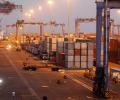
After recording positive growth for two months in a row, India's exports dipped marginally by 0.25 per cent to $27.67 billion in February and trade deficit widened to $12.88 billion, according to preliminary data released by the government on Tuesday. Imports grew 6.98 per cent to $40.55 billion during the month, the data showed. The trade deficit stood at $10.16 billion in February 2020. Exports during April-February 2020-21 were $255.92 billion, compared with $291.87 billion during the same period of last year, exhibiting a negative growth of 12.32 per cent.

India imports about 25 million tonnes of oil from Iraq each year.

Trade deficit during the month narrowed to USD 14.54 billion from USD 15.3 billion in January 2020. It was USD 15.44 billion in December 2020.
Export sectors that showed positive growth last month included chemical, iron ore, electronics, marine products and pharmaceuticals. Decline in overall imports, including oil and gold, led to narrowing of trade deficit.
Imports during October also rose by 17.62 per cent to $44.11 billion, leading to widening of trade deficit to $17.13 billion.

India's exports to EU and Britain stood at $35.35 billion and $9.35 billion in 2015-16, respectively

Giving a relief to exporters community, the government on Thursday said it will release Rs 56,027 crore to exporters against pending tax refunds under different incentive schemes for outbound shipments. The amount will be disbursed to more than 45,000 exporters. Briefing the media about the decision, Commerce and Industry Minister Piyush Goyal said that the Rs 56,027 crore, which is being released under various export promotion schemes, is over and above duty remission of Rs 12,454 crore for the Remission of Duties and Taxes on Export Products (RoDTEP) Scheme and Rs 6,946 crore for Rebate of State and Central Levies and Taxes (RoSCTL) Scheme already announced.

The Federation of Indian Export Organisations said that banks are charging as high as 9.75-10.50 per cent interest from exporters.

The steep depreciation of rupee will not give an immediate advantage to the country's exporters.
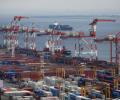
Barring rice, spices, iron ore and pharmaceuticals, all the remaining 26 key sectors registered negative growth in May. Imports too plunged 51 per cent to $22.2 billion in May.

India's exports rose marginally to $27.15 billion in December 2020, while imports surged 7.56 per cent to $42.59 billion, official data showed on Friday. The merchandise exports were valued at $27.11 billion in December 2019 while imports had totalled $39.59 billion.

After recording positive growth in September, India's exports declined 5.4 per cent to $24.82 billion in October on account of dip in shipments of petroleum products, gems and jewellery, leather, and engineering goods. Trade deficit in October narrowed to $8.78 billion as against $11.76 billion, as imports also fell 11.56 per cent to $33.6 billion during the month under review.
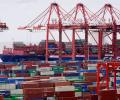
After staging a strong recovery from COVID-induced slowdown in 2021, India's exports are likely to extend the growth story to the New Year also on increased demand in the global markets, boost in domestic manufacturing due to production-linked incentive schemes and implementation of some interim trade pacts. Expectations of positive growth in the country's exports are also backed up by the outlook of the World Trade Organisation (WTO) which predicts a 4.7 per cent expansion in the global merchandise trade volume in 2022. Exporters believe that the outbound shipments would cross $400 billion mark in this fiscal going by the current momentum and may reach $475 billion in 2022-23.

The country's exports dipped 8.74 per cent to $23.52 billion in November on account of contraction in shipments of key sectors like petroleum, engineering, chemicals and gems and jewellery, official data showed on Tuesday. Trade deficit during the month narrowed to $9.87 billion as imports too declined by 13.32 per cent to $33.39 billion.

India's merchandise exports in February shrank for the 15th straight month on continued weak demand from Europe, the South Asian nation's biggest market.
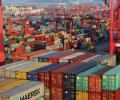
Currently, the five-year FTP aims to raise total exports to $900 billion but targets may be reduced

India's exports are expected to touch $360 billion in the current fiscal from $312.35 billion in 2013-14, Federation of Indian Export Organisations (FIEO) said.
Trade deficit marginally widened to $9.85 billion as against $9.72 billion in February 2019.

Exporters body FIEO said the slide in rupee, which closed at all-time low of 60.72 against the dollar, was a "serious" matter and asked traders to use derivatives to hedge the currency risk.

India's exports increased 3.79 per cent to $26.75 billion in January, helping the trade deficit to narrow to $9.92 billion.
 © 2026 Rediff.com - Advertise with us - Disclaimer - Privacy Policy - Sitemap - Feedback - About us - Terms of use - Grievances