
Rupee has strengthened but is this sustainable.Or are we staring at a slip very soon.
The poll predicts a better performance than this year's 9 per cent increase but far more modest than the 25 per cent surge in 2012 when foreign investors bought a massive $24.4 billion worth of Indian stocks.

Buffett said the economy is benefiting from improvement in areas that had not previously performed well, particularly homebuilding.
The precious metal spurted to regain Rs 27,000 level after June 24 as it rose in global markets following Federal Reserve Chairman Ben S Bernanke backed sustained stimulus for the for some time.

Healthy demand for the American unit from importers and corporate weighed on the rupee
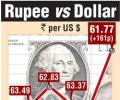
The partially convertible rupee closed at 61.77/78 per dollar compared to its close of 63.38/39 on Wednesday.

"Indian markets (are) well placed to absorb the US Fed rate hike. Gradual approach in future increases augurs well for emerging markets," Economic Affairs Secretary Shaktikanta Das has tweeted.
The Sensex ends up 16 points to end at 20,514.
There was sustained selling of the American currency by exporters ahead of a decision of US Federal Reserve on tapering its monetary stimulus.
In a speech to the National Economists Club that echoed dovish comments by his nominated successor, Janet Yellen, Bernanke also said that while the economy had made significant progress, it was still far from where officials wanted it to be.

Expressing concern over the rupee reaching an all-time low, the Bharatiya Janata Party (BJP) said the currency is likely to plunge further as a share of the US financial stimulus package given to India during the sub-prime crisis in 2008-09 may be withdrawn by the Federal Reserve.
The new Guv needs to focus on structural inflation problems.
The prime minister made a reference to orderly exit from unconventional monetary policies in the backdrop of splits between emerging markets and the US.
With the US housing and labour markets on the mend, the healing looks more durable, say RBS's Sanjay Mathur and Louis Kuijs.
The rupee on Thursday plunged by a whopping 130 paise to hit life-time low of 60 against the US dollar in early trade on the Interbank Foreign Exchange on strong demand for the American currency from banks and importers
A look at the frenzy over Twitter's IPO shows that the markets believe that monetary policy will be good for risk assets.

The Indian unit opened higher at 66.10 per dollar as against overnight level of 66.30 at the Interbank Foreign Exchange market and firmed up further to 66.04 on initial dollar selling.
It has been a choppy Samvat 2069 for the global markets.
A firming trend in domestic stock markets, however, capped the rupee fall to some extent
India, China and Russia have "squandered" capital by financing inefficient technologies, United States Federal Reserve Chairman Allan Greenspan has charged.
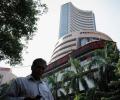
The Nifty too closed lower by 80.75 points, or 0.73 per cent, at 11,049.65 after hitting a low of 11,033.90.

The rupee's gains came even as most emerging Asian currencies eased as the yuan fell beyond 6.20 to the dollar for the first time since April last year amid market speculation that the central bank will keep the currency weak as economic growth slows.
Politics ahead of general elections, Fed tapering threats and inflation to keep markets on the toes.

Winding down quantitative easing will be messy for the West and a big problem for India.
Interview with Asia-Pacific economist, Morgan Stanley
A potential early wind-down of the US stimulus programme and a shrink in China's factory activity pulled down markets.
The government is worried the trade gap could worsen again and the currency could weaken as the US Federal Reserve looks set to start tapering its economic stimulus soon.
The broader markets ended lower with mid-caps and small-caps falling over 1 per cent on the BSE.
The central bank also asserted that the country is ready for the tapering of the US Federal Reserve's bond purchases.
After trading hours, the government said the June-quarter current account deficit widened to $21.8 billion from $18.1 billion in the previous quarter.
Investors need to ask some basic questions before betting in the markets on the Gujarat model's national success.
It wants to wait for more evidence of solid economic growth before making any changes.
Markets ended on a strong note after an extremely volatile trading session this Wednesday, on back of significant buying witnessed in the realty and bank spaces.

India is better prepared to deal with any further US Fed tapering, but the country needs to remain vigilant to face eventualities, Reserve Bank Governor Raghuram Rajan said.

The NSE index Nifty ended above the 10,500-mark.

Reserve Bank of India Governor Raghuram Rajan took charge of India's central bank when the rupee seemed to be in a tailspin while the country was facing runaway inflation.
The rupee fell 4.8 per cent last month, and was the worst performing Asian currency as the dollar rallied broadly on speculation that the Federal Reserve will begin reducing its monetary stimulus later this year.

Equity benchmarks erased early gains after realty, capital goods, teck, auto, PSU, IT, power and bankex counters came under selling pressure, falling up to 1.28 per cent.
 © 2026 Rediff.com - Advertise with us - Disclaimer - Privacy Policy - Sitemap - Feedback - About us - Terms of use - Grievances