
Equity markets would take cues from domestic inflation data announcement, global trends and trading activity of foreign investors in a holiday-shortened week ahead, analysts said. Markets would remain closed on Tuesday for 'Diwali Balipratipada'. "As we enter a truncated week with Muhurat trading on Sunday, global cues will play a pivotal role in shaping the market direction.

Stock markets will be largely driven by global trends and macroeconomic data announcements in a holiday-shortened week which may see volatility amid monthly derivatives expiry, say analysts. Equity markets will remain closed on Monday for Gurunanak Jayanti. Trading activity of foreign investors and the movement of the rupee against the dollar will also be tracked by investors.

Global trends, trading activity of foreign investors and movement of oil benchmark Brent crude would dictate terms in the domestic markets this week, analysts said. Equity markets, which fell nearly 3 per cent last week, may face volatile trends amid the monthly derivatives expiry on Thursday. "This week marks the September month Futures and Options (F&O) expiry, which is expected to bring about volatility in the market," said Santosh Meena, Head of Research, Swastika Investmart Ltd.

The US Federal Reserve's interest rate decision, global cues, macroeconomic data announcements and the ongoing quarterly earnings are the major triggers that will dictate trends in stock markets this week, analysts said. Besides, the trading activity of foreign investors and the movement of global oil benchmark Brent crude will also be tracked. "All eyes are on the outcome of the US Federal Reserve meeting scheduled for November 1, particularly due to the multi-year high levels of the US bond yields.

Quarterly earnings from IT majors Tata Consultancy Services (TCS), Infosys, macroeconomic data announcements, global trends and trading activity of foreign investors would guide the movement in the equity market this week, analysts said. Movement of global oil benchmark Brent crude and the rupee will also influence trading in the markets. "All eyes will be on the beginning of corporate performance for the second quarter of the current fiscal year. TCS is slated to unveil its Q2 results on October 11, with HCL Technologies and Infosys following suit on October 12.

India's prices are rising faster than many of its emerging market peers. The country's inflation print for May at 4.25 per cent is a marked reduction from the levels seen in May 2022 (7.04 per cent). However, even though the inflation rate remains within the Reserve Bank of India's medium-term target of 4 per cent, with a 2 per cent margin on either side, it continues to be higher than China, Russia, and Brazil.

From the Sensex pack, Tata Steel declined 3.45 per cent, followed by Tata Motors which fell by 3.19 per cent. Bajaj Finserv, NTPC, JSW Steel, State Bank of India, Larsen & Toubro and Bharti Airtel were among the other major laggards. Nestle, Asian Paints, Hindustan Unilever and Tech Mahindra were the gainers.

From the Sensex pack, NTPC jumped nearly 4 per cent after the company posted over 23 per cent rise in consolidated net profit in the April-June quarter of 2023-24. Power Grid, Tech Mahindra, Tata Steel, Tata Consultancy Services, Wipro, Maruti and JSW Steel were among the other major gainers.

The US Federal Reserve's interest rate decision, global market trends and trading activity of foreign investors are the major factors that would dictate terms in the equity markets in a holiday-shortened week ahead, analysts said. Equity markets will remain closed on Tuesday on account of Ganesh Chaturthi. From the global front, interest rate decisions from the Bank of England and Bank of Japan would also influence market trends.

With the first quarter earnings season coming to an end, the domestic equity markets would be driven by global trends and trading activity of foreign investors this week, analysts said. The movement of global oil benchmark Brent crude and the rupee against the dollar would also drive trends in the market. "Macroeconomic indicators, trends in global stock markets and FII activities will be pivotal in shaping market trends in the coming days," Pravesh Gour, senior technical analyst at Swastika Investmart Ltd, said.
S&P Global Ratings on Monday kept its forecast for India's economic growth unchanged at 6 per cent in the fiscal year starting April 1, before rising to 6.9 per cent in the following year. In the quarterly economic update for Asia-Pacific, S&P saw inflation rate easing to 5 per cent in 2023-24 fiscal, from 6.8 per cent in the current financial year. It saw India's gross domestic product (GDP) likely growing by 7 per cent in the current financial year ending March 31 (2022-23), before slowing to 6 per cent in the next 2023-24 fiscal.
The RBI interest rate decision, industrial production data for June and the ongoing quarterly earnings from corporates would largely drive the stock markets this week, analysts said. Other major factors such as global market trends, the movement of oil prices and the trading activity of foreign investors would also influence trading, they added. "The market will have an eye on the RBI Monetary Policy Committee (MPC) meeting, which will be announced on August 10, 2023. We are heading towards the last batch of Q2 earnings of key companies such as Adani Ports, Coal India, Hero MotoCorp, Hindalco and ONGC, among others, which will lead to stock-specific movement," said Pravesh Gour, senior technical analyst, Swastika Investmart Ltd.

In a dazzling resurgence, foreign investors have graced the Indian equity markets with an influx of nearly Rs 1.5 lakh crore in 2023, fuelled by optimism over the country's resilient economic fundamentals amid shadows of a gloomy global scenario. Experts believe that the positive trend may continue in 2024. This follows Indian equities witnessing the worst-ever net outflow of Rs 1.21 lakh crore by FPIs in 2022 on aggressive rate hikes by the central banks globally after net inflows for three consecutive years.

Investors' wealth eroded by Rs 3.46 lakh crore on Wednesday as equity markets took a sharp tumble amid weak global trends and foreign fund outflows. The 30-share BSE Sensex fell by 676.53 points or 1.02 per cent to settle at 65,782.78. During the day, it plunged 1,027.63 points or 1.54 per cent to 65,431.68. In line with the weak trend in equities, the market capitalisation of BSE-listed firms eroded by Rs 3,46,947.54 crore to Rs 3,03,33,258.69 crore.

with low interest rates these countries went on a borrowing spree and since they borrowed much more than their repayment capacity is, they are in a mess. Greece is the smallest of these countries and is in the biggest mess.

After bumbling for years since 2014, the Modi government seems to believe that massive government expenditure will lead us to prosperity supported by 'seat-of-the-pants' decision-making, observes Debashis Basu.

Fitch Ratings on Thursday slashed India's GDP growth projection for FY23 to 7 per cent, saying the economy is expected to slow against the backdrop of global economy, elevated inflation and high interest rate. In June, it had forecast 7.8 per cent growth for India. "We expect the economy to slow given the global economic backdrop, elevated inflation and tighter monetary policy. "We now expect the economy to grow 7 per cent in the financial year to end-March 2023 (FY23) from 7.8 per cent previously, with FY24 also slowing to 6.7 per cent from 7.4 per cent before," Fitch said in its September edition of the Global Economic Outlook.

Fitch Ratings has revised India's GDP forecast to minus 9.4 per cent in the current fiscal year from a previously projected contraction of 10.5 per cent after the economy staged a sharper rebound in the second quarter. In its Global Economic Outlook, Fitch said the coronavirus-induced recession inflicted severe economic scarring and the country needs to repair balance sheets and increase caution about long-term planning. "We now expect GDP to contract 9.4 per cent in the fiscal year to end March 2021 (plus 1.1 percentage point) followed by plus 11 per cent growth (unchanged) and plus 6.3 per cent growth in the following years," the rating agency said.

The situation on the bourses seems to be getting gloomier with every hour. Just when it seemed that we were over with the day's selling activity and the Nifty seemed to be stabilising around the 5000 level came the clincher in the form of the European markets.

Reserve Bank Governor Shaktikanta Das on Monday said despite the latest headwinds arising from the Jackson Hole summit leading to extreme volatility, our banking system and financial markets are strong enough to withstand such pressures. Taking the markets by surprise, US Fed chair Jerome Powell had told the annual Jackson Hole summit of central bankers and economists last week that he would have to keep raising federal fund rates to tame inflation, which remains the biggest challenge to the world's largest economy. He also warned of the pains that such monetary policy actions would create on growth and jobs.

Noting that external risks to global growth has increased significantly now, the Crisil report quotes its parent S&P's forecast of a recession in the US and in the Eurozone, and a record low growth in China, which is seen crashing to 2.9 per cent now, almost half of what it had said on March 5 when it has pegged the same at 4.8 per cent.

Indian consumers are likely to get respite from rising prices just before the festival season. Some consumer companies, including automakers, have indicated that they are planning to pause price hikes just before demand picks up in August, while keeping a close eye on volatile raw material prices.

The ongoing Greece economic crisis poses a little threat to the rest of the world as the global economy has withstood the stress tests of the last two weeks fairly well.

Kotak Bank was the top loser in the Sensex pack, shedding over 2 per cent, followed by ICICI Bank, PowerGrid, HDFC, IndusInd Bank and Axis Bank. NSE Nifty declined 45.75 points to 16,568.85.
Countries such as Pakistan, Indonesia, Kazakhstan, and Sri Lanka have a lower unemployment rate compared to India.

Auto, pharma, IT, chemicals among sectors with significant reliance on UK and European nations with Tata Motors, Motherson Sumi, Tata Steel, TCS, Wipro, Infosys and Tech M among key names.
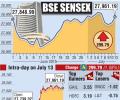
The 30-share Sensex ended up 300 points at 27,961.
FM said the slide would be contained when there is certainty in eurozone recovery.

Portugal will have to pay an interest rate of 5.7 per cent on the loan from the EU and the IMF.

At the BSE, 1,791 stocks declined, while 948 advanced, 110 stocks remained unchanged.

According to the RBI report, the unrest in the global economy continue, it can impact the jobs in the country's labour-intensive sectors and may even affect domestic demand.

Eurozone leaders have agreed on a bailout package of nearly $1 trillion (750 billion euro) for Greece, as part of their concentrated efforts to prevent the debt crisis contagion from spreading to other nations.

Axis Bank was the top loser in the Sensex pack, shedding over 4 per cent, followed by Asian Paints, SBI, IndusInd Bank, ICICI Bank, Bajaj Finance, HDFC and Reliance. On the other hand, Bajaj Auto, Hindustan Unilever, UltraTech Cement, TCS, Bajaj Finserv and Infosys were the gainers.

The Indian rupee had lost 10 paise to close at 64 on Thursday.

The rupee on Tuesday tumbled by 32 paise to close at 64.17 on fresh dollar demand from importers.

In a historic referendum on Thursday, the United Kingdom voted to leave the Eurozone.
There is a large price disparity in Europe.

The rupee hovered in a narrow range of 62.20 and 62.28
London is the most expensive among main cities of Europe, as a range of goods and services are costliest in the British capital, a new study has found.
Unless the Eurozone crisis escalates further.
 © 2026 Rediff.com - Investor Information - Advertise with us - Disclaimer - Privacy Policy - Sitemap - Feedback - About us - Terms of use - Grievances