
Six companies, including Blackstone-backed Horizon Industrial Parks and Lalithaa Jewellery Mart, are poised to collectively raise nearly Rs 5,600 crore through initial public offerings (IPOs) in the upcoming week, adding to the bustling primary market activity.

Foreign portfolio investors (FPIs) significantly increased their buying in Indian equities during the first half of August, with financial services attracting the largest inflows, reversing previous outflows. The IT sector also continued to see strong interest from overseas investors, driven by a reassessment of valuations and the role of Indian IT firms in AI deployment.

Indian benchmark indices closed mixed, with the Sensex gaining 113.61 points to 78,079.96 and the Nifty falling 40.10 points to 24,395.85, as elevated crude prices and ongoing geopolitical uncertainty in the Middle East made investors cautious.
Indian benchmark indices closed mixed, with the Sensex gaining 113.61 points to 78,079.96 and the Nifty falling 40.10 points to 24,395.85, as elevated crude prices and ongoing geopolitical uncertainty in the Middle East made investors cautious.

E-commerce enablement platform Shiprocket Ltd saw its shares list with a 35 per cent premium on its market debut, trading at Rs 129.50 on the BSE and Rs 131 on the NSE against an issue price of Rs 97, achieving a market valuation of Rs 9,901.60 crore.

Many investors are working hard as their own fund managers, unaware whether their efforts have actually rewarded them for the job.

Foreign Portfolio Investors (FPIs) have withdrawn over Rs 62,853 crore from Indian equities in the first fortnight of June, bringing the total outflows for 2026 to Rs 2.87 lakh crore, surpassing the entire 2025 figure, driven by geopolitical tensions, global economic growth concerns, and a weakening rupee.

The Airports Authority of India has received a request for a waiver from contractual restrictions that prevent airport concessionaires and their group entities from holding equity in scheduled airlines, Minister of State for Civil Aviation Murlidhar Mohol confirmed in the Rajya Sabha. This comes amid reports of the Adani group's interest in the airline business, despite their denial.

Indian benchmark indices Sensex and Nifty closed lower, with the Sensex dropping 388 points and Nifty declining 112 points, as a sharp rally in crude oil prices, driven by geopolitical uncertainties and concerns over the Strait of Hormuz, dampened investor sentiment and reignited inflation fears.
Foreign Portfolio Investors (FPIs) injected Rs 12,921 crore into Indian equities during the first week of August, extending their buying spree, driven by improving macroeconomic conditions, expectations of US rate cuts, lower crude oil prices, and a stable rupee.

Manappuram Finance has announced the appointment of Ashish Singh as its new managing director and chief executive officer, effective January 1, 2027, marking a significant shift from its family-led governance structure.

Indian benchmark indices Sensex and Nifty closed lower, with the Nifty recording its fourth consecutive day of decline, primarily due to elevated oil prices and ongoing geopolitical tensions between the US and Iran, which dampened investor sentiment.

Indian benchmark indices, Sensex and Nifty, saw declines in early trade, with the ongoing US-Iran standoff cited as a major factor impacting investor sentiment and raising concerns about inflationary pressures and currency volatility for oil-importing nations like India. Track Sensex, Nifty on August 14, 2026.

In April alone, they snapped up shares worth Rs 19,664 crore, recording their biggest buy since October 2024.
Indian benchmark equity indices, Sensex and Nifty, extended their decline for a second consecutive day, primarily due to elevated crude oil prices and selling pressure on Tata Group stocks following Tata Sons Chairman N Chandrasekaran's announcement that he will not seek reappointment.
Indian benchmark indices, Sensex and Nifty, experienced declines in early trade due to a significant spike in crude oil prices, driven by escalating geopolitical uncertainties, despite positive cues from Asian and US markets.

New dematerialised (demat) account additions in India reached a six-month high in July, with 2.89 million new accounts opened, driven by a buoyant initial public offering (IPO) market and a broad-based rally in equities.

The combined market valuation of five of India's top-10 most valued firms eroded by Rs 1 lakh crore last week, with IT giant Tata Consultancy Services (TCS) experiencing the largest decline amidst a bearish trend in domestic equities.

The Bombay High Court has directed the FDA to conduct a fresh inspection of the Mumbai Cricket Association's kitchens after serious food safety and hygiene violations were found, including insects. The court also humorously questioned if cricketers were aware they were consuming "non-vegetarian tea" due to the unhygienic conditions. The MCA has been asked to clean its premises before the inspection.

Indian benchmark indices, Sensex and Nifty, experienced declines in early trade, primarily due to a surge in crude oil prices and a retreat in Wall Street, as investors reduced exposure to risk assets amidst geopolitical uncertainty. Track Sensex, Nifty on August 7, 2026.
Indian benchmark indices Sensex and Nifty saw declines in early trade, influenced by elevated crude oil prices stemming from renewed geopolitical uncertainties, particularly concerns surrounding the Strait of Hormuz. Track Sensex, Nifty on August 11, 2026.

Indian benchmark indices closed marginally higher, with the Sensex gaining over 43 points and the Nifty remaining flat, as a spike in crude oil prices due to geopolitical uncertainties tempered risk appetite.

Indian benchmark stock indices, Sensex and Nifty, experienced mixed trading following the introduction of a new Closing Auction Session (CAS) for shares with futures and options (F&O) contracts, aimed at enhancing price discovery transparency. Track Sensex, Nifty on August 4

Indian benchmark indices, Sensex and Nifty, closed lower, primarily due to a downturn in banking and financial stocks, coupled with crude oil prices remaining above USD 80 per barrel. Geopolitical uncertainties and new regulatory proposals for the non-bank lending sector also contributed to cautious investor sentiment.

N Chandrasekaran not only faces muted financial performance from the group's listed companies, but also mounting losses at Tata Sons' unlisted subsidiaries, many of which have been set up by him in the last decade.

The Securities and Exchange Board of India (Sebi) has swiftly barred Copthall Mauritius Investment and Mansi Share & Stock Broking from the securities market for alleged manipulative trades during the closing auction session (CAS) on Sensex expiry. The regulator has also directed the impounding of wrongful gains totalling 3.67 crore from the two entities.
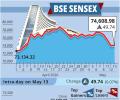
Indian benchmark equity indices, Sensex and Nifty, closed marginally higher, breaking a four-day losing streak, despite elevated crude oil prices and ongoing geopolitical uncertainties. The market saw a temporary pause in panic selling, though cautious sentiment persists.

Indian benchmark indices, Sensex and Nifty, closed almost flat in choppy trade as investors remained cautious due to ongoing uncertainty in West Asia, relentless foreign fund outflows, and anticipation of the RBI's monetary policy decision.

Prime Minister Narendra Modi has called upon India's youth to dream big, assuring them of government support and resources, including a Rs 1 lakh crore Innovation Fund, to bolster the country's burgeoning startup ecosystem and drive its journey towards becoming a developed nation.

Minister of State for Telecom Chandra Sekhar Pemmasani urged BRICS nations to collaborate on building institutional capacity and advocating for fair standards in international telecom and ICT bodies. He highlighted India's willingness to share its modular, open-source digital public infrastructure frameworks like Aadhaar and DigiLocker, emphasising their role in sustainable development and economic growth across the Global South.

Chelsea is undergoing a significant close-season transformation under new manager Xabi Alonso, with major signings like Morgan Rogers.

N Chandrasekaran's exit marks a major shift for TCS, leaving its leadership to navigate AI disruption without the group chairman's deep expertise.

Indian benchmark indices Sensex and Nifty experienced declines in early trade, driven by a surge in Brent crude oil prices above USD 91 per barrel due to escalating tensions between Iran and the US, alongside an increase in US 10-year bond yields. Track Sensex, Nifty on August 18.

Axis Bank has opened 50 new branches across India, while Abakkus Mutual Fund has surpassed Rs 10,000 crore in AUM. YES Bank launched a new credit card for women, and J&K Bank partnered with HDFC Life to enhance its insurance offerings, showcasing significant growth and strategic developments in the Indian financial sector.

Jio Platforms Ltd, the digital and telecommunications arm of Reliance Industries, has approved filing draft papers for an initial public offering (IPO) involving a fresh issue of up to 27 crore equity shares, aiming to unlock value for shareholders and fuel its ambitious expansion into 5G, AI, and global markets.

Amidst a sharp run-up in gold and silver prices, investors are advised to rebalance their portfolios by booking partial profits in precious metals and reallocating to domestic equities and debt, according to financial experts.

Today, many investors are less concerned about holding bullion physically. What matters more is gaining exposure to price movements. As a result, the new-age investment trend has shifted more towards ETFs.

Understanding the most common mistakes during market downturns can help you protect your investments and stay focused on your long-term financial goals, says Ramalingam Kalirajan

JPMorgan has downgraded Indian equities to 'neutral' from 'overweight', citing elevated valuations, rising earnings risks, and limited exposure to next-generation technology like AI. The brokerage believes other emerging markets offer more attractive risk/reward propositions despite India's strong structural growth story.
The divergence between the Sensex and Nifty closing values narrowed on the third day of the Closing Auction Session (CAS) rollout, but market participants, including Zerodha's Nithin Kamath, highlight structural issues and the unfortunate timing of its introduction alongside new RBI norms.
