
Indian manufacturing sector witnessed the fastest improvement in operating conditions in over 17 years in August, driven by an increased production efficiency and healthy demand conditions, a monthly report said on Monday. The seasonally adjusted HSBC India Manufacturing Purchasing Managers' Index (PMI) rose from 59.1 in July to 59.3 in August, indicating the fastest improvement in operating conditions for 17-and-a-half years.

Ahead of the upcoming budget, eminent economists during a meeting with Prime Minister Narendra Modi on Thursday urged the government to take steps to accelerate economic growth and improve infrastructure, sources said. The meeting was organised by the NITI Aayog on Thursday to elicit views and suggestions of economists for the first budget of the Modi 3.0 government. "Earlier today, interacted with eminent economists and heard their insightful views on issues pertaining to furthering growth," Modi said in a post on X.

'This escalation was definitely not part of Gen Z's plan. It seems now that these external forces were keenly observing the initial developments from the sidelines and jumped into the fray, taking advantage of the situation, finding that the time was suitable for such acts'

France today increasingly resembles the Italy of the past, when governments fell with bewildering regularity, prime ministers came and went in rapid succession, and political instability became the norm rather than the exception, point out Krishnan Srinivasan and Manoj Mohanka.

The GST Council on Wednesday approved a two-tier rate structure of 5 and 18 per cent, which will be implemented from September 22.

India's consumer price index (CPI)-based retail inflation rate is likely to have cooled further in June, thus remaining below the 4 per cent target of the Reserve Bank of India (RBI) for a fifth consecutive month, giving the central bank wiggle room to focus on growth. Economists reckon that the decline is on account of easing prices in various categories of goods, especially food items, and a favourable base effect.

India's industrial production growth accelerated to a 4-month high of 3.5 per cent in July this year due to good performance of manufacturing sector, according to official data released on Thursday. The country's industrial output earlier recorded this level of growth at 3.9 per cent in March 2025.
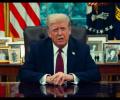
'What the US appears to be doing is to force India to be "the buyer of last resort", on whom their products can be dumped, 1.4 billion people have to eat something, so why not eat American corn?' 'What is exercising the Trump lot is the fact that most of the farms are in solidly Republican Midwestern states: Illinois, Indiana, Kansas, Michigan, Minnesota, Missouri, Nebraska, North Dakota, Ohio, South Dakota, Wisconsin,' points out Rajeev Srinivasan.

Indian economy grew by 7.8 per cent in April-June -- the highest in five quarters -- before the disruptive US tariffs were imposed.

Generative AI is transforming workplaces but at a cost -- there are fewer jobs for young workers just entering the workforce, reveals a Goldman Sachs report.

GST 2.0 may cushion consumers against US tariffs, but like the 2019 corporate tax cut, it risks being another tactical fix rather than a structural growth strategy, expects Debashis Basu.

Donald Trump's tariffs, meant as political punishment, have avoided the predicted chaos, lifting US growth, weakening rivals, and letting him claim victory in a resilient global economy, observes T T Ram Mohan.
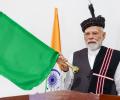
In the last 11 years, India and the world witnessed what he stood for, what he promised and did not deliver, and what he actually stood for and practised without fearing how history would judge him. Modi's tenure has been punctuated with headline-grabbing decisions, symbolic gestures, and stage-managed moments that continue to define his leadership and India's politics, points out Ramesh Menon.

"An Indian citizen has the right of movement in the entire country. There is no mention of territorial rights anywhere in our Constitution," he said.

'The Budget needs to focus more on social welfare schemes.'

Even as the high inflation figure for October has ruled out any possibility of a rate cut by the Reserve Bank of India's (RBI's) monetary policy committee (MPC) in December, a rate cut in February also looks uncertain due to global uncertainties. Economists told Business Standard that unless domestic growth slows markedly, the outlook on rate cut remains unclear. India's headline inflation touched a 14-month high of 6.2 per cent in October, breaching the MPC's upper tolerance band of 6 per cent.

India's manufacturing sector growth strengthened in July to a 16-month high of 59.1, supported by faster increases in new orders and output amid favourable demand conditions, a monthly survey said on Friday. The seasonally adjusted HSBC India Manufacturing Purchasing Managers' Index rose from 58.4 in June to 59.1 in July, signalling the strongest improvement in the health of the sector since March 2024.

'India is cosying up to Xi Jinping. They don't need the Russian oil. It's a refining profiteering scheme.'

The Centre's fiscal deficit stood at 17.9 per cent of the full-year target at the end of June, according to data released by the Controller General of Accounts (CGA) on Thursday. It was at 8.4 per cent of Budget Estimates (BE) of 2024-25 in the first three months of the previous financial year.
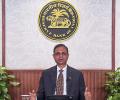
For the time being, the RBI is done with the cuts. A cut in October, which many are still predicting, is not certain. Of course, if growth nosedives, the script will be different, expects Tamal Bandyopadhyay.

Since February 2025, the RBI has reduced the policy rate by 100 basis points. In its previous policy review in June, it had trimmed the repo rate by 50 basis points to 5.5 per cent.
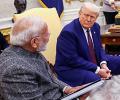
To those who ask, "Is all this really worth it? Why can't domestic demand fill the gap?", it is important to remind them that only 13 economies since the Second World War have grown at 7 per cent or more for 25 years -- like India needs to. They all had one thing in common: Strong export growth underpinned by strong global engagement, explains Sajjid Z Chinoy.

The Indian services sector growth touched an 11 month high in July, supported by a pickup in new exports orders and sharp rise in overall sales, a monthly survey said on Tuesday. The seasonally adjusted HSBC India Services PMI Business Activity Index was at 60.5 in July, little-changed from 60.4 in June, and the rate of expansion was the best seen since August 2024.

'The biggest point of contention is market access for US agricultural and dairy products.'

India's goods exports rebounded in July after two months of contraction, with outbound shipments rising 7.3 per cent to $37.24 billion, led by a surge in exports to the United States before the country's reciprocal tariff kicked in and bolstered by a recovery in exports to other key markets.
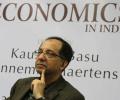
Former World Bank Chief Economist Kaushik Basu on Thursday said the US economic policy towards India has taken an unfortunate turn, noting that President Donald Trump's harsh stance against New Delhi appears baffling. US President Donald Trump on Wednesday announced a 25 per cent tariff on Indian goods from August 1, amid signs of a stalemate in the ongoing bilateral trade negotiations between the two countries.

The Reserve Bank of India's (RBI) Monetary Policy Committee's (MPC) decision to cut the repo rate by 50 basis points (bps) to 5.5% was contrary to the expectations of many economists. Firstly, most of the economists expected the MPC to cut the repo rate by 25 bps citing the weakening of inflation, prospects of economic growth, geopolitical uncertainty and comfortable system liquidity.
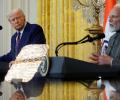
The deal fell through over unresolved disagreements over contentious issues, mainly on agriculture and automotive sector tariffs.

The 25 per cent US tariffs, plus a penalty for Russian imports, could dent India's GDP growth by 30 basis points in the current fiscal, but the higher duty is unlikely to significantly affect India's domestic demand-driven economy, Barclays said on Thursday. If the 25 per cent tariff, announced by US President Donald Trump on Wednesday, is implemented from August 1, the effective average US import tariff on Indian goods will rise to 20.6 per cent in trade-weighted terms, as per Barclays estimates.

Retail inflation declined to over six-year low of 2.1 per cent in June, nearing the RBI's comfort zone, on account of subdued prices of food items, including vegetables, driven by widespread monsoon.
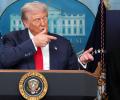
In trade negotiations, as in chess, sometimes you need to accept a temporary disadvantage to secure a better long-term position, points out Sonal Varma, chief economist (India and Asia ex-Japan) at Nomura.

The Budget for 2024-25 should focus on employment generation, besides promoting the manufacturing sector, economists attending the pre-Budget consultation meeting with Finance Minister Nirmala Sitharaman here on Wednesday said. The meeting was attended by National Co-convenor Swadeshi Jagran Manch Ashwani Mahajan, Director and Chief Executive of the Institute for Studies in Industrial Development (ISID) Nagesh Kumar, and TCA Anant among others.

India will take all necessary steps to safeguard and promote national interest, Commerce and Industry Minister Piyush Goyal said on Thursday, a day after US President Donald Trump announced 25 per cent tariffs plus penalty on domestic exports to America from August 1.

Office space owners are looking at good times ahead as rentals are expected to rise due to demand for Grade A office spaces outpacing supply that has been sluggish due to construction delays, long gestation periods and developers' interests shifting to residential.

In Professor Sulochana Gadgil's passing, India has lost a scientific giant, a fierce intellect, and a compassionate soul, remembers Dr Madhavan Nair Rajeevan.

Ranade was earlier removed from the position on September 14 by the then chancellor Bibek Debroy, after a fact-finding committee concluded that his appointment as the GIPE's VC did not conform to the UGC regulations on minimum qualifications for the appointment of teachers and other academic staff.

The point to note for India is that we must not panic. The United States may be our largest export destination, but high tariffs will not exactly mean gloom and doom. Sure, we can throw some morsels as we continue negotiating, but we must be firm that some red lines cannot be crossed, no matter what, asserts Shreekant Sambrani.

Trump's new rules for how countries should treat him have led to the current breakdown in India-US relations, explains Ambassador T P Sreenivasan.

'...they always address problems superficially, never tackling root causes.' 'Currently, the policy response will focus on immediate relief -- getting people to safety, providing facilities, clearing debris.' 'This is necessary, but once immediate relief operations end, everything returns to 'normal' without addressing underlying vulnerabilities.'

Commerce Minister Piyush Goyal assures Parliament that India will take necessary steps to protect its national interests following the US announcement of tariffs on Indian goods. The government is assessing the implications and engaging with stakeholders.
 © 2026 Rediff.com - Investor Information - Advertise with us - Disclaimer - Privacy Policy - Sitemap - Feedback - About us - Terms of use - Grievances