
Lavrov said that the US has set itself the objective of 'achieving economic domination', adding further to it that Americans want to control the routes to leading countries to provide its energy sources to them.
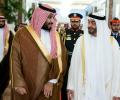
What began as a mentor-protege relationship between UAE President Mohammed bin Zayed and Saudi Crown Prince Mohammed bin Salman has now evolved into a broader contest over influence, strategy, and leadership in the Middle East, points out Asif Ullah Khan.
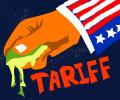
India must focus on building enduring national capabilities and economic sovereignty in the face of shrinking space for rules-based trading, anti-immigrant stance, weaponization of energy sources and growing use of export controls in critical sectors, the Economic Survey said on Thursday.
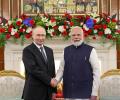
Luckily for us, a Russia that is desperate to stay relevant in an emerging multipolar world finds in India a reliable geostrategic partner. The Russian proximity to India also keeps China from exploiting its economic dominance vis a vis Russia, points out Colonel Anil A Athale (retd).
If the US' renewed closeness with Pakistan ends up strengthening Pakistan's military, it will clearly show that Washington no longer wants a strong India and could be ready to let China dominate Asia, notes Colonel Anil A Athale (retd).

The stock and bond markets told Trump firmly that any idea of isolating China would lead to harming the US economy and this forced Trump to backtrack, points out Aakar Patel.

Active participation in multilateral co-operation can be India's response to China's growing economic presence.

There is a growing sentiment in the world and the global South in a way embodies it. But there's also political resistance, he said.

Policymakers should aspire to restore the pre-Independence environment where the rupee was trusted and used all over South Asia, in Southeast Asia, in West Asia, and in East Africa, suggests Ajay Shah.

Indian policymakers are almost alone, alongside the United States, in seeking a hard and multi-sectoral global decoupling from China in the expectation that it will boost their economies, observes Mihir S Sharma.

Since 2012, 44 Indians have been anointed as grandmasters -- the highest achievement in chess, points out Arvind Subramanian, economist and former chief economic adviser to the government.

'I hope that the incoming Biden-Harris Administration works with India to address some of the most profound geopolitical transboundary challenges.'

Economist Arvind Subramanian's new book, Eclipse: Living in the Shadow of China's Economic Dominance, defies the mainstream consensus of thinkers like Harvard's Joseph S Nye, Jr (author of The Future of Power) and Niall Ferguson that America's dominance is omnipotent vis-a-vis China.
By 2030, China will exercise dominance while still being only an upper middle-income country.
Using purchasing power parity estimates narrows the differences between the two economies.

Iran's decision to keep India out and welcome China to the scene is a huge strategic setback for India, observes Dr Rajaram Panda.

The India-Japan joint naval exercises are a strategic signal for China, observes Dr Rajaram Panda.

This is a high-stakes strategic conflict between a power which wants to preserve the status quo in its favour and one which wants to usurp that throne. The rest is all theatre, says Harsh V Pant.

The Chinese had enough foreign reserves.

Ground surveys have found that several members of the dominant castes are in economic conditions quite similar to that of peer communities with the advantage of quotas.

Questioning the bullet train in view of the investment needed in Indian Railways is similar to saying that India needed to invest in primary education rather than in IITs, says Shreekant Sambrani.
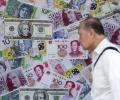
For several years the Chinese authorities have been taking steps to internationalise the use of the yuan.

'In contrast to the generally buoyant tone of the Economic Survey in January, he sounds uncharacteristically pessimistic, saying that forces in the world economy -- slowing global trade, protectionism, robots -- will limit India's manufacturing to levels well below what propelled East Asia's economies decades ago.'

The WTO toolkit provides various instruments to deal with such situations - anti-dumping duties, countervailing duties and safeguard measures.
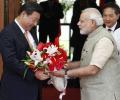
Arvind Subramanian talks about US and China's power play and where India figures in these dynamics.
.jpg)
India's fear of small states derives from memories of Partition and the paranoid view that it will break up under 'too many' states. It's time to shed such fears and bite the 'states' reorganisation' bullet. India won't crumble under a few more Telanganas, Vidarbhas or Gorkhalands, says Praful Bidwai.
 © 2026 Rediff.com - Advertise with us - Disclaimer - Privacy Policy - Sitemap - Feedback - About us - Terms of use - Grievances