Chhattisgarh Deputy Chief Minister Vijay Sharma announces the impending surrender of senior Maoist commander Papa Rao and his team, a significant step towards eradicating Naxalism in the state.

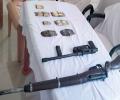
108 Maoists surrendered in Chhattisgarh's Bastar district, yielding a large cache of weapons and cash. The surrender highlights the government's success in combating Left Wing Extremism and the weakening of Maoist ideology.
The Bastar region of Chhattisgarh, India, is transitioning away from decades of Maoist conflict, with plans to convert security camps into public infrastructure. A senior Maoist commander recently surrendered, marking a significant step in the government's efforts to eliminate Naxalism.

A senior Maoist commander, Papa Rao, surrendered with his team in Chhattisgarh, signalling a significant blow to Left-Wing Extremism in the region. This event underscores the impact of sustained security pressure and rehabilitation efforts on the Maoist movement.
In a significant victory for the government's anti-Naxal efforts, 108 Maoists, including 44 women, surrendered in Chhattisgarh's Bastar district, citing disillusionment and the appeal of rehabilitation programs. The surrender also led to the recovery of a large cache of weapons and valuables.
After more than four decades, Chhattisgarh's Bastar region has been declared free of Left-Wing Extremism (LWE), marking the end of the armed Maoist rebellion in the area. The decline is attributed to sustained security operations, improved governance, and socio-economic development initiatives.
Fifteen Naxalites, including a veteran ultra with a significant bounty, surrendered in Chhattisgarh, effectively dismantling the Maoist movement in the Raipur-Sambalpur region.
Three Naxalites, including a woman, carrying a reward of Rs 12 lakh, were killed in an encounter with security personnel in Chhattisgarh's Sukma district. The encounter took place in Gondiguda, and a large cache of arms and explosives were recovered.

Three senior leaders of the banned CPI (Maoist) surrendered to the Telangana police. The leaders cited health issues, ideological differences, and changing socio-political circumstances as reasons for their surrender. The Telangana DGP appealed to other underground Maoist cadres to return to the mainstream.

Senior Naxalite Mallojula Venugopal Rao, also known as Bhupathi, surrendered to police in Maharashtra's Gadchiroli district along with 60 other cadres. Bhupathi, a key strategist in the banned organization, carried a significant bounty.

'The biggest game changer has been the belief among Maoists that they can surrender and join the mainstream'
A hill with an altitude of 5,000 feet, once a hub of the Maoists along the Chhattisgarh-Telangana border, was reclaimed by the security forces after driving out the extremists following nine days of intense anti-Naxal operation, official sources said.
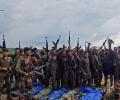
Originally hailing from Andhra Pradesh, the 67-year-old was involved in indoctrination and radicalization of youth and also responsible for numerous Maoist attacks in Chhattisgarh, resulting in the death of civilians and security personnel, they said.

Maoists have admitted that 28 cadres, including their top leader Basavaraju, were killed in an encounter with security forces in Chhattisgarh's Bastar region last week. The Naxals also claimed that some of their cadres had surrendered to police and provided information that led to the operation. Police have recovered a large cache of weapons, including an AK-47 looted by Basavaraju from security forces in a 2010 ambush.
A massive anti-Naxal operation involving around 10,000 security personnel along the Chhattisgarh-Telangana border entered its fifth day on Friday, with the Maoists reportedly issuing a statement calling for a halt to the exercise and initiating "peace talks." The statement, circulating on social media, claims that the government is resorting to repression and violence despite the possibility of resolving the issue through dialogue. The operation, considered one of the largest counter-insurgency actions in the Bastar region, involves personnel from various units including the Chhattisgarh police, the Central Reserve Police Force (CRPF), and its elite CoBRA unit. The operation, launched on Monday in the densely forested hills of Karregutta and Durgamgutta along the inter-state border, is aimed at targeting PLGA battalion No. 1, the strongest military formation of the Maoists.
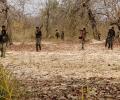
A cache of weapons, including an AK-47 rifle, one SLR (self-loading rifle), one INSAS rifle, one LMG rifle and one .303 rifle were also recovered from the encounter spot.

As many as 14 Maoists were killed in an encounter with security personnel in Chhattisgarh's Bastar region on Friday, a senior police official said. However, ANI has put the toll at 30.

Ramanna was instrumental in several killings and attacks on security forces, including the 2010 Tadmetla massacre that claimed the lives of 76 troopers. He was also involved in the 2013 Naxal attack in Darbha valley where 29 people, including some senior Congress leaders and policemen, were killed.

"With the death of RK, the outlawed CPI (Maoist) has lost its three central committee members and as many other senior cadres in the last two years. These deaths would certainly deplete the strength of the Naxal movement which has been losing its ground. Security forces would make an all-out attempt to soon bring an end to the five-decade-long mindless violence by ultras in the region," Inspector General of Police (Bastar range) Sundarraj P said.
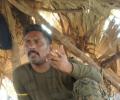
In this photograph, which is being circulated on social media, Manhas, a commando with the 210th CoBRA battalion of the Central Reserve Police Force (CRPF), is seen sitting in a hut alone without any Naxal in the frame.
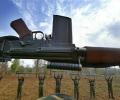
Despite major setbacks, the Maoists' ability to inflict damage on the State and maintain its position as the saviour of the tribals will keep them relevant, says Bibhu Prasad Routray.
