
For the first time, the Chinese military on Thursday acknowledged last year's incursion at the DepsangValley in Ladakh region and said such incidents occurred due to different perception about the Line of Actual Control.

Tacitly acknowledging the withdrawal of its troops from Depsang Valley in Ladakh, China on Monday said the "stand-off incident" with India has been resolved through "fruitful consultations," keeping the larger interests of bilateral relations in mind.

India and China on discussed the recent intrusion by Chinese troops at the Depsang Valley during External Affairs Minister Salman Khurshid's two-hour-long meeting with his Chinese counterpart Wang Yi.
China on Wednesday called for "proper and timely" settlement of the boundary issues with India to preserve peace at the borders in the light of the row over Depsang Valley in Ladakh where the troops of People's Liberation Army intruded recently.

India and China on Tuesday held talks to finalise details of External Affairs Minister Salman Khurshid's visit to Beijing and Chinese Premier Li Keqiang's trip to New Delhi, a day after both sides withdrew their troops from the Depsang Valley.

China on Thursday declined to give any timeline for withdrawal of its troops from Depsang valley in Ladakh but said the issue that has sparked new tensions in bilateral ties "will be properly resolved soon through negotiations".

Chief of Army Staff General Bikram Singh briefed Prime Minister Manmohan Singh and the Cabinet Committee on Security on the incursion by Chinese troops in Ladakh. "The CCS met today and the army chief briefed us on the Ladakh situation," Finance Minister P Chidambaram told reporters after the meeting.
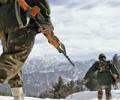
"Negotiations are going on at various levels to resolve the issue peacefully," Defence Minister A K Antony told media persons in Bengaluru.
China and India should "examine" the recent border stand off in Depsang Valley in Ladakh and be able to resolve such incidents "much quicker" in the future, External Affairs Minister Salman Khurshid said on Friday.
India will take up with Chinese Premier Le Kequiang the issue of the recent intrusion by the People's Liberation Army troops into Depsang valley in Ladakh and wants to push ahead with the bilateral dialogue on settling the border row.

External Affairs Minister Salman Khurshid arrived in Beijing on Thursday on a two-day visit to hold talks with Chinese leaders, just days after the resolution of a row over Depsang Valley in Ladakh, where the troops of People's Liberation Army intruded recently.
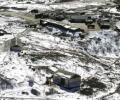
Bharatiya Janata Party President Rajnath Singh on Sunday demanded cancellation of External Affairs Minister Salman Khurshid's May 9 visit to China till it withdraws its army personnel from DepsangValley in Ladakh where they intruded a fortnight back
External Affairs Minister Salman Khurshid will go ahead with his visit to China on May 9 notwithstanding the ongoing standoff between Indian troops and Chinese forces which intruded deep inside Depsang Valley in Ladakh ten days back.

Ignoring India's demand to revert to a status-quo in Depsang Valley, China on Wednesday firmly stuck to its stand that its troops have not violated the Line of Actual Control "by a step" in the Ladakh region.
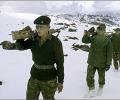
Three months after the 21-day stand-off in Depsang valley in Ladakh, Chinese troops again came deep inside the Indian territory in that area last week to reach upto 2 kms close to Indian posts, in one of five such incursions in the recent past.

China on Monday said Defence Minister A K Antony's visit Beijing has given both countries an opportunity to enhance their "strategic cooperative partnership" and jointly maintain peace and tranquillity in the border areas through increased military-to-military coordination.
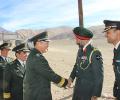
Amidst reports of Chinese incursions, the Peoples Liberation Army and the Indian Army on Sunday decided to uphold treaties and agreements signed between the governments of the two sides to maintain peace and tranquility along the Line of Actual Control.

China on Tuesday dismissed reports of fresh incursions by its troops into India as "routine patrolling" and asserted that both countries have a very effective and smooth mechanism to handle border incidents.

Senior commanders of the two armies held intense negotiations for nearly 11 hours on Sunday at a designated meeting point in Moldo on the Chinese side of the Line of Actual Control.

Border incursion, the finalisation of the Border Defence Coordination Agreement (BDCA), a new mechanism suggested by China last year for improving security at the borders, pending the final settlement of the territorial dispute, top Antony's agenda for talks.
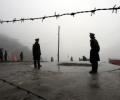
India is concerned about periodic provocative incursions by Chinese troops that have resulted in "eyeball-to-eyeball confrontations", but was hopeful that the border issues will eventually be settled.

In a subtle show of strength to China, the Indian Air Force on Tuesday landed its C-130J Super Hercules transport plane at the world's highest and recently-activated Daulat Beg Oldie airstrip in Ladakh near the Line of Actual Control, the scene of a stand-off with Chinese troops in April.

The Border Defence Cooperation Agreement inked between India and China on Wednesday facilitates establishment of a hotline between the military headquarters of the two countries, besides border personnel meeting sites in all sectors receiving broad directive not to tail each others' patrols along the disputed borders.
India and China are trying to develop effective mechanisms to prevent the "embarrassing" face-offs between their troops along the "disputed" points of the Line of Actual Control, Defence Minister A K Antony said in New Delhi on Friday.
Virtually defending the latest incursion by the People's Liberation Army in the Chumar sector in Ladakh, China on Thursday said its troops were patrolling on its side of the Line of Actual Control and asserted that "status quo" should not be changed pending a final settlement.

'Problems will keep recurring unless China vows to resolve all outstanding issues between the two sides,' says Sana Hashmi.
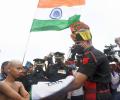
'This Chinese behaviour we have not seen for a very long time.' 'This sort of build up on the border, this pattern in Chinese behaviour, and especially the aggression and brutality with which our people were attacked on the 15th of June, this is not something we have seen before.'
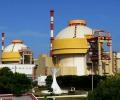
India and Russia are involved in talks to sort out the nuclear liability issues before they sign an agreement for setting up Units III and IV of the Kudankulam power plant in Tamil Nadu during Prime Minister Manmohan Singh's annual summit with President Putin in Moscow next week.

Special Representatives of India and China will hold the 16th round of boundary talks in Beijing on Friday, the first such meeting under the new Chinese leadership, to make another bid to move forward on the resolution of the vexed dispute.

'China knows the best way of twisting the knife in its dealings with India: By launching a major incursion into Indian territory,' says Rajeev Sharma.

Prime Minister Manmohan Singh on Sunday left for a five-day visit to Russia and China.

Nevertheless, border dispute will feature prominently on Modi's agenda but the matter won't be discussed at length. Nayanima Basu reports
Playing down recent border stand off in Ladakh ahead of Premier Li Keqiang's visit to India, China on Thursday said the two sides have the ability to prevent such issues from affecting overall growth of ties, while working "very hard" to find a solution at an "early date".

Playing down the continuing standoff at the Ladakh border region, China's military on Thursday said such incidents are "sometimes inevitable" but the situation is under "effective control" with the joint efforts of the two sides.

India and China decided to seek a fair and rational solution to their border dispute on Saturday as they focused on the proposed border defence cooperation agreement to avert incursions like the one witnessed in Leh region last month.

How to deal with a country that has made export of terror a reason to make the world notice and fund it? Rediff.com contributor Sanjeev Nayyar offers a few suggestions
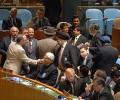
'Under Narendra Modi's leadership, we will be able to regain our rightful place in the community of nations,' veteran diplomat Hardeep Singh Puri, who joined the BJP on January 2, tells Rediff.com's Sheela Bhatt.
 © 2026 Rediff.com - Advertise with us - Disclaimer - Privacy Policy - Sitemap - Feedback - About us - Terms of use - Grievances