
For Bharatiya Janata Party's chief ministerial candidate Harsh Vardhan, retaining his stronghold of Krishna Nagar for the fifth consecutive term may not be very difficult though Congress' V K Monga, a popular face in the area, is likely to make the contest interesting.

'The loose use of words like foreigner or Bangladeshis obscures the fact that the post-Partition migration to Assam has been of both Hindus and Muslims.'

Indian Prime Minister Narendra Modi who envisioned Make In India last September was at his eloquent best as he made a fervent plea to global businesses to come Make In India.

Modi's real problem is not his silence on Hindutva excesses growing in the country. He needs to transform India without the minute-by-minute tweets.

'No civilised nation can thrive if it is possessed with the spirit of Hindutva.'

'For years, a whispering campaign against the non-Nagas -- and occasional violence -- has dominated the local discourse, but Farid Khan's lynching was unprecedented in its ferocity.'

"India has become the fastest growing major economy in the world. Despite the global slowdown, we have registered excellent growth. Today, India is a bright spot in the global economy. We are seen as the engine of global growth," he said.

For India's leading MFI-turned bank, the challenge is to stay competitive while pricing its loans
There are perks for banking with the newest bank in India.

'In the last one year, it looks like there were bad things that didn't take place, and there were good things that didn't take place,' says Rajeev Srinivasan.
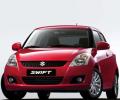
Paris-based international advisory firm Mazars predicts four per cent growth in India's automobile sector this financial year.
'People are more interested in India now than ever before.'

Asserting that "maritime muscle flexing" by some countries and other factors have made the Indo-Pacific region "more contested and more volatile," naval chief Admiral Sunil Lanba on Tuesday said that the Indian Navy has its task cut out as it has been a major security provider in the region.

The preference for digital banking now cuts across all customer segments.

'Unity in diversity is a dated notion as India, today, is more unified and cohesive and yet more pronouncedly diverse than ever in its history,' argues Shekhar Gupta.

ISB professor Tarun Jain talks to Shobha Warrier/Rediff.com about what the government must do to achieve 8 pc growth.
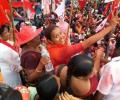
Rampant corruption by Congress ministers must be counted as the single biggest factor to prompt the electorate to hand over a thumping mandate to the Communist parties, says M K Bhadrakumar.
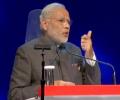
"Reform is not an end in itself. Reform for me is just a way station on the long journey to the destination. The destination is the transformation of India," he said.
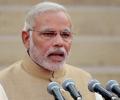
Why does Modi want to speak to the students while his audience should be teachers and parents, not necessarily in that order. And September 5 is not Children's Day but Teachers' Day, says Mahesh Vijapurkar.
Eight states and Union Territories have Muslim share of population in excess of national average of 13 per cent. Mayank Mishra report

'Over the next 10 years we expect more than 100,000 new start ups to come up and create more than $500 billion in value and 3.5 million to be employed in these start ups.' 'And these are the start ups that will be solving India's problems.'

'Modi is a symbol of Asia Rising; and, for the first time in decades, a non-white has the potential to be the most compelling global leader.'

Economist Dale W Jorgenson declares that India is doing "very, very well" and forecasts that India might continue to outrun world economies, including China over the next many years.

Narendra Modi's speech at the India Economic Convention was the best such oration since Atal Bihari Vajpayee addressed the nation from the Red Fort in the aftermath of Kargil, feels Shreekant Sambrani.
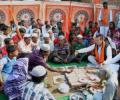
The million dollar question that begs for an answer is: Why is it that an amateurish attempt to convert a handful of Muslims by fringe Hindu elements garners so much attention while large scale systematic attempts to subvert Hinduism go unnoticed or are deliberately overlooked? If this is not double standards then what is, asks Vivek Gumaste.

Two young designers from Meghalaya are making a positive impact with their skills.

'When the youth population is so large, in a globalised world, they look for opportunities. Are there enough opportunities for the youth in India?' 'The idea of affirmative action has to be creating capability. All individuals have potential. Unfortunately, there is capability deprivation because of the State's inaction.' 'Nation building has been a disaster in India mainly because we lacked the work ethic compared to the US and European countries.'

'People are tense. The morale of the perpetrators of the Kaliachak attack is very high.' 'People there fear that if the arsonists there could burn the police station today, they can burn the courts tomorrow; they will burn the collectorate.'

Prime Minister Narendra Modi on Tuesday said Australia will not be at the periphery of India's vision but at the centre of its thought, as he called for closer bilateral security cooperation and a comprehensive global strategy to tackle the menace of terrorism.

'India should think big: About how in a multi-polar world, India can indeed be one of the poles, rather than being a secondary power that has to worry about 'alignment' with one of the poles. A G3 in other words, India should look to getting others to align with itself rather than the US or China,' says Rajeev Srinivasan.

Parekh said divestment can unlock huge funds.

President Pranab Mukherjee on Monday addressed the first joint sitting of Parliament as mandatorily required under the Constitution after the general elections. The address is the political, economic and foreign policy road map of the Narendra Modi government and covers virtually all crucial areas.
