
The main objectives of test-firing were to validate safe separation of the missile from the parent aircraft, effect of missile plume on engine air-intake, functionality of store management system, including safety interlocks, effect of missile plume on composites structures and handling quality assessment during missile launch.

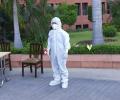
Scientists have applied their technical know-how and expertise in textile, coating and nanotechnology to develop the PPE having specific type of fabric with coating.

Like most army combat uniforms, this one has been designed to serve two requirements: First, protection against harsh climatic conditions, including extreme heat and cold. Second, the need to provide soldiers' outfits with field camouflage, so as to increase his battlefield survivability.
The army confirmed that they will buy 12 Nishant Unmanned Aerial Vehicle for reconnaissance and surveillance operations, a top Defence Research and Development Organisation official said on Friday.

Chaos prevailed outside a newly-inaugurated 900-bed Covid-19 hospital in Ahmedabad as people flocked there in large numbers since early morning on Thursday with the hope of securing admission for their ailing family members and relatives.
Till now, India has been importing Israeli-made 'Heron' medium and high altitude series of UAVs for the three services, which are using them extensively for surveillance operations in Jammu and Kashmir and certain other strategic areas.
BrahMos is unique among cruise missiles due to its 2.8 Mach supersonic speed (all other cruise missiles are sub-sonic at present) and much-longer strike range.

It was decided that the senior-most Army officer in a state would get in touch with the chief minister to understand the requirement and take forward the process, including offering to treat civilians wherever possible
India is planning three more tests of the nuclear capable Agni-III missile with a range of 3000 km.

The missile has a strike range of 2000 km, the sources said soon after it blasted off from a mobile launcher at the Launch Complex-4 of the Integrated Test Range, the sources said.
India is almost ready with its undersea launch version of the supersonic BrahMos cruise missile and wants the navy to help in preliminary test trials by the end of the year.
Defence Research and Development Organisation scientists have traced the possible fault that caused the failure of the first test of Agni-III missile on July 9 and are addressing it, DRDO Director General M Natarajan said.
The Defence Research and Development Organisation (DRDO) has prepared the design of the aircraft while HAL is producing the engine and other parts.

The army has long been deficient in artillery, the modern battlefield's most lethal killer, says Ajai Shukla.
India succefully test-fired a 3,000-km Agni-III missile on April 12 this year.
Defence sources said the missile, which was launched from a mobile launcher at 3.15 pm, successfully hit a target attached to a pilotless target aircraft.
While it was not directly suggested that the COVID-19 pandemic was related to biological warfare, it is significant that the government is exhorting military laboratories to work concertedly on biological defence.
Highly placed sources said the test firing could take place any time this month.
Defence Minister Pranab Mukherjee has ruled out any move to convert the short range surface-to-surface Prithvi missile into an anti-missile or a nuclear shield.
He is eminent technologist M Natrajan, project director of the country's indigenous main battle tank Arjun.

More than 100 BrahMos missiles are planned to be built in the next three years.
What President Kalam told young scientists at DRDO.
The Defence Research and Development Organisation has initiated talks with the Indian Air Force to design and develop a fifth generation fighter plane, to be called Medium Combat Aircraft (MCA).
Among them was P Venugopalan, leading designer of the propulsion systems for Prithvi, Agni and BrahMos missiles.

Agni-V is a three stage missile, 17 metres tall, two metres wide and capable of carrying 1.5 tonne of nuclear warheads.
Design engineers are critical to producing state of art weapons like submarines, electronic warfare system, setting up networking of armed forces and for forays into frontiers of space and missile technology, he added.

DRDO's Air Independent Propulsion system will allow Indian Navy submarines to operate for up to two weeks without having to surface to recharge its batteries.

Dr Bhabha and Dr Sarabhai didn't feel guilty for their ambitions; it was for those 'mad scientists' that India is a powerhouse -- both at the atomic level and in the vastness of space, observes Kumar Abishek.
It will be ready for field trials by the end of December, the government told the Lok Sabha.
It was the naval version of Prithvi, which has a range of 250 to 300 km.
The revival of the AWACS project comes after five years DRDO's HS-748 technology demonstrator aircraft crashed killing some DRDO scientists and technicians in Tamil Nadu in 1999.

The HSTDV is capable of powering missiles to attain a speed of around Mach 6 or six times the speed of sound, the officials said, adding only a very few countries like the United States, Russia and China have such a capability.

Government sources said that since the allegations were of a serious nature, the CBI has been asked to probe.
 © 2026 Rediff.com - Advertise with us - Disclaimer - Privacy Policy - Sitemap - Feedback - About us - Terms of use - Grievances