
India's eight key infrastructure sectors grew at a slower pace of 1.8 per cent in November against 5.8 per cent in the same month last year, amid a dip in production of crude oil, natural gas, refinery products, and electricity, according to official data released on Monday.

The value of the rupee, which has slipped to the 92 per dollar mark, does not accurately reflect India's stellar economic fundamentals, the Economic Survey said on Thursday.

India and the US have agreed to a trade deal that will see Washington reduce reciprocal tariffs on Indian goods from 25% to 18%, according to US President Donald Trump. The deal also includes commitments from India to reduce tariffs and non-tariff barriers against the US and to increase purchases of American products.

India and the US are expected to sign the first phase of a bilateral trade agreement by mid-March, which will result in the US lowering import duties on Indian goods. India will then begin reducing import duties on certain US goods.
India and the US are expected to sign the first phase of a bilateral trade agreement by mid-March, which will result in the US lowering import duties on Indian goods. India will then begin reducing import duties on certain US goods.

US Treasury Secretary Scott Bessent indicated a potential pathway to remove tariffs imposed on India for purchasing Russian oil, citing a significant decrease in such purchases. He also criticized Europe's approach and accused India of profiting from discounted Russian oil.

From the Sensex pack, Sun Pharma, Eternal, Tata Motors, Bajaj Finance, IndusInd Bank and Bajaj Finserv were among the major laggards. In contrast, Tech Mahindra, Infosys, Asian Paints and Maruti were among the gainers.

A 500 per cent tariff would effectively shut out India's goods and services exports to the US.

Market sentiment is likely to remain cautious as investors position themselves for the upcoming Union Budget and the US Fed's interest rate decision, where expectations are muted.

Reliance Industries Ltd on Thursday said it has halted the use of Russian crude at its export-only refinery in Jamnagar, Gujarat, as the company moves to comply with European Union sanctions. Reliance is India's largest buyer of Russian oil, which it processes and turns into fuel, such as petrol and diesel, at its giant oil refining complex at Jamnagar.

Finance Minister Nirmala Sitharaman's biggest challenge will be to find a new growth driver, particularly against the backdrop of a global economy ravaged by heightened uncertainty and fragmentation, financial markets on a precipice, and global commodity prices on a continued uptrend.

In an event-heavy week ahead, stock markets are expected to track Q3 corporate earnings from several blue-chip firms, including TCS and Infosys, while inflation data and global trends would also dictate investors' sentiment, analysts said.
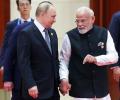
Prime Minister Narendra Modi will host Russian President Vladimir Putin for a private dinner and summit, focusing on defence, trade, and geopolitical issues, including the Ukraine conflict and the impact of US sanctions.
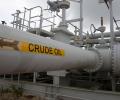
India's exports to the US contracted 8.6 per cent to $6.3 billion in October, while imports rose 13.9 per cent to $4.5 billion leading to a trade surplus of $1.8 billion during the month.

India has called for a ceasefire, release of all hostages, and peaceful resolution of the Israel-Hamas conflict through dialogue and diplomacy. The Centre informed Parliament that India welcomed the agreement on the first phase of the Gaza Peace Plan. The article also covers India's energy sourcing strategy and the release of Indian fishermen by Pakistan.

Shares of Reliance Industries Limited (RIL) tumbled on Tuesday, posting its biggest single-day decline in 19 months, amid controversy over its purchase of Russian oil and profit-booking after recent gains.

The fiscal tilt towards capex benefits companies in investment-related sectors like capital goods, defence equipment, engineering & construction and metal & mining. The planned cut in revenue expenditure will weigh on companies in consumption sectors like FMCG, consumer durables and retail.

Indian private sector and State-run refiners continued to receive crude oil from Russian suppliers even after November 21 -- the winding-down date for US sanctions on supplies from leading Russian oil producers imposed in October -- as new intermediaries sprung up in West Asia to sell the oil, according to senior refining sources and ship tracking data.
India has gained the least since Russia invaded Ukraine in February 2022 and was penalised the most, while the US, China and the European Union emerged as the biggest beneficiaries from the war.

Russian President Vladimir Putin arrived in New Delhi for a two-day visit focused on strengthening ties with India, including defense cooperation and trade, amidst a changing geopolitical landscape.

Gor also announced that India will be a member of the Pax Silica alliance.

After a three-month slowdown, India's oil imports (already landed) from Russia bounced back in the first 15 days of October to 1.8 million barrels per day.

India's exports jumped by 19.37 per cent to $38.13 billion in November, while imports dipped by 1.88 per cent to $62.66 billion, according to government data released on Monday.

Oil marketing companies (OMCs), paint manufacturers, tyre producers, and aviation stocks witnessed significant gains as Brent crude oil prices slipped below $70 per barrel. The price drop came after a double blow: The US imposed tariffs on Canada and Mexico, including energy imports, and OPEC+ - the group of major oil-producing nations including Russia - announced an output increase of 138,000 barrels per day, the first such hike since 2022.

The rupee breached 90-levels against the greenback for the first time on Wednesday, falling 6 paise to 90.02 in early trade, as banks kept buying US dollars at higher levels and FII outflows continued.

Putin's State visit will centre on fixing the huge India-Russia trade imbalance, with both sides pushing to lower duties, ease non-tariff barriers, and seal a landmark mobility pact to send more Indian workers to Russia.

India's decision to import LPG from the US helps it to diversify sources as it reduces almost full reliance on West Asian countries for supply of the country's primary cooking fuel.
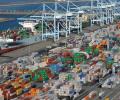
'The immediate impact for India will be very minimal as the share of Venezuela in our total overseas production is very low.'

India is preoccupied with analysing the US sanctions, which may cut off India's access to discounted Russian crude and force it to buy at market prices.

Russian President Vladimir Putin's visit to India this week aims to secure energy supplies, stabilise defence deliveries and ensure bilateral trade continues smoothly despite strong Western sanctions, GTRI said on Tuesday.

In a first, Indian oil public sector undertakings (PSUs) finalised a one-year contract to import around 2.2 million tonnes (mt) of liquefied petroleum gas (LPG) from the US. The LPG import deal comes at a time when negotiations for an India-US bilateral trade agreement (BTA) are gathering steam. Earlier in the month, US President Donald Trump had said Washington and New Delhi were "pretty close" to reaching a fair trade deal.

The Indian economy is likely to grow at 7.4 per cent in 2025-26, up from 6.5 per cent in the previous fiscal, mainly on account of better performance of manufacturing and services sectors, as per the government data released on Wednesday.

Shares of tyre manufacturers have outperformed broader equity benchmarks, buoyed by multiple tailwinds. Softer raw material prices, an uptick in demand from automakers following the reduction of the goods and services tax (GST) rates, and steady replacement demand have lifted sentiment toward the sector.

'Incidentally, Prime Minister (Modi) and President Trump have also spoken on the phone on eight occasions during 2025, covering different aspects of our wide-ranging partnership'

WPI inflation data, trading activity of foreign investors and global cues would dictate trends in the stock market this week, analysts said.

Growth of eight key infrastructure sectors remained flat in October as expansion in output of petroleum refinery products, fertiliser and steel was offset by a contraction in coal and electricity production, according to official data released on Thursday.

Stock markets are likely to trade in a range-bound manner in a holiday-shortened week where trading activity of foreign investors, currency movement and global macroeconomic data announcements are expected to drive sentiments, analysts said. Several global markets may see subdued activity on account of Christmas and New Year holidays, an expert said.
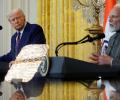
US President Donald Trump warned India about potential tariffs for continuing to purchase oil from Russia, claiming he received assurances from Prime Minister Narendra Modi that India would halt such purchases.

Ukraine claimed responsibility after explosions hit the vessels on Friday and Saturday.

India, the world's third-largest oil consumer, spent 2.5 billion euro on buying crude oil from Russia in September, 14 per cent less than the previous month, a European think tank said. India remained the second-largest buyer of Russian fossil fuels in September behind China, according to the Centre for Research on Energy and Clean Air (CREA).
 © 2026 Rediff.com - Investor Information - Advertise with us - Disclaimer - Privacy Policy - Sitemap - Feedback - About us - Terms of use - Grievances