
As lower GST rates take effect on Monday, sales of air-conditioners, TV sets surged dramatically with buyers rushing to grab cheaper deals offered by retailers at the beginning of the Navratra festival.

Despite a strong 7.8 per cent growth in the first quarter, the Indian economy is expected to grow at 6.5 per cent in the current financial year as the impact of US tariffs on Indian exports will reduce prospects, particularly in the second half, ADB said on Tuesday.

With lower GST rates taking effect, fast-moving consumer goods players face challenges in setting reduced prices for their products in round figures, but expect the magical price points to be restored within two months.

Amid the impending rejig in the goods and services tax (GST) rates, an association representing the country's beverages industry has appealed to the Centre to not classify aerated beverages as sin/demerit good and bring it under the 18 per cent slab while citing their "mass consumption" as a reason.

Private consumption is back driven by festive spending, and the medium-term economic outlook remains bullish as the innate strength of the macro-fundamentals reasserts itself, the Reserve Bank Bulletin said on Wednesday. Global economic activity remained resilient during Q4:2024 amidst fragile confidence and rising protectionism, said an article on 'State of the Economy' published in the November Bulletin.
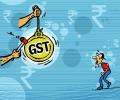
The State Bank of India (SBI) in its latest research report said that reforms in GST through reduction in rates will cause a minimal revenue loss of Rs 3,700 crore. The government estimates the net fiscal impact of GST rates rationalisation will be Rs 48,000 crore on an annualised basis.

The 50 per cent US tariff on Indian goods pose a downside risk to growth but the impact is expected to be short-lived for the economy, and consumption demand could see an uptick after the new goods and service tax (GST) rates are implemented which could even offset the external uncertainty, Chief Economic Advisor (CEA) V Anantha Nageswaran reckoned on Friday.

India is set to become the world's fourth-largest economy in 2025, but slow income growth, lack of structural change, and rising inequality highlight the gap between progress and real transformation.

The GST Council on Wednesday approved a two-tier rate structure of 5 and 18 per cent, which will be implemented from September 22.

Congress leader Rahul Gandhi has said the 'wholesale attack on the democratic system' currently underway in India is the single biggest risk the country is facing, and asserted that allowing different traditions to thrive is very important as 'we cannot do what China does, which is to run an authoritarian system'. IMAGE: Kindly note that this image has been posted for representational purposes only. Photograph: / Rediff.com Speaking at a seminar titled 'The Future is Today' at the EIA University in Medellin, Colombia, Gandhi also alleged that there are 'huge amounts of corruption at a centralised level' in India now. "In India, we have huge amounts of corruption now at a very centralised level. So, three or four businesses taking over the whole economy, having a direct relationship with the prime minister, is rampant in India," the Leader of Opposition in Lok Sabha said. "But I believe decentralising power, making things more transparent, bringing people into conversations, and bringing people into processes is the best way forward," Gandhi said while addressing the seminar on Wednesday. Hitting back at the Congress leader for his remarks, the Bharatiya Janata Party on Thursday accused Gandhi of insulting and degrading India on foreign soil. Posting a video clip of Gandhi's speech on X, BJP national spokesperson Gaurav Bhatia said, 'Rahul Gandhi does it again, degrades India on foreign soil. From defaming our democracy in London, to mocking our institutions in the US, now in Colombia he spares no chance to insult Bharat globally.' 'This isn't dissent. It's disgrace to the fake Gandhi. Criticising BJP may be your right but dare you malign Mother India for your cheap and petty politics,' Bhatia said. Speaking at the seminar, Gandhi said India has a much more complex system as compared to China and its strengths are very different from that of the neighbouring country. India also has a very old spiritual tradition and a thought system with profound ideas that are useful in today's world, he said, adding that there is a lot that the country can offer in terms of tradition and way of thinking. "I am very optimistic about India, but at the same time, there are fault lines within the Indian structure. There are risks that India has to overcome. The single-biggest risk is the attack on democracy that is taking place in India," the Leader of Opposition said. "India has multiple religions, traditions and languages. India is actually a conversation between all its people. Different ideas, religions and traditions require space. The best method for creating that space is the democratic system," he said. "Currently, there is a wholesale attack on the democratic system in India, so that is a risk. The other big risk is different conceptions -- some 16-17 different languages, different religions... So, allowing these different traditions to thrive, and giving them space to express themselves is very important for a country like India.

The proposed 'Next Gen GST' with sweeping reforms, lower tax rates, and just two slabs, aims to boost the economy amid tariff threats and set the stage for a single tax rate regime by the time India becomes a developed nation, government sources said.

Among Sensex firms, Mahindra & Mahindra, Tata Motors, Trent, Eternal, Asian Paints and Infosys were the major gainers. However, Sun Pharma, ITC, Hindustan Unilever and Titan were among the laggards.

Uttar Pradesh's leading export hubs are reeling under the impact of a steep 50 per cent tariff imposed by the US on Indian imports, with exporters warning of job losses, stalled orders and shrinking market access. Industry leaders from Noida, Kanpur and Varanasi said the tariff has put years of painstaking market-building at risk, even as protests and demonstrations erupted in several districts last week.

Among Sensex firms, Mahindra & Mahindra, Asian Paints, Infosys, Titan, Sun Pharma, Tata Consultancy Services, Tech Mahindra and Power Grid were the major laggards. However, Bajaj Finance, Eternal, UltraTech Cement and Reliance Industries were among the gainers.

New lower GST rates kicked in from Monday, resulting in a slashing of prices of as many as 375 items ranging from toothpaste and shampoo to cars and television sets, a move seen as an attempt to boost consumption to cushion an economy facing tariff headwinds. Tax rates of 5, 12, 18, and 28 per cent have been clubbed into two rates of 5 per cent and 18 per cent, resulting in a reduced price of 99 per cent of daily use items.

India's industrial production growth accelerated to a 4-month high of 3.5 per cent in July this year due to good performance of manufacturing sector, according to official data released on Thursday. The country's industrial output earlier recorded this level of growth at 3.9 per cent in March 2025.

Opposition-ruled states warn of steep annual losses; Centre assures higher consumption will offset revenue hit.

'Indian markets may underperform global peers for the next two quarters.' 'But beyond that, India should catch up and resume its long-term growth path.'

Several fast-moving consumer goods (FMCG) companies have said that they would pass on the full benefit of goods and services tax (GST) rate cuts to consumers starting September 22. Dairy major Mother Dairy, on Tuesday, announced rate cuts in products spanning its portfolio-- from milkshakes to paneer and jams to frozen products under its Safal brand.

'Crude oil prices are around $66-67 per barrel now but could fall to $55-60 if global disturbances ease.'

'Immigrants have always been America's greatest strength, building prosperity, breakthroughs, and communities that enrich us all. Instead of embracing that strength, Trump is clamping down on every form of immigration, tearing families apart, destabilising businesses, and weakening our economy'

The GenZ violence that engulfed Nepal is not only against nepo-babies -- its anger is broader and riddled with contradictions, making it difficult for interim PM Sushila Karki, points out Aditi Phadnis.

Indian economy grew by 7.8 per cent in April-June -- the highest in five quarters -- before the disruptive US tariffs were imposed.

Investor sentiment across Asian markets has shifted sharply in August, reveals the latest Bank of America (BofA) Fund Manager Survey, which found global growth expectations retreating after three months of improvement.

Senior finance ministry official Navjot Singh, killed in a BMW crash, was cremated. The driver's alcohol test was negative, and an investigation is underway.

From the Sensex firms, Infosys, Tata Consultancy Services, HCL Tech, Tech Mahindra, Tata Motors, Sun Pharma, Maruti and Titan were among the major gainers. Bharat Electronics, Asian Paints, Bharti Airtel and ICICI Bank were among the laggards.

The additional 25 per cent tariff imposed by US President Donald Trump on India is set to deliver a major blow to West Bengal's export-driven economy, with the state's labour-intensive leather, engineering and marine sectors expecting losses ahead of the festive season, stakeholders said. The increased levies on Indian products for the country's purchases of Russian oil came into effect on Wednesday, bringing the total amount of tariff imposed on New Delhi to 50 per cent.

Fitch Ratings on Monday affirmed India's sovereign rating at 'BBB-', with a stable outlook, saying a strong record of delivering growth and improving fiscal credibility will drive improvements in structural metrics. "India's ratings are supported by its robust growth and solid external finances," Fitch said, as it forecast GDP growth of 6.5 per cent in the fiscal year ending March 2026 (FY26), unchanged from FY25, and well above the 'BBB' median of 2.5 per cent.

The additional 25 per cent duty will come into effect after 21 days or August 27.

Fitch Ratings on Wednesday raised India's GDP growth forecast to 6.9 per cent for current fiscal year, from 6.5 per cent earlier, citing strong June quarter growth and domestic consumption-led demand.
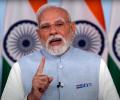
Prime Minister Modi urged the people of the country to take pride in selling and buying indigenous goods.

Prime Minister Narendra Modi has described sports as an essential aspect of India's journey towards becoming a developed nation, saying that the new National Sports Policy will ensure a sporting growth that covers the farthest school to the elite Olympics.

India's real estate investment trust (Reit) sector is set for robust expansion, with at least one new Reit expected to enter the market each year over the next three-five years. This growth trajectory builds on rising occupancies, surging leasing activity, and increasing investor interest.

Among Sensex firms, Eternal, Infosys, Asian Paints, HDFC Bank, Bajaj Finserv and Titan were the major gainers. However, Tata Steel, Tech Mahindra, Adani Ports and Bharat Electronics were among the laggards.

'I am doing the drive in making sure that people pass this on. So the drive is not with distrust. The drive is just in case.' 'Just in case it doesn't get passed on, I am here.'

Electric vehicle (EV) manufacturers breathed a sigh of relief after the GST Council on Wednesday night retained the concessional 5 per cent rate on EVs, though they now face competition from small petrol and diesel cars, which will attract a lower 18 per cent levy.

'GST reduction will help larger and high-end cars too.'

'If nominal growth improves and earnings pick up, Indian stock markets could see a rally next year.'

Market reaction to the Union Budget was overall neutral. The income tax "gift" wasn't enough to move the needle. There was some apparent rationalisation of Customs duty structure as well as cuts on import duties of some key components for the telecom and IT industry and duty cuts on vehicle imports. Other proposals related to development of agriculture and rural economy and renewables seem to be generally positive.

A recent World Bank report placing India among the most equal countries globally may present a limited view of inequality, with economists suggesting that broader data sets could tell a different story. According to the report, India's Gini index (or coefficient/ratio), a key measure of inequality, stood at 25.5 in 2022-23, placing the country fourth globally in terms of equality, behind only the Slovak Republic, Slovenia, and Belarus.
 © 2026 Rediff.com - Investor Information - Advertise with us - Disclaimer - Privacy Policy - Sitemap - Feedback - About us - Terms of use - Grievances