

Electric vehicle (EV) manufacturers breathed a sigh of relief after the GST Council on Wednesday night retained the concessional 5 per cent rate on EVs, though they now face competition from small petrol and diesel cars, which will attract a lower 18 per cent levy.
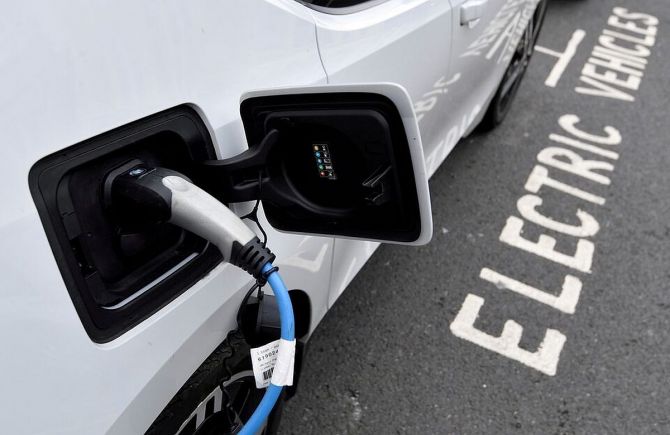
Before the Council meeting, media reports suggested that goods and services tax (GST) on electric cars priced between Rs 20 lakh and Rs 40 lakh could be raised to 18 per cent, and to 28 per cent for those above Rs 40 lakh.
These reports had caused concern across the nascent EV industry in India.
For EV makers, the Wednesday night announcement was a relief and seen as a signal of policy continuity.
Shailesh Chandra, managing director (MD), Tata Motors Passenger Vehicles and Tata Passenger Electric Mobility, said: “The Council’s decision to retain the 5 per cent GST rate on EVs is a forward-looking move that reinforces India’s commitment to sustainable, zero-emission mobility and signals long-term policy stability.”
Rajesh Jejurikar, executive director and chief executive officer (CEO) of Auto and Farm Sector at Mahindra and Mahindra, said: “We appreciate the continuation of the 5 per cent GST rate on EVs, which is a critical enabler of India’s clean mobility vision.
"This measure will accelerate the adoption of EVs and reinforce India’s leadership in sustainable, green transportation.”
Tata Motors and M&M are two major electric car manufacturers in India.
A senior executive of an electric car manufacturer told Business Standard that Wednesday night’s decision came as a big relief to all electric carmakers of the country.
Jyoti Malhotra, MD, Volvo Car India, said: “In the EV segment, the continuation of the standard 5 per cent GST reinforces the government’s sustained commitment to advancing electrification and promoting sustainable mobility.”
Santosh Iyer, MD & CEO, Mercedes-Benz India, added: “We are thankful to the government for keeping the GST rate for BEVs (battery electric vehicles) unchanged, ensuring faster transition to a decarbonised future.”
In contrast, Toyota, which has a significant portfolio of strong hybrid cars, reiterated its demand for tax parity between EVs and hybrids.
Swapnesh R Maru, deputy MD, Toyota Kirloskar Motor, said: “Given India’s rapid economic growth that is bound to increase the demand for energy, particularly fossil fuel consumption by the transportation sector, it is crucial that all cleaner and greener technologies are also promoted and incentivised through suitable policy measures, including taxation, so that these are preferred by consumers over the conventional petrol and diesel vehicles.”
The GST Council’s decision also brought relief to all car segments.
Small cars — defined as those up to 4 metres in length with engine capacity of up to 1,200 cc for petrol and 1,500 cc for diesel — saw their tax rate cut from 28 per cent to 18 per cent.
This is expected to make conventional entry-level cars more affordable, increasing competitive pressure on EVs in the mass market.
For larger vehicles, the change was more of a rationalisation.
Large ICE (internal combustion engine) cars, which earlier faced an effective levy of about 50 per cent (28 per cent GST plus up to 22 per cent cess), are now taxed at 40 per cent.
Large strong hybrid cars, which were previously taxed around 43 per cent (28 per cent GST plus 15 per cent cess), too move into the same 40 per cent slab.










 © 2026