
RBI recently cut repo by 0.25 percentage point, taking the rate to 7.25 per cent in three reductions since January.

Rupee, however, added some respite after strengthening for the first time today during the last five trading sessions.

Among top losers that dragged down key indices were Infosys, TCS, Reliance, SBI, Tata Steel and ITC, falling up to 2.15 per cent.

The RBI has targeted consumer price inflation at 6 per cent by January and 4 per cent by March 2018.
In a bid to widen the ambit of beneficiaries getting reservation under the Other Backward Classes quota, the central government on Thursday enhanced the ceiling for applying the 'creamy layer' restriction on "socially advanced persons". While the income criterion so far was Rs 4.5 lakh per annum, the Union Cabinet on Thursday increased it to Rs 6 lakh per annum.

The RBI's idiosyncratic focus on wholesale price inflation at the expense of retail inflation is a serious policy error.

In January, consumer price index-based inflation rose for the fourth consecutive month. It stood at 10.78 per cent, against 10.56 per cent in December.

India's August industrial output rose just 0.4 per cent compared with 2.4 per cent estimated in a Reuters poll.
Vegetable prices recorded the maximum spurt in prices, up 24.55 per cent, followed by edible oils -- 17.63 per cent and milk products -- 14.94 per cent in April, year-on-year basis.

The DA hike will take effect from July 1.

Rajan said the central bank has used up all its "space available" to cut interest rates

Retail inflation in March inched up to 8.31 per cent from 8.03 in February, mainly on account of a rise in fruit and vegetable prices.
The Consumer Price Index based inflation was at 10.91 per cent in February.
While the average CPI hovers at 10 per cent for five years now, our tax benefits are almost a decade old.

DBS called Rajan's decision not to seek an extension as a 'negative surprise'.
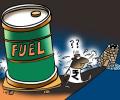
Inflation in food articles, fuel and power contracted in July.
.jpg)
Food prices for consumers also eased to an annual 11.06 percent in August from 11.24 per cent in July.
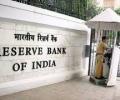
CLSA says government actions to facilitate investment more important for revival than a token monetary easing.
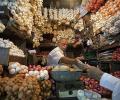
Among food articles, vegetable prices surged by 69.69 per cent mainly on account of onion, which witnessed 455.83 per cent jump in prices, followed by potato at 44.97 per cent.

The broader NSE Nifty managed to end higher for the second day at 10,426.85, up by 5.45 points or 0.05 per cent after shuttling between 10,478.60 and 10,377.85, intra-day.

Inflation in protein-based items -- egg, meat and fish -- stood at 14.36 per cent during the month. In oils and fats segment, it stood at 11.72 per cent.

The RBI gauges both measures of inflation when deciding on monetary policy,

The vegetables basket in Dec. recorded the highest inflation of 25.71 per cent.

The retail inflation was 9.90 per cent in November and 9.75 per cent in October.
His comments poured cold water on hopes that the central bank may have a rethink on rates after the wholesale price index, the main inflation gauge, rose a lower-than-expected annual 7.25 per cent in June, its slowest rise since January, helped by moderation in fuel prices.

The wholesale price-based inflation hovered over seven per cent through 2012, down from 10 per cent inflation seen in the previous year, reflecting the impact of tight money policy of the Reserve Bank of India.
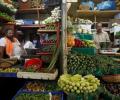
The states that witnessed high CPI-based inflation rates were Lakshadweep, Tripura, Odisha, Uttar Pradesh, Kerala, Madhya Pradesh, Puducherry, Tamil Nadu, Rajasthan, Manipur and Mizoram.
In the first price revision after the government capped the number of subsidised cylinders for consumers, domestic liquefied petroleum gas (LPG) has become nearly 17 per cent dearer, thanks to firm international prices.

According to the global financial services major, the Consumer Price Index based inflation is peaking off and is expected to be around 7.5-8 per cent in September.

If imputed inflation for April and May is used, then you have inflation of over 6 per cent for two consecutive quarters, which is a worrying signal for the RBI.
It was 10.56 per cent in December.
India's year-on-year inflation rate as measured by the consumer price index rose to 3.43 per cent in January from 3.2 in December, a government statement said on Wednesday.
Food prices for consumers rose an annual 10.65 per cent in May, slightly faster than an annual rise of 10.61 per cent in April.

The retail inflation, which is factored in by the RBI to arrive at its monetary policy, has been on decline since last month. The previous low was 5.54 per cent in November 2019. The government has asked the RBI to restrict the inflation around 4 per cent, with a margin of 2 per cent on the either side.

Moody's on Monday slashed India's growth forecast for 2020 to 5.4 per cent from 6.6 per cent projected earlier, on slower than expected economic recovery. In its update on Global Macro Outlook, Moody's Investors Service said India's economy has decelerated rapidly over the last 2 years and economic recovery is likely to be 'shallow'.
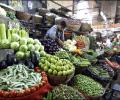
Retail inflation has eased from double digits in 2013.

HDFC, L&T, Hind Unilever, ICICI Bank among top Sensex losers

Driven by rising prices of food items such as sugar, pulses and vegetables as well as clothing, retail inflation moved closer to the double digit mark.

The RBI targets inflation at 6 percent by January 2016 and 4 percent for 2017/18.
This breathes in a sense of relief for the Indian economy already reeling under low growth rate, depreciation of rupee and slowing down of industrial production.
 © 2026 Rediff.com - Investor Information - Advertise with us - Disclaimer - Privacy Policy - Sitemap - Feedback - About us - Terms of use - Grievances