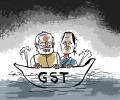
The Centre managed to collect only Rs 990 crore as compensation cess in April 2020-21, almost one-ninth of the figure of Rs 8,874 crore mopped up a year ago. The subdued collection would further increase states' problems unless the GST Council, which meets next week, decides to borrow from the market.
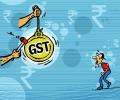
The broad trends of GST collections will make you wonder if indeed the biggest indirect tax reform in the country has led to a real improvement in revenues, notes A K Bhattacharya.

The government should scrap the windfall profit tax on domestically produced crude oil as the levy is adversely impacting the capex-intensive exploration of oil and gas, the industry said in its recommendation for the forthcoming annual Budget. India first imposed windfall profit taxes on July 1, joining a growing number of nations that tax super normal profits of energy companies. At that time, a Rs 23,250 per tonne ($40 per barrel) windfall profit tax on domestic crude production was levied.
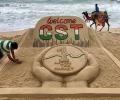
GST collections in February grew 18 per cent to over Rs 1.33 lakh crore in February even as the Omicron wave dented the month-on-month collection momentum. This is for the fifth time in the current fiscal that the Goods and Services Tax (GST) collection has crossed Rs 1.30 lakh crore mark. Also, this is the first time, cess collection has crossed the Rs 10,000 crore mark, signifying recovery in certain key sectors, especially automobile sales, the finance ministry said on Tuesday.

The Central government will borrow up to Rs 1.1 lakh crore on behalf of the states to bridge the shortfall in GST collections, the finance ministry said on Thursday. A slowdown in the economy since last fiscal has resulted in a drop in the Goods and Services Tax (GST) collections, upsetting the budgets of states which had given up their right to levy local taxes such as sales tax or VAT when GST was introduced in July 2017. To make up for the shortfall, borrowing from the market was proposed.

The all-powerful GST Council on Friday decided to charge food delivery platforms such as Swiggy and Zomato a tax even as it extended concessional tax rates on certain COVID-19 drugs by three months till December 31. The Council, which comprises the Union finance minister and her state counterparts, decided to continue keeping petrol and diesel out of the GST purview as subsuming the current excise duty and VAT into one national rate would impact revenues. Briefing reporters on the decisions taken by the Council at a meeting here, Union Finance Minister Nirmala Sitharaman said GST has been exempted on muscular atrophy drugs like Zolgensma and Viltepso, which cost crores of rupees.

Mobile phones and TV sets manufactured in India would become cheaper with Finance Minister Nirmala Sitharaman announcing cuts in Basic Customs Duty (BCD) on import of their components but smokers would have to pay more as the government has increased taxes.

The GST Council in its next meeting may look at raising the lowest tax slab to 8 per cent, from 5 per cent, and prune the exemption list in the Goods and Services Tax regime as it looks to increase revenues and do away with states' dependence on Centre for compensation, sources said on Sunday. A panel of state finance ministers is likely to submit its report by this month end to the Council suggesting various steps to raise revenue, including hiking the lowest slab and rationalising the slab. Currently, GST is a four-tier structure attracting a tax rate of 5, 12, 18 and 28 per cent.
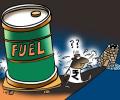
The GST Council might on Friday consider taxing petrol, diesel and other petroleum products under the single national GST regime, a move that may require huge compromises by both central and state governments on the revenues they collect from taxing these products. The Council, which comprises central and state finance ministers, in its meeting scheduled in Lucknow on Friday, is also likely to consider extending the time for duty relief on COVID-19 essentials, according to sources in the know of the development. GST is being thought to be a solution for the problem of near-record high petrol and diesel rates in the country, as it would end the cascading effect of tax on tax (state VAT being levied not just on the cost of production but also on the excise duty charged by the Centre on such output).

Mihir Tanna, Associate Director, S K Patodia & Associates, answers your tax queries.

The government on Monday ruled out making public the RBI report detailing the reasons why the central bank could not keep inflation within the targeted 6 per cent upper limit for the three consecutive quarters. "Yes sir, RBI has furnished a report to the central government, as mandated under Section 45ZN of the RBI Act, 1934 and Regulation 7 of RBI Monetary Policy Committee and Monetary Policy process Regulations, 2016," minister of state for finance Pankaj Chaudhary said in a written reply. The said provisions of the RBI Act, 1934, and regulations therein does not provide for making the report public, he said.
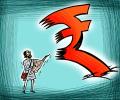
The Centre is staring at a combined shortfall of up to Rs 1 trillion in excise and Customs revenues in the current financial year (FY23) compared to the Budget estimates (BE), mainly because of duty cuts on edible oil and petroleum products. The government set a target of Rs 3.35 trillion for excise and Rs 2.13 trillion for Customs mop-up for FY23 while presenting the Budget in February. "As excise duty collection is mainly driven by diesel volumes, we might see a clear gap in the level budgeted for FY23, following the reduction in cesses on petrol and diesel in May. We are expecting somewhere between Rs 80,000 crore and Rs 1 trillion dip in excise and customs duty collections," a senior government official told Business Standard.

GST revenue for May stood at nearly Rs 1.41 lakh crore, a 44 per cent increase over the same month last year, the finance ministry said on Wednesday. Bucking the month-on-month increasing trend of the last two months, the Goods and Services Tax (GST) revenues came in lower than the record high collection in April at Rs 1.68 lakh crore. In March GST revenues were at Rs 1.42 lakh crore, while in February it was Rs 1.33 lakh crore.

The government wants new domestic companies to set up their manufacturing units fast and hence the concessional tax rate of 15 per cent has been extended by a year till March 2024, revenue secretary Tarun Bajaj said on Friday. Stating that direct and indirect tax collections are going up and have good buoyancy, Bajaj said it means that the corporate sector is also doing well, and India's tax to GDP ratio could be "highest ever" in the current year. The Budget 2022-23 presented on February 1 has proposed that the concessional 15 per cent corporate tax rate would be available for one more year till March 2024 for newly incorporated manufacturing units.

The political-electoral calculus favours spending thousands of crores on vanity projects like Sardar Patel's statue and the Central Vista over building up our military to handle the confrontations and conflicts that loom large, points out Ajai Shukla.
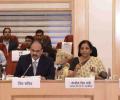
After the GST Council's meeting in March, the Centre had sought views from Attorney General K K Venugopal -- who is the chief legal officer of the government -- on the legality of market borrowing by the council to make good any shortfall in the compensation fund. The AG in his view said there is no obligation on the central government to pay the GST compensation shortfall, according to the sources.

If there is no third wave of the pandemic, the fiscal position of the Centre and the states will be much better than budgeted for FY22 and the states may garner Rs 60,000 crore more in tax collections at Rs 8.27 lakh crore this fiscal year than they have budgeted, a report said. The report by SBI Research on Monday bases its optimism on GST collection so far this fiscal, which has been the best ever in spite of the fact that the two months bore the maximum brunt of the second wave -- with April setting a record Rs 1.41 lakh crore and May collection a tad low at Rs 1.03 lakh crore. The report also said overall government finances do not look overstretched as GST collections have continued to maintain pace so far and the additional fiscal impact arising from free vaccination and more food supplies will only be around Rs 28,512 crore.

The Centre on Thursday placed before the GST Council two options for borrowing by states to meet the shortfall in GST revenues, pegged at Rs 2.35 lakh crore in the current fiscal.
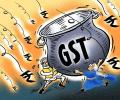
The CAG has pulled up the union government for adopting an erroneous process of devolution of IGST to states and short-transfer of cesses to reserve funds, which resulted in under-reporting of deficit figures for the 2017-18 and 2018-19 fiscals. The Integrated Goods and Services Tax (IGST), which is levied on inter-state sale of goods and services, is shared between the Centre and states in the 50:50 ratio. In its report on the union government accounts tabled in Parliament, the Comptroller and Auditor General of India (CAG) found that a sum of Rs 13,944 crore was left unapportioned and retained in the Consolidated Fund of India (CFI) in 2018-19, even though the amended IGST Act now provides for a process for ad-hoc apportionment of IGST.
India's gross tax collections soared to a record high of Rs 27.07 lakh crore in the fiscal year ended March 31, led by impressive growth in corporate tax and customs, taking the tax-to-GDP ratio to an over two-decade high of 11.7 per cent, Revenue Secretary Tarun Bajaj said on Friday.

Under the GST law, states were guaranteed to be paid for any loss of revenue in the first five years of the GST implementation from July 1, 2017.

The question on who should borrow from the market and whether the borrowing will be under two buckets should be decided by the GST Council, and not by the Centre. If there is no consensus, there has to be a vote, says A K Bhattacharya.

'I would want people to have food on their tables and their wages to rise.' 'Will that happen or not is the question that we need to ask and answer.'
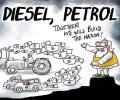
The government has put off by one month the levy of an additional Rs 2 per litre excise duty on petrol and diesel that is not doped with ethanol and bio-diesel in a bid to give the industry more time to implement the measure.

Total number of GSTR-3B returns filed up to January 30, 2022 is 1.05 crore that includes 36 lakh quarterly returns, the finance ministry said. January is the fourth straight month when Goods and Services Tax collection has crossed Rs 1.30 lakh crore.

Concessional rate of tax on dividends received by Indian companies from foreign subsidiaries will be done away with from April 1, a change that may hamper global expansion of Indian companies and compel some firms to move their headquarters out of India to geographies such as Singapore and Dubai. At present, dividends received by Indian companies from their foreign subsidiaries are subject to a concessional tax rate of 15 per cent under Section 115BBD of the Income Tax (I-T) Act. The provisions of this section shall not apply from assessment year 2023-24 onwards, according to the Finance Bill.

This will boost availability of these items as well as make them cheaper, it said, adding that Modi also directed the revenue department to ensure seamless and quick custom clearance of such equipment.

Mihir Tanna, Associate Director, S K Patodia & Associates, answers your tax queries.
The demand for extension of the GST cess regime among others was made by several state finance ministers at a pre-budget consultation called by Union Finance Minister Nirmala Sitharaman in New Delhi. Besides, many states also demanded raising the share of the Union government in the Centrally Sponsored Schemes (CSS). Currently, the central government and state government share in some CSS is 60:40 while in others it is 75:25.

The three year lock-in period enables ELSS fund managers to invest in high conviction stocks for a long period of time because of relatively less redemption pressure, says Dwaipayan Bose

'We can go somewhere between 35 per cent and 40 per cent.'

He interrupted his speech to observe a minute's silence in the House along with other Opposition leaders, mainly the Congress, to pay tribute to farmers who had lost their lives during the two month agitation.

The surge in wheat export from India owing to the Ukraine crisis has once again demonstrated how farmers in states that have flexible marketing frameworks and low taxes benefit more from an emerging situation. The bulk of the wheat exported from India, trade and industry sources say, is being sourced at rates significantly higher than the state-mandated price of Rs 2,015 per quintal in Madhya Pradesh (MP), Uttar Pradesh (UP), and Gujarat - states which have low mandi taxes compared to Punjab and Haryana. This is not only benefiting farmers there but could also lead to significant savings for the states in procurement costs in the months to come.

This may leave those not opting for any of the two options offered by the Centre before the GST Council meet scheduled for October 5 in the lurch. It is clear from the present situation that these states will have to wait till June 2022 to get their compensation, subject to the council extending the cess collection period beyond June 30, 2022.

Anil Rego, CEO, Right Horizons, answers your personal income tax queries.

Ahead of the first meeting of the top decision-making body in nearly eight months, finance ministers of eight states ruled by non-Bharatiya Janata Party and like-minded parties -- Rajasthan, Punjab, Chhattisgarh, Tamil Nadu, Maharashtra, Jharkhand, Kerala and West Bengal -- have devised a joint strategy to press for a zero tax rate on Covid essentials, sources said.

Fuel cess, TDS on large cash payouts bid to destroy truckers and get foreign players in, says an industry body.
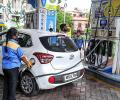
After Rajasthan, petrol price on Thursday crossed the Rs 100 per litre mark in Madhya Pradesh after fuel rates were increased for the tenth day in a row. Petrol price was hiked by 34 paise per litre and diesel by 32 paise, according to a price notification of state-owned fuel retailers. While branded or additive-laced petrol, which attracts higher taxes, had crossed the Rs 100-mark in some places in states like Maharashtra, Madhya Pradesh and Rajasthan, regular petrol crossed the physiological mark in Sriganganagar town of Rajasthan on Wednesday, and on Thursday it went past that mark in Madhya Pradesh. In Anuppur of Madhya Pradesh, petrol is priced at Rs 100.25 per litre and diesel at Rs 90.35. Fuel prices differ from state to state depending on the incidence of local taxes such as VAT and freight charges.
In the current financial year, the Centre released nearly Rs 1 lakh crore compensation to the states till September.

 © 2026 Rediff.com - Investor Information - Advertise with us - Disclaimer - Privacy Policy - Sitemap - Feedback - About us - Terms of use - Grievances