
House economists at the nation's largest lender State Bank of India (SBI) have urged the government to budget for nursing the pandemic-ravaged economy and not to focus too much on fiscal consolidation as there is a need for more stabilisation measures to sustain the fledgling recovery. And one of the best way to begin the new fiscal is to complete the share sale of LIC this fiscal. This can go a long way in repairing the overstretched balance sheet which in turn will bring down fiscal deficit to a much lower 6.3 per cent in FY23 as the public coffers will be left with a cash surplus of at least Rs 3 lakh crore to begin the new fiscal, SBI chief economist Soumya Kanti Ghosh said in a pre-Budget note on Wednesday.
A bench of Justices SK Kaul and MM Sundresh said in a matter like this an affidavit is filed that Centre and state both have powers.

Passengers complained that they had to wait a long time for Ola and Uber cabs, and added that those were available at inflated rates.
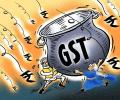
The CAG has pulled up the union government for adopting an erroneous process of devolution of IGST to states and short-transfer of cesses to reserve funds, which resulted in under-reporting of deficit figures for the 2017-18 and 2018-19 fiscals. The Integrated Goods and Services Tax (IGST), which is levied on inter-state sale of goods and services, is shared between the Centre and states in the 50:50 ratio. In its report on the union government accounts tabled in Parliament, the Comptroller and Auditor General of India (CAG) found that a sum of Rs 13,944 crore was left unapportioned and retained in the Consolidated Fund of India (CFI) in 2018-19, even though the amended IGST Act now provides for a process for ad-hoc apportionment of IGST.
Goa has been following the Portuguese Civil Code 1867, which is also called Uniform Civil Code.

Serum Institute of India announced a price of Rs 400 per dose for its COVID-19 vaccine 'Covishield' for state governments and Rs 600 per dose for private hospitals.
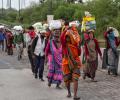
A bench of Justices Ashok Bhushan, SK Kaul and MR Shah took note of the submissions of the Centre and state governments on steps taken so far to mitigate the miseries of the migrant workers stranded across the country during the Covid-19 lockdown.
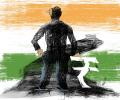
The employment situation remains dire. Whatever can be done to promote greater low-skill employment should be pursued aggressively, advises former chief economic adviser Shankar Acharya.
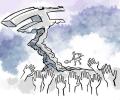
Banks should neither be timid nor adventurous while lending as the loans of today should not become NPAs of tomorrow, he said.
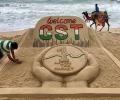
The finance ministry has set up two committees of state finance ministers which would rework rate slabs, review GST exempt items and identify potential evasion sources. Four years after the roll out of the national Goods and Services Tax (GST), which replaced the complex indirect tax structure, the centre and states have started work on moving towards a "simpler rate structure in GST" by reviewing the current rate slabs, including special rates and merger of rate slabs. The Group of Ministers (GoM) on rate rationalisation would also review items under inverted duty structure to help minimise refund payout, and review the supply of goods and services exempt under GST with an objective to expand the tax base and eliminate breaking of input tax credit (ITC) chain.

"I have been the chief minister twice with your blessings. I have decided that the 2023 assembly election will be my last fight. It is not for me to come to power or become the chief minister," he said.
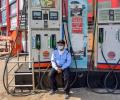
Hitting out at Prime Minister Narendra Modi over the issue of tax cuts on petroleum products, Tamil Nadu Chief Minister M K Stalin on Thursday said people were aware of the fact behind the issue and pointed out at his government effecting a Rs 3 a litre cut on petrol earlier.

The October 5 meeting assumes significance as the Centre and states are at loggerheads over the issue of funding Rs 2.35 lakh crore GST collection shortfall.
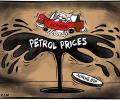
Many states are open to the idea of petrol and diesel being brought under the goods and services tax (GST) regime - contrary to the perception that they are averse to it - but they want a concrete proposal, including a compensation mechanism, from the Centre. West Bengal Finance Minister Amit Mitra says while the issue can be discussed, the Centre may not be keen to bring the change because it earns "much more" from taxes on petrol and diesel. "(The peak rate of) GST is 28 per cent. Under the regime, the Centre would only get 14 per cent. "So, definitely, the Union government does not want GST on fuel. It is all lies. Currently, they are in a very cozy place," Mitra said.
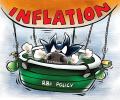
Reserve Bank on Wednesday said it expects retail inflation at 5.2 per cent in the first half of the current fiscal and revised downwards the target to 5 per cent for the quarter ended March. While headline inflation at 5 per cent in Feb 2021 remains within the tolerance band, some underline constituents are testing the upper tolerance level. Going forward, the food inflation trajectory will critically depend on the temporal and special progress of southwest monsoon in the 2021 season, RBI Governor Shaktikanta Das said on Wednesday while announcing the first monetary policy for the current fiscal. Reserve Bank of India (RBI) has kept the key repo rate unchanged at 4 per cent to support growth in the current situation.
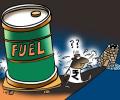
Bringing petrol, diesel and other petroleum products under the single nation-wide GST regime will reduce taxes on these products and increase the revenue of both the Centre and states, Union Minister Nitin Gadkari said on Wednesday. Finance Minister Nirmala Sitharaman will definitely try to bring petrol and diesel under GST if she gets the support of the state governments, said Gadkari while addressing the Times Now Summit virtually. "In the GST Council, finance ministers of states are also members.
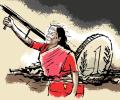
Finance Minister Nirmala Sitharaman will present the much-awaited 2022-23 Union Budget on February 1. While there has been strong recovery in some sectors, touch services like hospitality, tourism and leisure continue to suffer after two Covid-19 waves. Household savings have been hit due to increased spending on health care. Consumption has still not reached pre-pandemic levels.
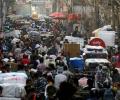
India's macroeconomic situation is certainly better than what it was a year ago, eminent economist Pinaki Chakraborty said on Monday, while expressing hope that the country will be back on the path of economic growth if there is no major third wave of the COVID-19 pandemic. In an interview with PTI, Chakraborty, who is the director of the National Institute of Public Finance and Policy (NIPFP), said that inflation may remain at an elevated level as there was a significant fiscal and monetary expansion in the last 18 months. "The current macroeconomic situation is certainly much better than what it was one year back. We are seeing recovery in most sectors," he said. Chakraborty noted that COVID-19 vaccination has been going on at a very fast rate in India.
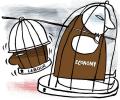
The four labour codes are unlikely to be implemented this fiscal in view of slow progress on the drafting of rules by the states and also for political reasons like elections in Uttar Pradesh, a source said. The implementation of these laws assumes significance because once these are implemented there would be reduction in take-home pay of employees and firms have to bear higher provident fund liability. "The ministry of labour is ready with the rules under the four labour codes. But the states have been slow in drafting and finalising those under new codes.

As the Centre pushes reforms in the power sector, especially for the beleaguered electricity distribution segment, several states, especially those ruled by Opposition parties, are clamouring against it. Maharashtra, West Bengal, Tamil Nadu, and Kerela have voiced their reservations against the proposed amendments to the Electricity Act, 2003. The irony is the states opposing the amendments on the ground of threat of privatisation already have private partnerships in power supply. The proposed Bill was slated to be placed on the floor of Parliament in the Monsoon session. But it still awaits Cabinet approval amid several states complaining that they have been not consulted on the issue.

If international crude oil prices zoom past the current level of about $90 per barrel and move towards $100 and beyond, middle-class consumers are not going to keep quiet about their discomfort, points out Arun Balakrishnan, former chairman and managing director, Hindustan Petroleum.
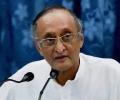
Stating that GST council meetings have become "almost toxic" with the erosion of trust between the Centre and states, West Bengal minister Amit Mitra on Wednesday urged Union Finance Minister Nirmala Sitharaman to consider a "course correction" to rebuild faith. In a letter to Sitharaman, the state's finance minister also claimed that the central government comes to GST council meetings with a "predetermined conclusion". Mitra on June 13 alleged that his voice was "muzzled" during the GST Council meeting on that day and his opposition to levy taxes on Covid essentials like vaccines, masks, PPE kits and anti-viral drug Remdesivir, was not heard.

Kejriwal's centralised way of governance might work in Delhi, but Punjab will call for delegation, observes Sanjeev Nayyar.

The top court said it is not satisfied with the efforts of the Centre as well as the states on the issue of registration of workers in unorganised sectors.
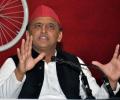
Samajwadi Party chief Akhilesh Yadav on Sunday accused Uttar Pradesh Chief Minister Yogi Adityanath of getting his telephones tapped and listening to the conversation every evening.
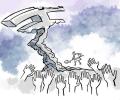
India's primary deficit (Centre and states) for FY21 is assumed to be 6.8 per cent of GDP, according to the Economic Survey tabled in Parliament on Friday. It said the Covid-19 pandemic has created a significant negative shock to demand. Active fiscal policy -- one that recognises that fiscal multipliers are disproportionately higher during economic crises than during economic booms -- can ensure that the full benefit of seminal economic reforms is reaped by limiting potential damage to productive capacity.
'Just because there is some misunderstanding, you cannot recall the chief secretary.' 'This is not a good development. This is an assault on federalism.'

At a combined level, the fiscal deficit of the Centre and states together will come at 12.1 per cent, with the states contributing 4.5 per cent.
This is a moment when the leaders at the Centre and states must show true leadership for the sake of the country. And it is the top political leaders, not attorney generals or bureaucrats, who should be sitting together and settling this thorny issue of compensation, says Arvind Subramanian, former Chief Economic Adviser to the Government of India.

Speaking at the meeting called by the central government, Modi said India is in a better position than many other countries in terms of the ratio of the population hit by the disease but underlined the need to remain vigilant as he cited the resurgence of the infection in some countries like the UK, sources said.
The Reserve Bank of India on Friday raised the retail inflation forecast for 2021-22 to 5.7 per cent due to supply side constraints, high crude oil and raw materials cost. The RBI in June had pegged the retail inflation estimate at 5.1 per cent for the current financial year. The RBI has the mandate to keep inflation in a band of 2-4 per cent, with a tolerance level of 2 per cent on either side.

High cost of acquisition due to a variety of reasons, including higher GST than all other major countries, is slowing down car demand in the country and unless the Centre and states take steps to reduce it, the industry is unlikely to experience reasonable growth, according to Maruti Suzuki India Chairman R C Bhargava. Addressing shareholders in the company's Annual Report for 2020-21, he said after the devastating second wave of the coronavirus pandemic hitting the first quarter of FY22, the performance in the next three quarters will largely depend on how effectively people get vaccinated and observe safety protocols.
Whatever the outcome from the assembly elections, what's evident is that West Bengal has entered an era of identity politics, reports Ishita Ayan Dutt.

As the new year arrives, the Bharatiya Janata Party's finds itself on the cusp of the most consequential cycle of state polls since the 2019 Lok Sabha elections as the results will tell if the road ahead in its bid for a third straight term at the Centre is getting any bumpier or a strong opposition challenge remains elusive.
If the Centre and states are keen on spending more to meet the COVID-19 challenges in the coming year, they must bear in mind the need to raise more resources through taxes and non-tax revenues, suggests A K Bhattacharya.

A bench of Justices Ashok Bhushan, Sanjay Kishan Kaul and M R Shah said industries and employees need each other and they should sit together to arrive at a settlement on the issue of payment of wages.
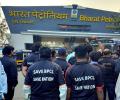
The divestment of Bharat Petroleum Corporation (BPCL) may hit a fuel price hurdle, according to officials dealing with the matter. They pointed out that the inconspicuous administered price regime could hamper the prospects for potential buyers of BPCL. A senior oil ministry official said public-sector oil-marketing companies (OMCs) take a hit when they sell petrol, diesel, and liquefied petroleum gas (LPG), three of the most popular petroleum products in the country.

'This will require statesmanship and not politicking.'
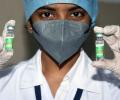
"The initial supply price of Covishield for all government immunization programme, including India, has been the lowest", SII said.

Gathering of five or more people at public places is prohibited, but there are no restrictions on people stepping out for the purpose of buying medicines, and visiting friends and relatives (after 11 pm in view of the night curfew).
 © 2026 Rediff.com - Advertise with us - Disclaimer - Privacy Policy - Sitemap - Feedback - About us - Terms of use - Grievances