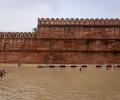
The Yamuna surged to a record 208.48 metres at 8 am, the Central Water Commission said on Thursday, adding that it is likely to rise to 208.75 metres by 4 pm.

The rain ebbed in some places in north India and pelted down in others on Tuesday, with at least seven more people dead and hundreds stranded as raging waters gushed through villages, towns and fields -- from the desert state of Rajasthan to the hills of Himachal Pradesh.
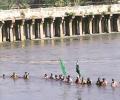
The petition stated that the proposed project would affect the flow of the river Cauvery considerably and will severely affect the irrigation in Cauvery basin of Tamil Nadu.

Poor dam management was considered as a major reason for the 2018 floods in the state that led to a loss of around Rs 50,000 crore and claimed as many as 483 lives, reports Shine Jacob.

Bharadwaj said it has not rained in Delhi in the last 3-4 days, yet still the water level in Yamuna reached 208.66 metres.

The flood situation in the three districts of Barak Valley -- Cachar, Karimganj and Hailakandi -- remained critical as the water levels of Barak and Kushiara rivers continued to rise, inundating vast tracts of land, officials said.

According to the Central Water Commission, of the 91 major reservoirs in the country, 62 water bodies reported 80 per cent or below of normal storage.

The devastation in Uttarakhand is a classic example of the callous manner in which the Central Water Commission, the nodal agency tasked with flood forecast in the country, operates, says Himanshu Thakkar

Today, with the Lok Sabha polls only months away, any inter-state dispute over the Cauvery water dispute has the potential to take more political turns than otherwise, predicts N Sathiya Moorthy.

The temporary water body was formed after sediments that the catastrophic flash flood earlier this month brought down, blocking the mouth of a stream that joins the Rishiganga river.

Assam reeled under devastating floods caused by incessant rain, with Prime Minister Narendra Modi taking stock of the situation and Chief Minister Himanta Biswa Sarma visiting several relief camps sheltering affected people on Saturday, officials said.

People affected due the flood have taken refuge in safer areas as the administration prepares to shift them to relief camps.

The toll due to the flood since mid-May is now 101, they said.

With the flood situation in Assam remaining critical on Monday and affecting a population of nearly 43 lakh in 33 of its 35 districts, Chief Minister Himanta Biswa Sarma directed air dropping of food and other relief materials in areas where there is heavy inundation, officials said.

In a statement, it said 198 properties in the state were partially damaged and 30 houses completely destroyed in the rains from July 31 to till date.
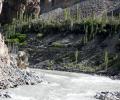
The three-day meeting between the two commissioners of PCIW completed discussions on all agenda items on Wednesday.

The IMD also issued a red alert in the same 10 districts for August 3 also.

Pakistan has raised objections to the design of India's Kiru hydroelectric plant, a mega 624 MW project over the Chenab river in Jammu and Kashmir, but New Delhi asserts that the project is fully compliant with the Indus Water Treaty, according to officials.

The Tamil Nadu government has told the Supreme Court that "repeated assertion" by Kerala to seek decommissioning of the 126-year-old Mullaperiyar dam is "wholly impermissible" as the dam has been found to be hydrologically, structurally and seismically safe.

The court directed the Congress to explain whether they were adhering to COVID norms such as wearing face masks, and maintaining social distancing.

Chaired by Cabinet Secretary P K Sinha and attended by chiefs of the three services, secretaries of home, defence and others, the National Crisis Management Committee took stock of the prevailing situation in Kerala and directed all concerned to ensure continued assistance to the state government to meet the crisis, a home ministry spokesperson said.

An alert has been sounded by the Delhi government after the water level of Yamuna river crossed the danger mark, an official said.

Karnataka Chief Minister Basavaraj Bommai on Sunday said action will be taken in accordance with law, as he hit out at Congress leaders for going ahead with padayatra (march), demanding implementation of the Mekedatu project across the Cauvery river, by violating government's COVID-19 restrictions.

The cyclonic depression may have crossed the Tamil Nadu coast on Thursday evening, but the state continues to be battered by heavy rains.
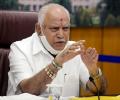
"I don't want to discuss Tamil Nadu or any other state. We have got every right and we are going to start the work," Yediyurappa said in response to a question on Tamil Nadu's objection to the Mekedatu project.
Technical Experts Committee comprising Dr C D Thatte, ex-chairman, Central Water Commission and Dr MS Reddy, ex-chairman, CWC set up by the Planning Commission for comprehensive review of Subansiri Lower Project submitted its report to Planning Commission.
In response to the White Paper on irrigation over the past decade prepared by Maharashtra's water resources department, the Aam Aadmi Party has prepared an exhaustive Black Paper on the issue. It will be released by Arvind Kejriwal at Roha on December 2 in Raigad district, the political stronghold of Irrigation Minister Sunil Tatkare.

The talks as part of the annual Permanent Indus Commission meeting are being held after a gap of over two years.
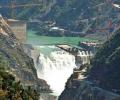
This will be the annual meeting of the Permanent Indus Commission. Under the provisions of the Indus Water Treaty, both the commissioners are required to meet at least once a year alternately in India and Pakistan.
The Supreme Court on Monday directed Karnataka to release 2 TMC (Thousand Million Cubic feet) of Cauvery water to Tamil Nadu and asked the Central Water Commission to file report on the water requirement of the two warring states.
A bench headed by Justice R M Lodha, which three-days back had allowed release of 2 TMC water, increased by 0.44 TMC the amount of water to be provided to Tamil Nadu on the recommendation of the Central Water Commission (CWC).
Met department assures rains are likely to revive from next week
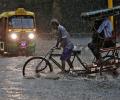
As the month ended with 33 per cent deficiency, which translates to around 67 per cent of the Long Period Average, several parts of the country have been witnessing drought-like situation.
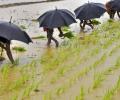
Sowing of kharif crops begins with the onset of southwest monsoon from June, while harvesting starts from October. Rice is the main kharif crop, besides bajra, arhar, urad, moong, groundnut and soyabean.
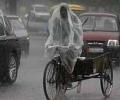
Rainfall in the week ended August 29 was about six per cent more than normal and the best weekly rains in the southwest monsoon season this year. This helped ease concern on drought across several parts of the country.
The Telugu Desam Party on Sunday accused the central government of ignoring Andhra Pradesh by doing nothing to prevent Maharashtra from going ahead with the Babhli project despite directives from Supreme Court and Central Water Commission.TDP chief Chandrababu Naidu said the Centre has to 'come into the picture' and direct Maharashtra to stop work at the Babhali barrage in Nanded district. "Chavan is going ahead with the project for his political gains," he alleged.

Andhra Pradesh, Uttarakhand, Maharashtra and Tamil Nadu likely to be India's most water-scarce states this summer
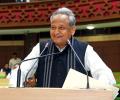
Rajasthan Chief Minister Ashok Gehlot is determined to implement the Eastern Rajasthan Canal Project despite the Centre's indifference.

Eleven deaths have been reported in Saharanpur followed by 10 in Meerut, six in Agra, four in Mainpuri, three each in Muzaffarnagar and Kasganj, two each in Amroha, Bareilly, Baghpat and Bulandshahr and one each in Kanpur Dehat, Mathura, Ghaziabad, Hapur, Rae Bareli, Jalaun, Jaunpur, Pratapgarh, Banda, Firozabad, Amethi, Kanpur and Pilibhit, they said.

The prime minister also asserted that in view of the COVID-19 situation, the states must ensure that people follow all health precautions such as wearing of face masks, hand sanitisation and maintaining an adequate physical distance with each other while undertaking rescue efforts.
