
After effecting two back-to-back 25 basis points rate cuts, Reserve Bank Governor Sanjay Malhotra on Wednesday hinted at another reduction in key policy rate by changing the central bank's monetary stance to 'accomodative' from 'neutral', which may further lower EMIs for consumers.

Raghuram Rajan rejected the argument that inflation has come down largely because of "good luck" stemming from low oil prices.

Digital payments across the country registered an 11.11 per cent year-on-year rise as on September 2024, according to RBI's index that measures the adoption of online transactions. RBI's Digital Payments Index (RBI-DPI) for September 2024 stands at 465.33 as against 445.5 for March 2024, the Reserve Bank said in a statement on Wednesday.

Foreign investors continue to pull back money from the Indian equity market withdrawing a little over Rs 30,000 crore in the first fortnight of the month amid escalation in global trade tensions. This came following an outflow of Rs 34,574 crore from equities in February and Rs 78,027 crore in January.

State Bank of India, Tech Mahindra, Larsen & Toubro, Tata Steel, Sun Pharma, Infosys, HCL Tech, Axis Bank, Tata Consultancy Services and NTPC were among the biggest laggards among Sensex shares. Nestle, Hindustan Unilever, Titan, Power Grid, UltraTech Cement and ITC were among the gainers.

By piling more pressure on governments, central banks risk not accomplishing much and yet provoking a political backlash that could threaten their independence.

Gold prices hit a fresh record high of Rs 84,900 per 10 grams in the national capital on Friday, driven by robust domestic demand and strong global cues, according to the All India Sarafa Association. The precious metal of 99.9 per cent purity continued its ascent for the third straight session, jumping by Rs 1,100 to hit a new peak of Rs 84,900 per 10 grams.

Goldman Sachs expects gold to reach $3,150 per ounce in the international market by December 2025, up around 19.1 per cent from its current level of $2,645, according to a recent report in Business Standard. Domestically, gold is trading at Rs 76,018 per 10 grams after delivering a remarkable 21.9 per cent return in the past year.

Moody's Ratings on Wednesday said India's economic growth will exceed 6.5 per cent in the next fiscal, up from 6.3 per cent this year, on higher government capex and consumption boost from tax cuts and interest rate reduction. Projecting a stable outlook for the banking sector, Moody's said although the operating environment of Indian banks will remain favourable in the next fiscal, their asset quality will deteriorate moderately after substantial improvements in recent years, with some stress in unsecured retail loans, microfinance loans and small business loans.

'If the US stagnates and falls into a recession, the dollar will weaken, oil prices will also dip. This augurs well for India.'

Net NPAs increased to Rs 36,260 crore in the December quarter from Rs 34,843 crore in September and Rs 33,116 crore in December 2023, observes Tamal Bandyopadhyay.

'I don't see 88 per dollar now.'

The Reserve Bank of India (RBI) on Wednesday came out with comprehensive draft guidelines to harmonise and regulate gold loans across all financial entities, including putting a cap of 75 per cent on loan-to-value (LTV) ratio. The draft guidelines also aim to address concerns related to certain lending practices, provide clarity on specific aspects, and strengthen the conduct-related standards in the sector.
The Reserve Bank of India (RBI) was a net seller of the US dollar in August, reversing its net buying position from July. During the current financial year up to August, the central bank had sold a net $1.11 billion. The RBI sold a net total of $6.49 billion worth of the foreign currency in August, according to the central bank's monthly bulletin.

The repo rate cut by 25 basis points by the monetary policy committee (MPC) of RBI announced Friday will give a long-awaited relief on interest rates and also be supportive of economic growth, according to experts. Repo rate is the interest rate at which the RBI lends money to commercial banks.

The recent depreciation of the rupee along with sharp fall in the country's foreign exchange (FX) reserves has sparked a debate whether stability of the exchange rate is necessary and desirable. The rupee was one of the least volatile currencies among peers for almost two years before the current downward pressure started in September after the US Federal Reserve lowered interest rate.

Voices from the Treasury are clamouring for lowering rates as this would boost demand.

Among Sensex shares, Mahindra & Mahindra, Bharti Airtel, Bajaj Finance, Zomato, Nestle, Bajaj Finserv, Maruti and Titan were the biggest gainers. Sun Pharma, Power Grid, Tata Consultancy Services, Tech Mahindra, Asian Paints and Tata Motors were among the laggards.

Gold prices could hit the $3500 an ounce (oz) mark in the next 18 months - up around 13 per cent from the current levels - given the global uncertainties and aided by investment demand, said analysts at BofA Securities in a recent note. Uncertainty around Trump Administration trade policies, BofA said, could continue to push the US dollar (USD) lower, further supporting gold prices near-term.

IndusInd International Holdings chairman Ashok Hinduja on Tuesday announced the acquisition of Reliance Capital, completing the three-year-long resolution process of the debt-ridden company. IndusInd International Holdings Ltd (IIHL) has transferred the bid amount to the escrow account of the lender, and the takeover of the management from the Administrator will happen on Wednesday.

'I think today RBI supervision is much sharper than what it was earlier.'

Reserve Bank Governor Sanjay Malhotra on Friday said the exchange rate policy has remained consistent over the years and the central bank does not target any 'specific level or band' of the rupee, which slipped to an all-time low of 87.59 to a US dollar. On Thursday, the rupee plunged 16 paise to close at a record low of 87.59 against the American currency. "I would like to mention here that the Reserve Bank's exchange rate policy has remained consistent over the years.

'We never waste a crisis. There will be learning and the supervisory tools will get better with each episode.'
Currently there are 26 licensed players in the P2P lending sector but only 10-11 are actively operating.

Global funds have pulled out Rs 1.54 trillion from domestic stocks in fiscal 2024 - 25 (FY25), the highest-ever outflow recorded so far, according to the data compiled by Business Standard. The last time the global funds exited Indian shores in droves was back in 2022, when they sold a net Rs 1.41 in the backdrop of Covid-19.

Canada's next prime minister Mark Carney slammed United States President Donald Trump for 'unjustified tariffs', saying Americans should make no mistake as Canada will win the trade war just as it wins in hockey.
Foreign investors continue to pull back money from the Indian equity market, withdrawing Rs 24,753 crore (about $2.8 billion) in the first week of March amid escalating global trade tensions and lacklustre corporate earnings.

The RBI under new Governor Sanjay Malhotra on Friday cut interest rate for the first time in nearly five years as the central bank pivoted the policy stance to support a shuttering economy. The 25 basis points rate cut to 6.25 per cent comes after last rate reduction in May 2020. The last revision of rates happened in February 2023 when the policy rate was hiked by 25 basis points to 6.5 per cent.

Two more leading public sector lenders, Central Bank of India and IDBI Bank, on Friday joined the rate hike spree following the Reserve Bank's recent hike in interest rates by announcing a hike of 75 basis point in their base rates.

'Higher interest rates make gold less attractive as it doesn't generate yield.' 'However, with rates set to fall, the tables are turning for gold.'

Escalating trade tensions amid a tariff war after Donald Trump took over as President of the United States (US) could adversely impact global growth and fuel inflation, an article on the "State of the Economy" in the Reserve Bank of India (RBI) monthly bulletin said.
State-run Central Bank of India on Thursday said Reserve Bank of India's credit policy initiative has increased pressure on interest rates.

The hacking took place on the night of February 4.
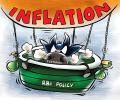
Retail inflation slipped to seven-month low of 3.61 per cent in February mainly due to easing prices of vegetables, eggs, and other protein-rich items, creating space for the RBI to go for another cut in interest rate next month.

'When Prime Minister Modi met President Trump, they agreed to initiate a bilateral trade dialogue.' 'It makes sense to give these negotiations a chance.'

The interest rate on these schemes have remained unchanged for over a year now.

Reserve Bank of India Governor Shaktikanta Das has been ranked as the top central banker globally for the second consecutive year by US-based Global Finance magazine. "Happy to announce that for the 2nd consecutive year, RBI Governor @DasShaktikanta has been rated 'A+', in the Global Finance Central Banker Report Cards 2024," the RBI said in a post on X.

The state-owned bank's loss largely offsets the Rs 1,800-crore (Rs 18-billion) capital injection the government will make in FY14.

The country's forex reserves dropped by a further $8.48 billion to $644.39 billion for the week ended December 20, the RBI said on Friday. In the previous reporting week, the reserves had dropped by $1.988 billion to a six-month low of $652.87 billion.

Moody's Ratings on Tuesday said India has a lower overall exposure to the US relative to others in the APAC region, although certain sectors such as food, textiles and pharmaceutical products face risks. Moody's said most companies in its rated portfolio are domestic-focused with limited exposure to the US market.
