
India finalised a free trade agreement with the UK, its 16th so far as the country aimed at boosting bilateral trade and investments. The other regions and countries with which India has signed such agreements include the four-nation European bloc EFTA, Japan, Korea and Australia.
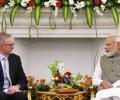
The matter came up for discussion during their wide-ranging dialogue that was aimed at expanding overall ties.


During his visit to India last year, Australian Prime Minister Tony Abbott had expressed concern over lack of growth in bilateral trade.

India and Malaysia on Friday signed a landmark pact that paves the way for freer flow of trade in goods and services, besides enhanced investment and economic cooperation between the two countries.
Taking the currently operational India-Singapore Comprehensive Economic Cooperation Agreement (CECA) forward, the Union Cabinet on Friday approved tariff elimination as well as reduction in additional 555 products. This will benefit exporters from Singapore.

The Singapore Minister applauded Prime Minister Modi's effort to make India the manufacturing hub of the world.
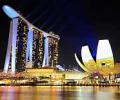
Indian banks operating there are required to meet very high qualifying standards in order to do business.

Seeking to give new impetus to the bilateral relations, India and Malaysia today formally announced firming up of Comprehensive Economic Cooperation Agreement (CECA) to boost trade and decided on a range of other engagements in various sectors, including defence.

Malaysia on Wednesday said it wants to complete talks this year for a separate trade-opening pact with India, in addition to liberalising commerce through the Indo-ASEAN Free Trade Agreement, operationalised this month.
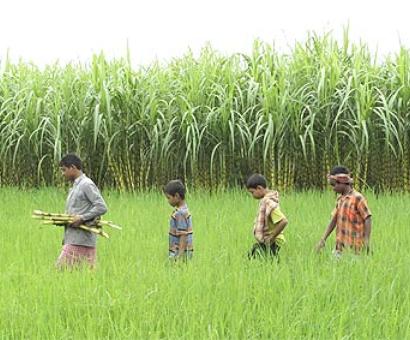
This accord marks the success of India's Look East Policy and is the first with a trading bloc.

This accord marks the success of India's Look East Policy and is the first with a trading bloc.
The first meeting of Trade Negotiating Committee on signing a Comprehensive Economic Cooperation Agreement started in Kuala Lumpur.
With growing appetite for investments abroad, the number of Indian companies setting up units in Singapore has grown three-fold in six years to 3,084 in 2007.Wipro Technologies is also setting up an R&D centre in Singapore, Tan said, adding that there are few other companies which would shortly be firming up investments in Singapore which includes Tatas as well.
Under the CECA, signed between India and Singapore in June 2005, Singapore has committed to award three qualified full bank (QFB) licences to three Indian banks while India had agreed to give three Singaporean banks free access to the Indian banking

The main issue has been that of a higher Asset Management Ratio as has been prescribed by the Monetary Authority of Singapore for qualifying full banks from India.

During 2013-14, imports from Japan, South Korea and Malaysia stood at $9.49 billion, $12.47 billion and $9.21 billion respectively.

During their talks, the two leaders decided to significantly expand their ties in several key areas including defence, trade, energy and education.
Lee Hsien Loong's splendid victory in Singapore could be India's gain.
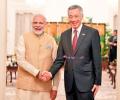
Modi hailed the close defence cooperation between the two countries and welcomed the completion of the logistics agreement between the two navies.

It is often said that the India-Indonesia relationship is overshadowed by mutual neglect.

Prime Minister Malcolm Turnbull's first State visit to India is an indication of the success of India's Act East Policy, says Dr Rahul Mishra.
 © 2026 Rediff.com - Investor Information - Advertise with us - Disclaimer - Privacy Policy - Sitemap - Feedback - About us - Terms of use - Grievances