Shares of metal, realty, consumer durables, auto, capital goods and banking hogged limelight on a flurry of buying by investors

L&T was the top loser in the Sensex pack, dropping 4.99 per cent, after the engineering major posted a 45 per cent decline in consolidated net profit for the September quarter. Titan, ONGC, Axis Bank, HUL, NTPC, M&M and HDFC were the other major laggards, shedding up to 3.32 per cent. NSE Nifty fell 58.80 points or 0.50 per cent to 11,670.80.
Stocks of IT, power, healthcare, capital goods, oil & gas, banking and auto were the major drivers.
CEOs have complained that high interest rates have blocked their investment decisions. At the same time, customers are also deferring their purchases for new consumer durables, cars, and homes.
Gains were led by realty, auto, capital goods, banking, infrastructure, metals, power, oil & gas, PSU and consumer durables sectors, which rose up to 3.30 per cent.

Power, oil and gas, PSU, metal, banking, auto, capital goods, infrastructure and healthcare sector stocks witnessed heavy buying through the session.

In four days, Sensex has fallen by 5,815.25 points. From the 30-share pack, 22 companies closed the day lower, led by Bajaj Finance, Maruti Suzuki India, Axis Bank, M&M, Tech Mahindra and ONGC, plunging up to 10.24 per cent.
Completed projects saw an improvement of 29.2 per cent over the June quarter, which is valued at Rs 0.31 trillion.

Financial, capital goods, IT, power and oil and gas sector stocks hogged the limelight, helped indices to reclaim their key level.

Among major Sensex gainers, ITC rose the most by 2.32 per cent, followed by TCS, M&M, SBI and Bharti Airtel.
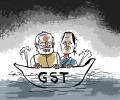
Experts said the rate hike would improve working capital position of the manufactures as it would correct the inverted duty structure but may lead to increase in price of the finished goods.

Equity benchmarks erased early gains after realty, capital goods, teck, auto, PSU, IT, power and bankex counters came under selling pressure, falling up to 1.28 per cent.

Asian Paints was the top loser in the Sensex pack, shedding 3.30 per cent, followed by Infosys, HCL Tech, ONGC, M&M, TCS, IndusInd Bank and L&T. On the other hand, ITC, Kotak Bank, Bajaj Finance, HUL and ICICI Bank were among the gainers, spurting up to 5.45 per cent.

The previous low at 1.8 per cent was recorded in October 2017.

Experts say a combination of improving asset quality and NBFCs' weak balance-sheets bodes well for both corporate and retail banks.
Most of the economic activity in the country had come to a standstill after the government imposed a 21-day nationwide lockdown beginning March 25 to check the spread of coronavirus.

Losses largely came from the metal index, followed by power, infrastructure, realty, PSU, oil and gas, capital goods, FMCG, healthcare, auto and banking.

Sources said GST exemption on such items would lead to blocked input tax credit, thereby increasing the cost of manufacturing and a higher price for consumers.

The sharp rise was also due to a statistical illusion -- low industrial numbers in November 2015, and sharp reversal of a 12-month declining trend in capital goods.

Infosys was the top gainer in the Sensex pack, rallying around 7 per cent, followed by TCS, IndusInd Bank, ONGC, HDFC Bank and HCL Tech. On the other hand, ITC, Bajaj Finance, Kotak Bank and Sun Pharma finished in the red.

Over 93% of the orders in the year came from the central and state governments, PSUs, and NHAI.

On the Sensex chart, Bajaj Finance, Bajaj Finserv, HCL Tech, Tech Mahindra, Infosys, HDFC Bank and ICICI Bank were among the prominent gainers.

On the Sensex chart, Sun Pharma was the top loser, followed by Maruti, L&T, Hero Motocorp, Infosys, ONGC and RIL.

Capital goods output registered a steep decline of 16.5 per cent in June

India's economic growth is estimated to have slowed down to 11-year low of 5 per cent during the current financial year ending March 2020.

This is the lowest that the BCI has ever fallen in the history of 113 rounds of the NCAER Business Expectations Survey.

'One can start accumulating economy driven stocks in the next few months with a two-three year view.'

In his statement to the Enforcement Directorate, Dhoot conceded that Rs 64 crore had been transferred to Deepak Kochhar's NuPower Renewables through a web of entities to allegedly acquire wind farm properties.

The previous low was recorded at 3.8 per cent in May this year.

Kotak Bank was the top laggard in the Sensex pack, shedding over 2 per cent, followed by ITC, PowerGrid, M&M, HDFC, Asian Paints and NTPC. On the other hand, Maruti rallied over 4 per cent. Bharti Airtel, Axis Bank, IndusInd Bank and Bajaj Finance were also among the gainers.

Experts say, investors will be better off exiting them at higher levels and investing in stocks of fundamentally sound companies.

PSU divestment, LIC IPO, fiscal deficit: Budget 2021 marks a clear change in the Modi government's stance from fiscal conservatism to growth orientation.

The BSE benchmark Sensex rose 192 points to end at 39,250 on Sunday as investors built up fresh positions in the special Muhurat trading session to mark the beginning of Hindu Samvat year 2076.

As per use-based classification, primary good registered a growth of 7.4 per cent, intermediate goods 22.4 per cent, and infrastructure/construction goods 0.1 per cent in February 2020 as against the same period a year ago.

Top gainers in the Sensex pack included Bajaj Finance, ONGC, Yes Bank, HDFC, HCL Tech, Tech Mahindra, TCS, ICICI Bank and RIL, rising up to 3.57 per cent.

Market participants are hoping for a few tweaks on the taxation front which will encourage consumers and businesses to spend.

However, it is noteworthy that foreign investors pumped in money on the day of election results as the mandate became clear
Yes Bank was the top gainer in the Sensex pack rising 5.80 per cent, followed by Tata Motors, ICICI Bank, IndusInd Bank, Axis Bank, Kotak Bank and Tata Steel.

Yes Bank was the top gainer in the Sensex pack, rallying 6.74 per cent, followed by TCS, Tata Motors, Bharti Airtel, M&M and RIL.

The S&P BSE Small-cap index has recovered 26 per cent as compared to a 23 per cent rise in the S&P BSE Sensex.
 © 2026 Rediff.com - Investor Information - Advertise with us - Disclaimer - Privacy Policy - Sitemap - Feedback - About us - Terms of use - Grievances