
Outlay for infra is also expected to see a significant increase in view of the government's Rs 111-trillion investment plan under the national infrastructure pipeline to develop social and economic infrastructure over five years.

'For the next two years, we expect the bulk of earnings growth contribution from sectors like financials and energy, where the outlook remains positive, while the sectors which are linked to domestic consumption and are currently witnessing strains on margins have low salience for Nifty earnings.'
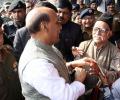
Has the army confronted China, equipping itself with emergency purchases that have been largely paid for by pensioners, asks Ajai Shukla.
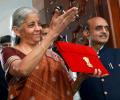
At the customary post-Budget media interactions, Finance Minister Nirmala Sitharaman and her topmost bureaucrats touched upon a number of issues. The minister said the government taxing income from digital virtual assets did not give them legitimacy and that issue was being dealt separately in the planned cryptocurrency Bill. She also expressed confidence that the Budget targets were achievable.
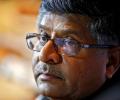
The Cabinet on Wednesday approved public private partnership mode for the rollout of BharatNet project for broadband services in villages in 16 states with viability gap funding of Rs 19,041 crore, Telecom Minister Ravi Shankar Prasad said. Prasad said the decision to involve private players was taken after Prime Minister Narendra Modi announced on August 15, 2020 that around 6 lakh villages in the country will be connected with broadband in 1,000 days. "The Cabinet has in-principle approved implementation of BharatNet in 16 states in a public private partnership model with total expense of Rs 29,430 crore.
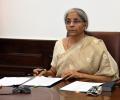
Union Finance Minister Nirmala Sitharaman will on Monday meet chief ministers and state finance ministers to discuss measures to attract private investments to help boost the economy. Finance secretary T V Somanathan said the meeting comes in the backdrop of strong economic recovery post the two COVID waves, and the central government has made a big push in Capex. The focus of this interaction will be on state-level issues, opportunities and challenges, which will enable us to go to a higher trajectory of investment and growth, he said.

This includes an infrastructure push which may lead to the government spending more than its budgeted capital expenditure for 2020-21. There are also discussions on increasing the scope and quantum of direct cash transfers to the beneficiaries who need it the most.

'We never go overboard on any stock, no matter how good it may seem.'
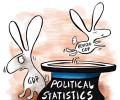
The GDP growth is estimated to come at the "deceptively high" level of 20 per cent for the April-June 2021 quarter but is far below the same in the pre-COVID times, rating agency Icra said on Wednesday. Icra said the low base of the last year, when the GDP had contracted by close to 24 per cent, "conceals" the impact of the second wave of COVID-19 infections. Economic activity is boosted by robust government capital expenditure, merchandise exports and demand from the farm sector, it said, estimating the GDP to grow by 20 per cent and the gross value added (GVA) will register a growth of 17 per cent for the June quarter.

'The signal is crude oil prices will rise, I am cutting my subsidy. Be prepared, prices will rise.'

Citing the massive surge in Omicron infections and the resultant impact on overall economic activities in the March quarter, Swiss brokerage UBS Securities has revised downwards its India's growth forecast for the current financial year to 9.1 per cent from 9.5 per cent earlier. However, UBS Securities does not see the third wave impact extending to the next financial year as it has revised upwards its real GDP forecast to 8.2 per cent, up from 7.7 per cent earlier, expecting the real GDP growth to remain well above the historical average. The World Bank pegs it at 8.3 per cent, unchanged from its June assessment, saying the recovery is not broad-based yet.

India Inc resorted to salary cuts to protect their profits in the June quarter, as revenues came under pressure due to the second pandemic wave that affected nearly the entire country, a report said on Wednesday. The "weak" wage growth will prove to be a drag on the overall economic recovery in the medium term as it will affect household consumption, the report by India Ratings and Research said. An environment of pandemic-led uncertainty and elevated inflation could impact the level of spending and hence the overall demand, it said.
Fitch Ratings on Monday said uncertainty over the bidder consortiums and process complexity, including valuation, may lead to potential delays in privatisation of India's second-largest fuel retailer, Bharat Petroleum Corporation Ltd (BPCL). Affirming BPCL's rating at 'BBB-' with a negative outlook, Fitch said it continues to treat the potential divestment of the company by the Indian government as an event risk. "Bidders are conducting due diligence, but uncertainty over the bidder consortiums and process complexity, including valuation, may lead to potential delays.

In the upcoming round of privatisation, unviable airports are likely to be clubbed with six main airports and a prospective bidder may be restricted to bid for two airports.

Finance Minister Nirmala Sitharaman on Tuesday unveiled a Rs 39.45 lakh crore Budget with a view to fire up the key engines of the economy to sustain a world-beating recovery from the pandemic. This was Sitharaman's fourth Budget. While the taxpayers were left in the lurch, once again, was she able to cheer Corporate India?

The broadening of the market rally sends the signal that growth will be broad-based, observes Akash Prakash.

'Higher than expected inflation in the US or the European Union, faster than expected tightening by the major central banks, break out of a war in Europe, and withdrawal of portfolio equities from the emerging markets are factors which can result in equity market corrections.'

The focus of the company would be to develop its capability across segments of injectables, vaccines, biosimilars, inhalation and APIs to drive growth.
'Modi looks to be an effective, result-oriented, purposeful leader, focused on bringing greatness and glory to the nation.'
'
So it is best for his critics to give up their sniping and supplement his efforts,' asserts B S Raghavan, the distinguished civil servant who served three prime ministers.
Maintaining a rapid pace of the vaccination drive and quickly bridging healthcare infrastructure gaps across both urban and rural areas would emerge as the most sustainable stimulus for durable recovery of the Indian economy, says a report by the department of economic affairs.

'While we note the very strong cyclical recovery in the economy, we believe there is still uncertainty over medium-term prospects.'

In the post-demonetisation phase, the govt's tax revenues have ended up soaring in November.

Adar Poonawalla says it took a five-minute chat with his father Cyrus before making the decision to manufacture Covishield. The bet paid off, and handsomely. Serum Institute now has the capacity to make 4 billion doses of Covishield annually.

'It is a worrying trend as we are not seeing too much fresh capital being raised for new projects, plants, expansion or diversification. It's just private equity or venture capital or promoters cashing out.'

Flush with liquidity, banks are eager to lend. And, therein lies the problem, warns Tamal Bandyopadhyay.

'Market feels this Budget will promote all-round growth and that is what is giving it confidence.'

Most have seen decline in cash reserves and deterioration in financial ratios in recent years.
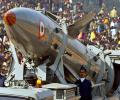
Free provision of food, cash transfers, and jobs in villages see enhanced flow of funds despite a precipitous fall in revenue. Till May, defence spend was nearly 30 per cent less than the previous year.
The government's programmes should be expected to generate some momentum, but the macro-economic numbers are not encouraging, observes T N Ninan.
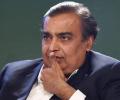
Reliance Industries on Friday reported a 41.5 per cent jump in its third quarter net profit as oil, retail and telecom businesses fired on all cylinders. Net profit of Rs 18,549 crore in October-December compared with Rs 13,101 crore a year back, the company said in a stock exchange filing. Income from operations rose to Rs 1.91 lakh crore from Rs 1.28 lakh crore.

In an interaction with Jash Kriplani, A Balasubramanian, managing director and chief executive officer, Aditya Birla Sun Life Asset Management Company, shares his optimism on what makes him believe that these cuts can help in addressing multiple issues plaguing the economy, without letting fiscal deficit pose any major risk.
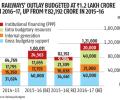
In his last Budget, Suresh Prabhu, set an ambitious target for capital expenditure.
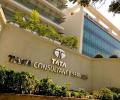
Tata Consultancy Services (TCS) has weathered the pandemic very well, and has earned tremendous goodwill from customers, which enhanced the firm's standing in the market, N Chandrasekaran, chairman, said in his virtual address of the 26th Annual General Meeting on Thursday. He said TCS shareholders received over 3,000 per cent return on their investments since the company was listed in 2004.

India must be prepared for a big, fat fuel import bill in FY23 - barring any further avatars of the Covid virus - as refiners crank up runs, or crude processing rates, to meet the growing demand for fuels, and crude prices soar. Capacity additions by an Indian state-run refiner will reinforce the need for foreign crude. Demand for all fuels is expected to increase by 3-8 per cent next fiscal from 2021-22, reaching pre-pandemic levels, according to analysts and industry experts.

'They are also sitting on huge public sector assets without many returns.'

Bank of America Merrill Lynch on Monday trimmed India's economic growth estimates by 30 basis points to 7.1 per cent for the current fiscal, while global financial services giant Morgan Stanley downgraded its GDP growth forecast for the current fiscal to 7.3 per cent from the earlier 7.7 per cent.

'Everyone says never waste a crisis.' 'When we went into Covid and we were in total lockdown, we were at work.' 'The planes were not flying and we wondered what to do.' 'We looked at each of our performance metrics -- what are customers complaining about, how do employees feel, how do investors feel?'

Narendra Modi will have to revive investment cycle if he becomes the next Primie Minister.
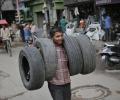
Tyre companies are stepping up on exports to offset declining volumes from domestic OEMs.

The Budget kept away from mood dampeners such as an increase in taxes (capital gain taxes) and even the much-feared introduction of Covid cess and wealth taxes, says Nimesh Kampani, chairman, JM Financial.
 © 2026 Rediff.com - Advertise with us - Disclaimer - Privacy Policy - Sitemap - Feedback - About us - Terms of use - Grievances