
Telcos Reliance Jio and Bharti may post a 5-7 per cent sequential rise in revenue with a steady margin for the second quarter of FY22, according to Jefferies. Bharti's growth will be led by segmented tariff hikes taken in the second quarter ended September, while Jio's growth will be driven by continued subscriber growth, it further said. Jefferies expects the outlook on tariff hikes for Bharti, further details on JioPhone Next for Jio, and tenancy outlook for Indus Towers to be the key things to watch for in the September quarter.

Infrastructure funds, which bet on stocks closely linked with infrastructure development in the country, have emerged as one of the best-performing categories over the past year. They have generated an average return of 90.63 per cent - the third-best, after technology funds and small-cap funds. Of the 21 schemes in the category, seven have given a return of more than 100 per cent in a year.

Operating margins for some companies dipped in Q3, 2021-22 but this sector could be nearing the bottom of the cycle in terms of profits.

A fall in crude oil price and Aramco's $75 billion annual dividend commitment may have delayed Saudi company picking a stake in Reliance Industries Ltd's oil-to-chemical unit (O2C), research firm Jefferies said. Richest Indian Mukesh Ambani had in August 2019 announced talks for the sale of a 20 per cent stake in the O2C business, which comprises its twin oil refineries at Jamnagar in Gujarat and petrochemical assets, to the world's largest oil exporter. The deal was to conclude by March 2020 but has been delayed for reasons not disclosed by either company.

New projects fell 6.3 per cent in the December quarter compared with the September quarter. The value of new projects in the just-concluded quarter was Rs 2.1 trillion, according to the data from Centre for Monitoring Indian Economy (CMIE), which was lower than the Rs 2.2 trillion seen in the September quarter. It is, however, higher than Rs 1.5 trillion recorded for the quarter ended December 2020, the first year of the Covid-19 pandemic. This data ties in with the November data for core sector growth, an index of eight core industries, which grew at its slowest pace since early 2021.

'Then select those that are well-aligned with your risk-return profile and investment time horizon.'

This may lead to the states' combined fiscal deficit to widen much faster, while the Centre may show a smaller or insignificant slippage in meeting its deficit target. The Centre will celebrate over its fiscal prudence, but the states would suffer, A K Bhattacharya points out.

A large part of this investment, about Rs 5,000 crore (Rs 50 billion), would go to the Paradip refinery

The social impact of this could be worse as 300 million subscribers may face the annoyance of network shutdown and churn.
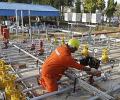
The 62 per cent increase in natural gas prices by the Indian government will boost the profitability of upstream companies in the country and support their investment spending, Fitch Ratings said on Tuesday. The price for gas from fields that were assigned by the state to oil companies, mainly Oil and Natural Gas Corporation (ONGC) and Oil India Ltd (OIL), increased to $2.90 per million British thermal units (mmBtu) for October 2021-March 2022, from $1.79 per mmBtu in the previous six months. "Higher gas prices will increase the input cost for key end-consumer sectors, to the extent the price hike is passed on," Fitch said.

The question mark over Vodafone Idea's survival is gone after the government's telecom package, managing director and chief executive officer Ravinder Takkar said in an interaction recently. The extended moratorium for spectrum payments and adjusted gross revenue (AGR) dues has indeed ensured that Vodafone Idea survives, at least for the time being, but questions remain. Answers to those questions may determine the future of Vodafone Idea and its power to stay in a difficult telecom market in the coming years.

The Railway ministry has been allocated budgetary support of Rs 140367.13 crore in the Union Budget on Tuesday - Rs 20,311 crore more than the revised figures of the previous fiscal. Overall, the national transporter is set to get a capital expenditure (CapEx) push of Rs 2.45 lakh crore in the financial year 2022-23, 14 per cent higher than the budgeted capital expenditure of Rs 2.15 lakh crore for the current financial year. Finance Minister Nirmala Sitharaman in her Budget speech for 2022-23 said that India will manufacture 400 new, energy-efficient Vande Bharat trains in the next three years.

Founded by James Lansdowne Norton in Birmingham (in 1898), Norton Motorcycles is among the most popular British motorcycle brands of all time.

Analysts caution against volatility and recommend buying stocks of companies that are on strong fundamental footing that have been beaten down badly in the recent carnage.

Jio is planning to win over 350 million 2G feature phone users by launching a smartphone at a fraction of the current cost.

Swiss brokerage Credit Suisse expects the economy to continue to show positive surprises and record up to 9 per cent growth in the next fiscal. For the current financial year too, the brokerage anticipates growth to be higher than the consensus forecast of 8.4-9.5 per cent, and printing in at around 10.5 per cent. As a policy, Credit Suisse does not provide absolute growth numbers in its forecast.

Every 10 per cent rise in crude oil price will shave off around 0.2 percentage point (pp) from India's GDP growth and widen the current account by 0.3 per cent, says Nomura.

UBS, Credit Suisse see emerging markets doing well next year, but expect India to underperform, given its rich valuations.

The economy is likely to register a 9.5 per cent growth this fiscal over 7.3 per cent contraction last year, as the ongoing recovery is faster and more credible than earlier foreseen, according to a foreign brokerage report. It will gather more momentum in the second half of the current fiscal, but will slow down to 7.7 per cent next financial year, it added. The government has budgeted for a 10.5 per cent growth this fiscal, but the Reserve Bank has scaled it down to 9.5 per cent.

Supermarket chain Spencer's Retail Limited has lined up a capital expenditure of Rs 400 crore (Rs 4 billion) for south during the current financial year.

'I have personally been very keen on investing in lithium ion battery technology for some time.'

The rise in India Inc's market value was led by asset-light firms.

More than a year of Covid-19 has pushed most businesses into gloom but Reliance Industries Ltd (RIL) managed to reduce its gross debt 25 per cent, enabling it to turn towards its next phase of capital expenditure that has come in the form of a Rs 75,000-crore plan for green energy and power storage. The company managed to stay afloat during the pandemic because of its large presence in the consumer-centric businesses of retail and telecommunication (see chart: "A new Reliance"). These two businesses constituted 45 per cent of its EBITDA during FY21 from 36 per cent in FY20.

'Overtightening of monetary policy by central banks and the spread of new Covid variants, which may force governments to restart lockdowns or restrict mobility.'

'India has entered an economic super-cycle driven by a housing cycle turnaround.'

A company official said work stopped temporarily only at two rigs and the remaining 34 in the offshore were operational. He added there was no impact on the company's production.
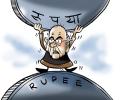
For the first eight months of the current financial year, the figure stood at Rs 7.17 trillion.

The upward revision is due to stronger-than-expected GDP numbers for the quarter ended March 2016.

Fierce competition and rising capex will put pressure on most operators in 2017.

'India's output contraction in the previous year was among the worst in the world!'
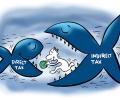
The government's capex spend is expected to rise and much of this is likely to be focussed on rural India, particularly for housing, roads and irrigation.

Govt squeezed capital expenditure, and also cut revenue expenditure, that does not go into creating assets, by 11% in H1

The Indian economy remains on track to regain its position as the world's fastest-growing major economy after official estimates on Friday put the expansion at a tempered 9.2 per cent this fiscal amid concerns over the impact of a resurgent virus on the fragile recovery. The growth in the gross domestic product (GDP) of 9.2 per cent in April 2021 to March 2022 fiscal (FY 2021-22) given by the National Statistical Office (NSO) in its first advance estimate compares with 9.5 per cent expansion forecast by the Reserve Bank of India (RBI) last month. The economy had contracted by 7.3 per cent in the previous financial year.

The slowdown in capital expansion is clearly seen in the current financial year. Large sectors such as cement, metal, oil and gas, power and telecom have provided negligible funds in the first quarter for their capex plans.

'In the short term, we may see some disruptions due to Covid, but in the medium-to-long term, we should keep an eye on US inflation and 10-year bond yields.'

According to the study spanning 11 key sectors, aggregate industrial investments would continue to grow despite the current economic slowdown amid expectations of a relatively muted GDP growth. The study stated that aggregate industrial investments would grow at a moderate pace over the next three years, with total investments projected at Rs 10,50,000 crore.

'For the next two years, we expect the bulk of earnings growth contribution from sectors like financials and energy, where the outlook remains positive, while the sectors which are linked to domestic consumption and are currently witnessing strains on margins have low salience for Nifty earnings.'

Outlay for infra is also expected to see a significant increase in view of the government's Rs 111-trillion investment plan under the national infrastructure pipeline to develop social and economic infrastructure over five years.
Tata Consultancy Services (TCS) has planned a capital expenditure of Rs 1,300 crore (Rs 13 billion) this financial year, Group chairman Ratan Tata said at the company's annual general meeting in Mumbai.

At the customary post-Budget media interactions, Finance Minister Nirmala Sitharaman and her topmost bureaucrats touched upon a number of issues. The minister said the government taxing income from digital virtual assets did not give them legitimacy and that issue was being dealt separately in the planned cryptocurrency Bill. She also expressed confidence that the Budget targets were achievable.
 © 2026 Rediff.com - Advertise with us - Disclaimer - Privacy Policy - Sitemap - Feedback - About us - Terms of use - Grievances