
The government on Tuesday exuded confidence that revenues from sale of spectrum for 3G telephony and broadband may touch Rs 50,000-55,000 crore (Rs 500-550 billion), beating the budget estimates of Rs 35,000 crore (Rs 350 billion).

Faster connectivity, a host of value added services like internet TV, video-on-demand, audio-video calls and high-speed data exchange will soon be a reality in India as one of the biggest auctions begins today for 3G spectrum.

The government has set base prices for all the 22 zones at Rs 3,500 crore.
Foreign companies, except those already present in India, have stayed away from the auction of third-generation mobile spectrum, or 3G, though two new ones are keen on broadband wireless access.Not one new foreign company has applied for 3G. The last day for showing interest in bidding for 3G and BWA spectrum drew to a close on Friday.

The last date for applying for both 3G and BWA spectrum is today. Auction for BWA spectrum will begin on April 11.
The 3G and broadband wireless access spectrum auction is running into further controversies with a section of telecom firms opposing the timing of the auction and internet companies planning to move the Prime Minister's Office.Even though Reliance Communications is ready with $1-billion investment for 3G rollout, it intends to focus on GSM rollout at the moment. The company is "receptive to the opinion that the 3G auctions should be held at a later date," a source said.
The voice revenue per minute in India is among the lowest in the world at around 50 paise, says Kanwalinder Singh, President,Qualcomm India.
The opening of bids has been deferred to September 22 from September 3 as decided earlier. The pre-bid conference, which was to be held on August 27, has also been re-scheduled to September 8. However, according to the revised schedule issued by the communications ministry, there will be no delay in the date of identifying the agency. The finalisation of the bids will be completed by September 30 as announced earlier by Telecom Secretary Siddhartha Behura.
The Department of Telecommunications has decided to hike four-fold the reserve price for broadband wireless access services in the country.

In just four days of auction, the bid for the pan-Indian broadband wireless access spectrum has gone up by three times to Rs 5,245 crore (Rs 52.45 billion) against the base price of Rs 1,750 crore (Rs 17.50 billion).

The reserve price for pan-India spectrum was Rs 3,500 crore.

The bid for pan-India spectrum for 3G telephony on Thursday crossed Rs 15,000 crore (Rs 150 billion) and is still rising.
The auction of third generation (3G) spectrum is expected to close in one-two days, with the government likely to rake in Rs 50,000 crore from it.

The government would earn a minimum of Rs 38,000 crore (Rs 380 billion) from the 3G auction, with the pan-India licence reaching a bid of about Rs 9,521 crore (Rs 95.21 billion) on the 18th day, up by over 172 per cent from a base price of Rs 3,500 crore (Rs 35 billion).

The amount is much higher than the earlier target of up to Rs 35,000 crore (Rs 350 billion).
.jpg)
On May 24, 2012, Bharti Airtel and Qualcomm announced an agreement under which Bharti had acquired 49 per cent interest in Qualcomm AP's India entities with licences to offer 4G data services in four circles of Delhi, Mumbai, Haryana and Kerala.

Reliance Industries, which holds pan-India 4G telecom spectrum for data services, has applied for a licence to offer mobile telephony.
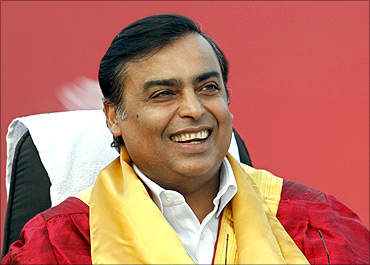
Gearing up for its pan-India 4G services launch in coming months, Reliance Jio Infocomm has approached the Department of Telecom for a network test conducted along with security agencies.

Officials of Reliance Jio Infocomm claimed to have achieved broadband speeds on their networks that are 10-12 times faster than 3G services.
When, recently, Bharti Airtel announced a Rs 21,000 crore rights issue, analysts pointed out that its structure was similar to that of Reliance's issue in June 2020. One similarity is that shareholders in both companies have to pay only 25 per cent of the money on application. The rest is to be paid in two tranches. In Bharti Airtel's case, it is within 36 months; in Reliance Jio's, it is within 17 months.

Bharti Airtel is the largest mobile phone operator in the country.

Airtel announced complete acquisition of WBSPL in October last year for an estimated Rs 2,000 crore (Rs 20 billion).

BSNL, which was formed in 2000, was in the pink of financial health but lost to competition because of inadequate investment in infrastructure expansion that ought to have been provided during past few years, he told Rajya Sabha.

Telecom companies have put in bids worth Rs 58,332 crore (Rs 583.32 billion) in spectrum auction at the end of 49 rounds on the 7th day of bidding on Monday.
Telecom operator Reliance Jio Infocomm has arranged credit facilities worth $1.5 billion with lenders, including Bank of America and Barclays, to refinance existing loans.

The licensee will have to ensure that at least half the areas under rural telecom exchanges gets the required street level coverage.

Says spending $3 billion every year on networks alone

Will help the government expand mobile and broadband penetration in the country

Govt is set to garner Rs 1 lakh crore from sale of radiowaves.

The auction will help operators augment expansion of high-speed 4G voice and data services in the world's second largest mobile phone market.
The amount generated so far is about 86 per cent of what the 3G auction fetched in 2010.

The uniform SUC, if implemented as per recommendations made by Telecom Regulatory Authority of India, will provide relief for mobile operators such as Airtel, Vodafone and Idea, but will increase rates for broadband wireless access spectrum holders like RJIL.
The government will get an additional revenue of 20 per cent from the auction of the 1,800 MHz and 900 MHz bands of spectrum, based on the Telecom Commission's recommendations, compared with those of the Telecom Regulatory Authority of India (Trai).
DoT and the company have not done anything that breached the guidelines mentioned in the notice inviting applications for the auction of the BWA spectrum in 2010, it stated in a reply to CAG's draft audit report.

To revive the two state-run telecom operators, Bharat Sanchar Nigam Limited (BSNL) and Mahanagar Telephone Nigam Ltd (MTNL), the government is likely to waive the one-time fee these telcos need to pay for retaining additional spectrum.

RIL has signed an infrastructure sharing agreement with Reliance Communications (RCom, of the Dhirubhai Ambani group) to launch its services.
Its says reconsider lower reserve price, uniform usage charges; GSM players to bear the brunt.

Spectrum auction took off on Wednesday from Rs 58,980.29 crore (Rs 589.80 billion) mark with demand for the premium 900 Mhz band seemingly tapering off at the end of 56 rounds.
Telecom companies put in bids worth a total of about Rs 45,000 crore (Rs 450 billion) on the second day of the auction on Tuesday, with premium 900 Mhz band in Delhi, Mumbai and Kolkata witnessing continuing demand.
 © 2026 Rediff.com - Investor Information - Advertise with us - Disclaimer - Privacy Policy - Sitemap - Feedback - About us - Terms of use - Grievances