
Dwaipayan Bose on how index funds play a key role in the diversification of portfolios and help manage risks

BSE's fresh shot at cracking the derivatives market is off to a promising start. However, Asia's oldest bourse is facing resistance from brokerages with nearly 10 large brokers yet to offer the relaunched Sensex and Bankex derivatives on their platforms. Many brokers maintain that they are working on the back end to enable BSE derivatives on their apps and websites. Some said while volumes are picking up, they are still miniscule compared to bigger rival NSE, which is the most-preferred venue for derivatives trading. Only a few brokers responded to formal queries sent by Business Standard on the issue of allowing BSE derivatives on their platform.

Gift Nifty will provide Indian investors cues on how domestic markets could react to global events.

Despite rising interest rates, and high inflation, the banking sector is doing well, on the back of a recovering economy. The last couple of quarters indicate credit demand is picking up and Return on Assets (RoA) is more than acceptable at the moment. The PSU bank pack may be more interesting at the moment simply due to being valued at far lower multiples than the private banks.

Dwaipayan Bose examines the seven important factors that investors about exchange traded funds must know before they start investing/trading in them.

The rout in Adani Group stocks after US-based short seller Hindenburg Research released a report on January 24 has sparked a rebound in trading activity this month. The average daily trading volume (ADTV) for the cash segment (both NSE and BSE combined) so far in February stands at Rs 59,346 crore, and is around 15 per cent more than the previous month's tally of Rs 51,844 crore, which was the lowest in six months. The ADTV for the futures and options (F&O) segment rose to a record Rs 204 trillion (notional turnover) against Rs 202 trillion in January.

Sundararaman Ramamurthy has been an interesting choice for the publicly-listed BSE, which has seen its chief move to bigger rival -- the National Stock Exchange (NSE) -- in July. Having spent nearly two decades at the country's largest bourse, Ramamurthy is among the early architects of NSE and understands all the cogs of the exchange wheel like only a few others in the country. Just like NSE's core team, which includes its founder RH Patil, the 59-year-old Ramamurthy has worked at the Industrial Development Bank of India (IDBI) before moving to NSE in 1995.

SBI was the top loser in the Sensex pack, shedding around 3 per cent, followed by Bajaj Finserv, Tech Mahindra, Sun Pharma, Bajaj Finance and Axis Bank. Nifty fell 143.60 points to 17,873.60.

Sun Pharma was the top loser in the Sensex pack, falling over 3 per cent, followed by IndusInd Bank, Bharti Airtel, Kotak Bank, ICICI Bank and HDFC Bank. Nifty fell 59.75 points to 17,829.20.

Shares of Yes Bank may face selling pressure as the Reserve Bank-mandated three-year lock-in period for individual investors and exchange-traded funds is ending on Monday, according to analysts. The analysts expect distress on the bank counter on Monday as they expect investors, primarily the nine banks led by State Bank, which picked up almost 49 per cent of its stocks in March 2020 for Rs 10 per share -- at a premium of Rs 8 on the face value as part of the RBI bailout, making an exit. Exchange-traded funds are also likely to press the exit button.

For the banking system a new cycle starts in FY2024. It's fraught with fresh challenges on asset quality and profitability, warns Tamal Bandyopadhyay.

Titan was the top loser in the Sensex pack, shedding over 3 per cent, followed by M&M, HUL, Maruti, Asian Paints and IndusInd Bank. Nifty fell 91 points to 17,157.40.

ICICI Bank was the top gainer in the Sensex pack, rising over 2 per cent, followed by Axis Bank, Infosys, HDFC twins, Bajaj Finserv and SBI. On the other hand, ITC, ONGC, Sun Pharma, Bharti Airtel and Titan were among the laggards.

After outperforming the broader market and their public sector peers for the better part of the post-Lehman period, private sector banks - such as HDFC Bank, ICICI Bank, Axis Bank, and Kotak Mahindra Bank - are now underperforming. Last week, the Nifty Private Bank index was up just 6 per cent year-to-date in the calendar year 2021, against nearly 13 per cent rally in the Bank Nifty and a 15 per cent rise in the benchmark Nifty50. Public sector (PSU) banks, such as State bank of India, Bank of Baroda, and Punjab National Bank, are now rally leaders and outperforming the broader market. The Nifty PSU Bank index was up 42 per cent since the beginning of this calendar year. But on a longer term, the Nifty Private Bank index is up 101 per cent since March 2016, against a 118 per cent rally in the Bank Nifty and just 2 per cent rise in the Nifty PSU Bank index in the period.

Despite the large economic impact of the Covid-19 pandemic, the markets have recovered sharply even though the performance among individual stocks has been quite polarised.

Banking and financial stocks got more than their fair share of foreign portfolio investor (FPI) flows in February. Overseas investors pumped in $3.56 billion into domestic equities last month. Of this $1.96 billion went into financial stocks, data analysed by Edelweiss shows. "The sector now has 34.8 per cent of FPI assets, up from 33.8 per cent in January.

UltraTech Cement was the top gainer in the Sensex pack, rising around 3 per cent, followed by TCS, Reliance Industries, HCL Tech, Infosys and Kotak Bank. Nifty rose for the sixth consecutive day, up 37.20 points or 0.28 per cent to 13,392.95.

The Sensex, Nifty and Bank Nifty roared to all-time closing highs, led by a buying frenzy in index heavyweight RIL and bolstered by a runaway rally in the banking stocks.

The laggards include FMCG (16 per cent), Energy (37 per cent) and Media (34 per cent).

Bank Nifty has recovered nearly 300 points at 10,968 from intra-day low of 10,669 touched in early morning deals.
The Sensex sky-rocketed to 22,994, stronger by 650 points, after scaling 23k on an intra-day basis, and ditto with the Nifty, which zoomed by 198 points to end at 6858.

Experts said banking is a play on the economy and the latest buying into this space is underpinned by hopes of a sharper-than-expected recovery in the economy.
Benchmark indices ended at record closing highs due to strength in banking stocks.
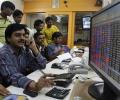
So far, brokers only reported margins at the end of the day, which is why they were able to give additional leverage even if the client didn't have minimum margins.
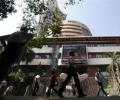
Markets surged on hopes that the exit polls would show that the BJP winning majority in the general elections.
India's benchmark index, Sensex ended on a flat note after a volatile trading session as investors braced for the US Federal Reserve policy meeting with caution.

The Bank Nifty is likely to be a bellwether.

This is not the first time that users of Zerodha clients have faced technical issues. As recently as February, 2019, the platform faced a connectivity issue that led to a pile-up of orders.

On BSE, 1,469 shares fell and 1,200 shares rose. A total of 190 shares were unchanged.

'Investors should plan and make investments strictly on the basis of their risk profile.' 'They should not bite more than they can chew.'

As many as 142 stocks from the S&P BSE500 index are currently trading below their level of May 12, 2014

The Nifty-Sensex have recorded successive 52-week lows through the last week.

The Nifty's put-call ratios are very bearish.

Why are investors gung-ho about State Bank? asks Tamal Bandyopadhyay.

The Bank Nifty is high beta anyhow and it could move the broader market.

The rupee may also gain against the euro but be prepared for a snapback in the euro as Greece resolves.

Sentiments remained upbeat for yet another session following healthy gains across Asian and a higher opening at European markets

Sensex falls 117.03 pts to end at 28,883.11; Nifty closes 32.85 pts down at 8,723.70.

Since the Budget announcement on July 5, FIIs have been busy unloading their stock.

YES Bank, Bank of Baroda, SBI, IndusInd Bank, and RBL Bank are amongst the banks, Jefferies says, are most prune to "high risk" emanating from ADAG, Cox & Kings, CG Power, DHFL and Essar Shipping.
