
The rupee commenced higher at 54.10 against the dollar from Tuesday's close of 54.14 at the Interbank Foreign Exchange (Forex) market.

The rupee had gained 18 paise to 55.43 against the dollar in Monday's trade.
The US stimulus programme has been credited with fuelling a global equities rally for most of the year.

Dollar sales by exporters and firm local equities also supported the local currency.
The rupee ended higher for the second consecutive week.
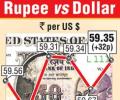
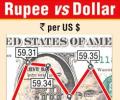
At the Interbank Foreign Exchange Market, the rupee resumed lower at 59.72 a dollar from the previous close of 59.67 and declined to a low of 59.88. It bounced back on dollar selling by exporters and some banks, touching a high of 59.30 before settling at 59.35, a rise of 0.54 per cent.
The dollar index was up by 0.43 per cent against a basket of six major currencies as euro dropped against the dollar, after quarterly economic reports from France and Germany missed expectations, said analysts.

Forex dealers said strengthening of the euro against the dollar overseas and a higher opening in the domestic equity market also supported the local currency.

The rupee got a boost as stock market investors cheered the Reserve Bank's steps. Fresh dollar sales by exporters amid sustained capital inflows also supported the local currency.

The rupee came under pressure on demand from importers as the dollar strengthened overseas.
.jpg)
In the global market, the US dollar rose against the basket currencies in early trade as US President Barack Obama called for diplomacy in dealing with alleged chemical weapons attack in Syria but kept open the possibility of military action against the Assad regime.

A strengthening dollar overseas also kept the rupee under pressure amid demand from importers. Goldman Sachs followed JP Morgan, HSBC and Nomura in cutting India's economic growth forecast and also said it expects the rupee to touch 72 against the dollar in the next six months.
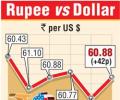
The local currency opened higher at 61.20 a dollar from the previous close of 61.30 at the Interbank Foreign Exchange Market.
A weak dollar overseas failed to restrict the rupee's decline, a forex dealer said.
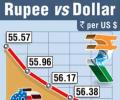
Foreign institutional investors pulled out Rs 86.66 crore (Rs 866.6 million) from local stocks on Monday, as per provisional BSE data.
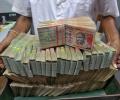
The rupee on Tuesday gained 29 paise to close at seven-month high of 60.48 against the dollar on sustained selling of the US currency by exporters and banks.

The rupee on Thursday appreciated 20 paise to end at 62.37, its highest in two weeks, on positive trends in local equities and fresh dollar selling by exporters.

The rupee gained for the second day, climbing 23 paise to a one-week high of 62.07 against the dollar on Wednesday, amid a modest recovery in local stocks and sales of the US currency by exporters and banks.

The rupee added another 8 paise to end at 61.23 against the dollar, the highest level in more than two weeks, as the US currency traded stable ahead of the outcome of Federal Reserve's meeting today and as domestic shares surged to a record.

For now, the rupee is likely to remain dependant on global factors. The dollar held on to broad gains on Thursday after Fed chairman Bernanke said the central bank still expected to start scaling back its bond purchase programme later this year, but left open the option of altering that plan.
However, FII outflows of Rs 545 crore (Rs 5.45 billion) capped the gains in the rupee, which had slumped by 126 paise in past two days.

The local currency had lost 119 paise in the past five sessions on rising worries over current account gap and fears that withdrawal of US stimulus will hit inflows from overseas.

Falling for the first time in three days, the rupee today erased initial gains to end 15 paise lower at 62.43 against dollar on fag-end demand of the US currency from banks and importers, amid a tepid stock market.

Falling for the second day, the rupee on Friday weakened by 12 paise against dollar to end at 62.68 weighed down by demand for the American currency from importers and data showing fiscal deficit crossed 95 per cent of the annual target during April-December.
.jpg)
The rupee bounced back from a one-month low to post its first gain in the New Year, rising 10 paise to close at 62.16 against the dollar after the RBI was said to have sold the US currency.
.jpg)
Fag-end dollar selling by exporters helped the rupee to recover lost ground and settle at the day's high of 60.77, a gain of 11 paise. The rupee earlier touched an intra-day low of 61.21 on July 8.

After another day of volatile trade, the rupee today appreciated by seven paise to close at a new one-month high of 59.04 against the dollar as the RBI's liquidity-tightening measures continued to lend support.
.jpg)
Snapping a two-day fall, the rupee opened strong at 59.49 a dollar from the previous close of 59.76 at the Interbank Foreign Exchange Market and then touched a low of 59.59.
.jpg)
A weak rupee makes imports costlier, including oil and other commodities.
The rupee appreciated further on Thursday, adding 106 paise to 66.01 against the dollar, after steps taken by new Reserve Bank of India Governor Raghuram Rajan to attract US currency inflows boosted market sentiment.

Banks and exporters preferred to reduce their dollar position in view of its weakness.
.jpg)
The rupee is set to breach the Rs 60-a-dollar mark again this week as the Street expects foreign institutional investors to continue pulling out of domestic markets. According to the street, this would result in government bond yields rising.

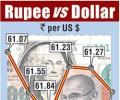
The rupee gained for the second day, adding 32 paise to close at a fresh two-month high of 61.07 against the dollar amid a rise in local equities and sustained capital inflows.

The battered rupee gained 225 paise to 66.55 against the dollar today, the most in at least 15 years, after the Reserve Bank of India eased pressure in the currency market by starting a facility for state-run oil refiners to buy foreign exchange.

After a day's respite, the rupee on Wednesday fell by 29 paise, its biggest single day fall in a week, to end at 56.73 today due to heavy dollar demand from importers amid renewed concerns over withdrawal of US monetary stimulus.
 © 2026 Rediff.com - Investor Information - Advertise with us - Disclaimer - Privacy Policy - Sitemap - Feedback - About us - Terms of use - Grievances