
Indian equity markets are likely to witness volatility this week due to concerns over rising cases of coronavirus and expiry of derivatives contracts, analysts said. Further, progress surrounding the COVID-19 vaccine, related updates, US stimulus talks and global cues would dictate the market trend, traders said. "Going ahead, the market is likely to be volatile as sentiments oscillate between fear of rising COVID cases globally and optimism over vaccine progress. Investors would closely watch out development over the US stimulus talks," said Siddhartha Khemka, Head - Retail Research, Motilal Oswal Financial Services Ltd.
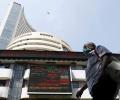
The market capitalisation of BSE-listed companies on Thursday crossed the historic Rs 200 lakh crore mark for the first time, driven by a continuous rally in the broader market. Riding high on the bullish investor sentiment, the market capitalisation of BSE-listed companies reached a record Rs 2,00,47,191.31 crore at close of trade. The 30-share BSE index closed the day with a gain of 358.54 points or 0.71 per cent at its lifetime peak of 50,614.29. This is the fourth consecutive day of gains for the markets.

In four days, Sensex has fallen by 5,815.25 points. From the 30-share pack, 22 companies closed the day lower, led by Bajaj Finance, Maruti Suzuki India, Axis Bank, M&M, Tech Mahindra and ONGC, plunging up to 10.24 per cent.

Sluggish corporate earnings, lacklustre global markets, FPI and slowdown concerns have played spoilsport for the markets.
With the Budget overhang gone, investors are breathing a sigh of relief and are back to make fresh calls.

A sharp decline in crude and strengthening of the rupee added to the buoyancy.
The markets are showing no signs of stability as the economic impact of the coronavirus outbreak is likely to be significant for many major economies.

Equity markets braved all odds this fiscal and rewarded investors with high returns as the benchmark Sensex surged more than 66 per cent despite COVID-led disruptions and concerns over its impact on the economy. Market analysts termed FY 2020-21 as a roller coaster ride for not only Indian markets but also for equity indices globally due to the pandemic. In an unprecedented come back, the 30-share BSE Sensex has jumped 19,540.01 points or 66.30 per cent so far this fiscal. This extraordinary rally holds significance as markets faced volatile trends this fiscal.

Tata Steel was the top loser in the Sensex pack, sinking over 5 per cent, followed by SBI, IndusInd Bank, Bajaj Finance, HDFC Bank and NTPC. NSE Nifty tanked 371 points to 16,614.20.

The stock, which is a play on the growth story of Indian Railways, has corrected 15 per cent from its 52-week high level of Rs 2,072.95 scaled on March 9. Yet, this has not deterred brokerages from holding a bullish view on the stock.

While small-caps have delivered higher returns than their large-cap peers, investors would do well to recognise the incremental risk of investing in these companies.

Among the lot, Rallis India, Escorts, Jubilant Life Sciences, and Crisil added half of the total gains made in the ace stock-picker's portfolio.

Concerns over economic slowdown, muted earnings, crisis in the auto industry and global trade issues have been weighing on investor sentiment, experts said.

From the 30-share Sensex pack, 23 scrips declined in Wednesday's session, led by IndusInd Bank, Bajaj Finance, Tata Motors and Tata Steel which fell by up to 3.87 per cent.

Investors took the Yes Bank event negatively because it raises a question on the stability of the overall Indian financial system.

At market close, the oil-to-telecom conglomerate's market capitalisation (m-cap) zoomed to Rs 10,01,555.42 crore on BSE.
From the 30-share basket, 28 scrips suffered losses. Over 200 stocks were at their 52-week low in Tuesday's trade.

Low home loan rates by banks could put large players in an advantageous position over smaller non-bank players, believe analysts.

Sebi's move to curb volatility didn't work for the market as rules were applicable for both long and short positions which makes difficult new long positions while short positions caused more price damage due to lack of liquidity.

According to experts, the Nifty has continued to form lower top-lower bottom formations, a trend seen in the last five weeks, and witnessed sharp selling towards 9,700 zones.

The global COVID-19 situation, rollout of vaccines, geopolitical trends, Union Budget and economic recovery would be the major factors driving investor sentiments in 2021 after a tumultuous year which saw both 'the worst of times and the best of times' for the stock market, said analysts. What a year 2020 turned out to be! From witnessing gigantic losses to record-shattering gains, investors went on a roller-coaster ride amid the coronavirus pandemic and massive stimulus measures. Markets closed 2020 with remarkable gains of around 16 per cent, but will the winning ways continue in 2021 as well?
As the Indian equities signed off 2019 on a remarkable note, the m-cap of BSE-listed companies rose by Rs 11,05,363.35 crore to Rs 1,55,53,829.04 crore.

Ajit Mishra will answer Your Questions on the stock markets on a weekly basis. Please mail your questions to getahead@rediff.co.in with the subject line 'Stock Market Query' along with your name and Ajit will offer his unbiased views.

Since the Budget announcement on July 5, FIIs have been busy unloading their stock.

Three stockmarket experts give their best picks for the New Year.

The threat of epidemic is looming large in worst-hit Ganjam district as the debris is yet to be cleared even six days after Cyclone Phailin left behind its trail of destruction.
 © 2026 Rediff.com - Investor Information - Advertise with us - Disclaimer - Privacy Policy - Sitemap - Feedback - About us - Terms of use - Grievances